


When 13-year-old Singaporean Choo Yixuan wants to take a break from her grueling daily schedule of schoolwork and swim training, she dons a jumpsuit to go skydiving — without a parachute.
However, her parents need not worry — Choo’s thrice-weekly indulgence happens inside a wind tunnel, shielding her from the risk of dramatic mishaps in the sky.
The self-confessed adrenaline junkie is among the growing ranks of young Singaporeans taking up versions of sports whose only extreme element is their level of safety.
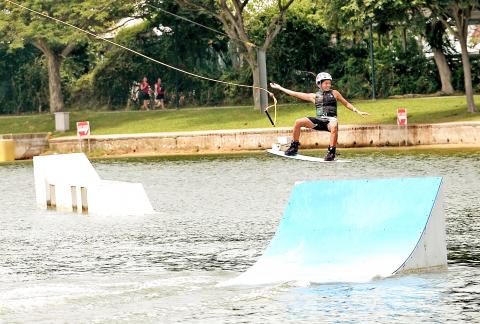
Photo: AFP
“I don’t see anything ‘extreme’ about indoor sky-diving, in fact it is actually very, very safe,” said Choo, a student at the elite Singapore Sports School and an aspiring professional swimmer.
Choo was recently part of a team that set a Guinness World Record for the most number of passes through a hula hoop while indoor-skydiving.
A study by Western Michigan University School of Medicine released earlier this year showed that out of 4 million injuries related to extreme sports in the US from 2010 to 2011, 11 percent were to the head and neck.
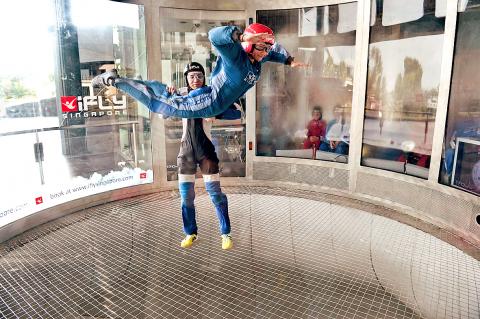
Photo: AFP
Such a trend would be unacceptable in Singapore, long called Asia’s “nanny state” due to government policy that is seen as overprotective and controlling.
The city republic’s tiny size — an airplane enters Indonesian and Malaysian airspace within minutes of takeoff from Changi Airport — also forces Singapore to make the most of its compact geography.
iFly Singapore, the territory’s only wind tunnel for indoor skydiving, has seen more than 150,000 visitors since its opening in 2011.
There are other options for Singapore’s daredevil hardcore — such as sliding down a minislope while sitting on a rubber tube in an indoor “Snow City,” cable-skiing around a pond and wakeboarding along a tiny strip of water.
“The younger generation of Singaporeans are looking for extreme sports that offer exhilarating experiences, but they are also calculating the level of risk it poses,” said Lawrence Koh, a former veteran military skydiver who founded iFly Singapore.
While the bulk of indoor skydivers at the facility — housed inside a gleaming glass building on the resort island Sentosa — are one-time thrill seekers, Koh said nearly 100 are committed local hobbyists.
Vernon Quek, a 28-year-old Christian pastor, is one of them, making weekly visits to the wind tunnel to practice “Dynamic 4 Way,” a form of synchronized indoor skydiving.
The indoor version may be without planes or parachutes, but Quek says the skills required are similar to the real thing.
“It is important to master the basic positions,” he said. “After that, the joy of being able to zoom around the tunnel, flying by controlling your hands, feet, body etc. is simply awesome.”
However, there are risks. Quek said he once paid the price for sloppily tied shoelaces.
“I quickly learnt that when shoes get sucked up into the tunnel, they usually don’t make it back in one piece,” he said.
Greg Pavlov, a 22-year-old Australian expatriate, said the city-state’s extreme sports scene is expanding fast.
“There is a lot of potential. There isn’t much land here in Singapore, but [these] places show that you can certainly do some outdoor sports in a small area too,” he said after an afternoon of wakeboarding at the Ski360Degree facility — a cable-ski facility set in a small lagoon along Singapore’s east coast.
However, others say that cost remains a barrier hindering more people from coming on board as extreme sports enthusiasts in Singapore.
Two hours at SKI360Degree will set you back S$64 (US$51) on a weekend, while two 45-second dives at the iFly Singapore wind tunnel costs S$99.
Mastering special moves is the main allure at SKI360Degree, where an automated cable system pulls wakeboarders or water skiers around a 650m circuit at a speed of up to 58kph.
“Many of our customers see this as a safer alternative to doing water sports out in the sea, it is a more controlled environment,” SKI360Degree managing director Roy Teo said.
The course has multiple ramps and sliders that allow cable-skiers to “trick-ski,” while some choose to slalom through the closed lagoon, just meters away from an actual beach.
Teo said while Singaporeans had come in droves when the facility opened in 2006, the numbers have dwindled since, with most of the 100-odd skiers daily being expatriates or tourists.
Unlike iFly Singapore, cable-skiing requires exposure to the elements — an experience some people do not enjoy too much in the humid and rainy tropical nation.
“I think Singaporeans would love it if there was something like this indoors. We cannot stand it when there’s no air-conditioning,” Teo said.

Ademola Lookman on Thursday scored on his Atletico Madrid debut in a 5-0 rout of Real Betis Balompie that sent Diego Simeone’s team to the semi-finals of the Copa del Rey. David Hancko, Giuliano Simeone, Antoine Griezmann and Thiago Almada also scored for Atletico as they advanced to the last four for the third straight season. Atletico are trying to reach their first Copa final since winning the competition in 2012-2013. Hancko opened the scoring for the visitors in the 12th minute and Giuliano Simeone added to the lead in the 30th, before Lookman got his first goal for Atletico on a fast

GUNNING FOR A WIN: The victory sending Arsenal to the final for the first time in six years was cathartic for a team who had lost their previous four semi-finals Arsenal on Tuesday reached the League Cup final for the first time in eight years as Kai Havertz sealed a 1-0 win against Chelsea in the semi-final second leg. Mikel Arteta’s side had put themselves in pole position in the first leg and Havertz came off the bench to finish the 4-2 aggregate victory in the closing moments at the Emirates Stadium. It was a cathartic triumph for the Gunners, who had lost their previous four semi-finals in last year’s UEFA Champions League and League Cup, the 2022 League Cup and the 2021 UEFA Europa League. In their first final for six years,

SUPERSTAR DELIVERS: Victor Wembanyama scored 29 points and pulled down 11 rebounds to propel the Spurs to a 135-123 victory over the Dallas Mavericks The Los Angeles Lakers on Thursday shook off the early exit of injured star Luka Doncic, rallying without him in the second half for a 119-115 victory over the Philadelphia 76ers. Austin Reaves, again coming off the bench in his second game back from a 19-game injury absence, scored 13 of his 35 points in the fourth quarter, drilling a pair of back-to-back three-pointers to give the Lakers their first lead of the game early in the final frame. “Losing Luka, you know nothing’s going to be easy after that because he does so much for us, but we bonded together,” said

France head coach Fabien Galthie on Thursday lauded his team’s attacking performance after their dazzling 36-14 victory over Ireland in their Six Nations opener. A brace of tries from Louis Bielley-Biarrey and one from mercurial flyhalf Matthieu Jalibert helped France storm into a 29-0 lead before taking their foot off the gas and allowing Ireland back into the match, before winger Theo Attissogbe put some gloss on the victory late on. “In an attacking sense, with the ball, the team played with great accuracy,” Galthie said. “It was one of the most accurate attacking performances in a long time, despite the weather


 RSS
RSS