


Bulgarian soccer fans cast aside their cares at the weekend to bask in the memory of the day that Hristo Stoichkov and his team-mates upset the odds to beat champions Germany and reach the World Cup semi-finals.
The team’s run in 1994, remembered in local parlance as “the unforgettable American summer,” still stands as Bulgaria’s biggest international success in soccer but it is something that many doubt they will see again.
The national game has fallen into decline and officials, including Borislav Mihaylov who was the 1994 goalkeeper, want the state to step in and rescue it.
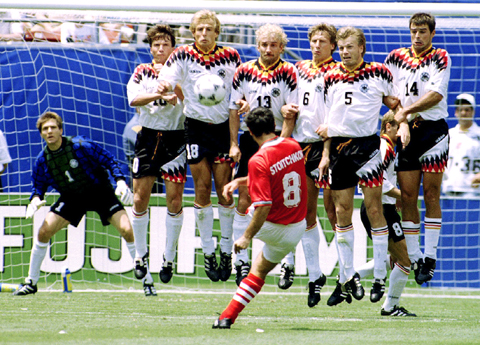
PHOTO: REUTERS
“Football is a social phenomenon and I believe that the state should take care of it,” Mihaylov, now the Bulgarian Football Union (BFU) president, told reporters. “We’re trying hard to keep a decent level but it’s not enough.”
The first generation of players who were allowed to compete abroad after the 1989 fall of Communist rule united the nation with their scintillating run at the 1994 World Cup.
Reaching the quarter-finals was far more than had been expected from the 50-1 underdogs and as a wave of euphoria swept through Bulgaria, police reported that the crime rate dropped significantly.
“The most important thing was that we managed to unite the whole nation,” Ivaylo Yordanov, who played in five matches during the 1994 finals, said at an anniversary match on Friday. “We did something that many politicians have failed to do so far.”
On July 10, 1994, Bulgaria came from a goal down to beat Germany 2-1 at Giants Stadium, New York to reach the last four.
Captain Lothar Matthaeus had put Germany in front with a penalty soon after the interval but Bulgaria battled back.
Stoichkov levelled the score by curling a rasping free kick that gave keeper Bodo Ilgner no chance in the 75th minute and Yordan Lechkov thundered home a perfect diving header three minutes later.
“It’s difficult to explain how we managed to achieve that,” midfield maestro Krasimir Balakov said. “Let’s just say that God was Bulgarian that summer.”
Stoichkov, who was the tournament’s joint top scorer with six goals, was on the mind of the Italians before the ensuing semi-final.
“How will you stop Stoichkov?” a journalist asked Italian coach Arrigo Sacchi before the game.
“I don’t know, maybe with a pistol,” Sacchi replied.
Bulgaria came close to another upset but lost 2-1 to Italy, complaining that French referee Joel Quiniou had not awarded a penalty for a “clear hand ball” in the penalty area.
“God was still on our side but the referee was French,” said the straight-talking Stoichkov after the final whistle.
Bulgaria’s journey to the finals had begun with winger Emil Kostadinov earning them a sensational victory over France in Paris with a goal from virtually the last kick of their final qualifying match in 1993.
They looked likely to live up to their underdog label when they were beaten 3-0 by Nigeria at the start of the tournament.
The painful defeat, Bulgaria’s 17th game without a win in six World Cup finals, was hard to swallow and several players drowned their sorrows in the bars of Dallas into the early hours of the following day.
However, an emphatic 4-0 win over Greece proved a turning point and was followed by a cool 2-0 win against Argentina and a knife-edged penalty shoot-out against Mexico in the second round.
Friday’s 15th anniversary of the win over Germany was commemorated with an exhibition match in which the 1994 team beat a side of former internationals 5-3 in Sliven, where Lechkov, now BFU vice president, is the mayor and president of the local first-division side.
Stoichkov, having been appointed coach of South Africa’s Mamelodi Sundowns two weeks ago, was missing but sent a letter to the fans and his former team-mates.
“Our life had not been easy since the fall of communism,” said 37-year-old driver and fan Dimitar Hinkov in Sliven. “But I was lucky enough to be part of the amazing street fiesta; it was one of the most memorable things in my life. Despite the hard times everyone was kissing and dancing.”
The intervening years have been disappointing after the success of 1994, when Bulgaria finished the tournament in fourth place.
The momentum lasted a little longer and Bulgaria reached the Euro 96 finals in England and the 1998 World Cup finals in France but decline soon set in.
Since then, the only major tournament the team have qualified for was the 2004 European finals in Portugal where they could not collect a single point.
Mihaylov hopes to get state help, announcing on Friday that BFU officials would meet representatives of the new government, which is expected to be formed by the end of the month, to discuss the issue.
The BFU will ask the authorities to grant funds for improving infrastructure and to build new sports facilities in the hope of recreating the glory days of 15 years ago.
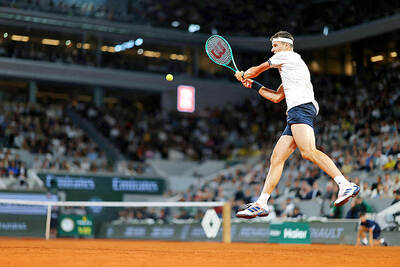
BIG NAMES GONE: Zverev is the clear favorite for a maiden Grand Slam title, reaching semi-finals for the fifth time in six years and finishing second on three occasions Alexander Zverev on Tuesday breezed past Rafael Jodar to stay on course for an elusive Grand Slam title at the French Open, while Jakub Mensik halted Joao Fonseca’s scintillating run in the quarter-finals. Zverev, the highest-ranked player left in the men’s draw, put an end to Spanish teenager Jodar’s impressive Roland Garros debut, easing into the semi-finals with a 7-6, (7/3), 6-1, 6-3 win. The 29-year-old Zverev is the clear favorite for a maiden Grand Slam title. He has finished runner-up on three occasions, including at the 2024 French Open. “I want to win the matches that are ahead of

For some, Cristiano Ronaldo remains the essential spearhead for Portugal’s FIFA World Cup bid, while others believe his presence would prevent Roberto Martinez’s strong side from flourishing. The debate around the five-time Ballon d’Or winner rages on, as it did at UEFA Euro 2024 and four years ago in Qatar — yet Ronaldo endures, ready to play in a record sixth World Cup. The 41-year-old remains a global superstar despite swapping the European elite for Saudi Arabia’s Al-Nassr, and is the leading men’s international goalscorer with 143 strikes. With 25 of those coming in 30 games under Martinez, the coach

Taiwanese sprinter Chen Yi-cen on Friday won the silver medal in the women’s 400m final at the Asian U20 Athletics Championships in Hong Kong, with a time of 53.16 seconds. Chen, 15, was the youngest among the eight finalists, and her performance also met the qualifying standard of 53.50 seconds for the Nagoya Asian Games in Japan in September and October. Chen first made her mark at the National Games in Tainan in 2023, at the age of 13, winning the women’s 400m final in 55.55 seconds to become the youngest gold medalist in the history of the event. Meanwhile,
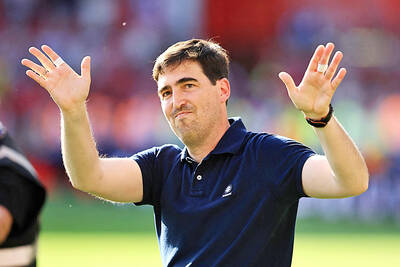
Liverpool are in advanced talks with former AFC Bournemouth manager Andoni Iraola as they seek a replacement for Arne Slot, reports said on Tuesday. Iraola has emerged as Liverpool’s top target to replace Slot, who was sacked on Saturday last week after a turbulent second season in charge. Liverpool have reportedly agreed a deal in principle to bring the Spaniard, who left Bournemouth at the end of this season, to Anfield. Sporting director Richard Hughes was heavily involved in hiring Iraola during his time at Bournemouth and is again spearheading the recruitment of the highly rated coach. The Reds are


 RSS
RSS