


The Pittsburgh Pirates could soon find out if an investment of US$20,000 can produce a couple of million-dollar arms.
Rinku Singh and Dinesh Patel, their two India-born pitchers who had never seen a baseball game before being the top two finishers in a TV reality show designed to find potential Major League Baseball arms, are nearly ready to make their professional debuts.
Neither had picked up a baseball, much less thrown one, until little more than a year ago. Aspiring cricket players, they had no idea that US athletes could make so much money playing a sport they knew nothing about.
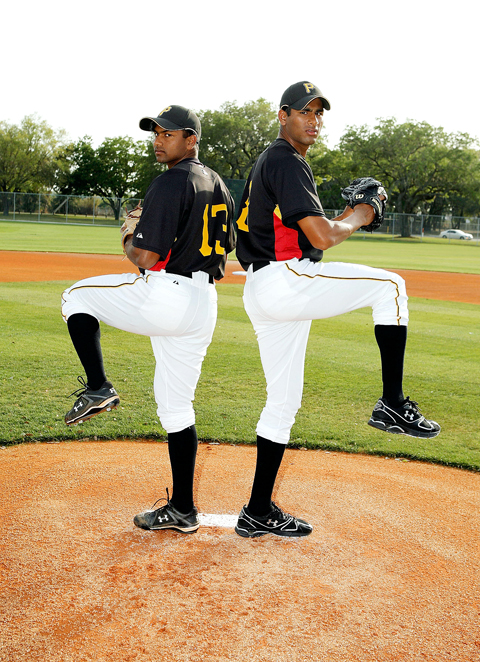
PHOTO: AFP
Now, after a busy year crowded with TV show appearances, basic baseball instruction, fitness workouts, constant throwing and adjusting to a pro athlete’s life in a new country, they are about to take the mound for the Bradenton Pirates of the rookie-level Gulf Coast League.
“It’s going to be fun,” Pirates general manager Neal Huntington said.
Pirates director of player development Kyle Stark said on Tuesday the two pitchers were likely to see game action this week, although the Bradenton pitchers have been set back by several recent rainouts.
As eager as sports-loving fans in India are to see whether the pair can become the first major league players from their country, the Pirates are just as curious to find out what they have in the two 20-year-olds.
Does either really possess a potential “Million Dollar Arm,” as the Indian reality show was called, or will they simply be a grand but failed experiment that proves on-the-job teaching can’t overcome the lack of a basic background in the sport?
Neither player had heard of the Pirates before signing with them last autumn for an estimated US$10,000 apiece, following months of workouts in California and Arizona with former major league pitcher and coach Tom House.
“It’s going to be a little different from the typical first professional outing,” Huntington said. “This is really their first outing [in the sport]. It will be different, but we’re not trying to get too caught up in it. We want to let them become part of the routine as much as possible.”
Huntington and Bradenton manager Tom Prince said it was surprising how quickly the two athletes, both of whom are from rural areas of India, have assimilated themselves not only into pro baseball but the US way of life.
Not long ago, Singh, a truck driver’s son, was living with seven brothers and sisters in a one-room house in northeast India. Today, he occasionally journeys to the Bradenton mall and enjoys eating at places other than the players’ cafeteria.
One Indian player initially wouldn’t go anywhere without the other but, as Huntington said, “They’re no longer joined at the hip.”
Singh and Patel hang out with teammates at the Pirates’ minor league dormitory and are treated as equals, even though every day brings a new adventure. Such as driving in a country where traffic laws must be obeyed, not routinely ignored as in India.
One on-field example: Covering first base on a ground ball, a rudimentary skill that pitchers normally are taught before high school. But it was foreign to the 1.88m Singh, who made US$100,000 while beating out 37,000 entrants to win the contest, and the 1.76m Patel, the runner-up.
Both pitchers’ velocity, in the low 150kph range during tryouts last autumn, is down now that they are throwing regularly.
The Pirates are optimistic that speed will return as their less-than-basic skills become more refined.
“You can very easily argue they’re 10 months old in terms of their baseball lives,” Huntington said. “We’re still at the rudimentary levels with them. That they’ll be able to pitch in the Gulf Coast League is remarkable ... I anticipate they’ll both be able to hold their own.”
In their own minds, the two pitchers made their professional debuts by appearing in extended spring training games, facing opposing hitters in different uniforms. Before doing so, each learned a breaking ball and a changeup to go with his fastball.
“I don’t think this [pitching in a pro game] will be that major of a deal for them,” Huntington said. “They had some tough outings [in extended spring], but they had some OK ones, too. We’re right where we anticipated them being.”
Even if neither could have possibly envisioned something like this 18 months ago.
“They’re quality, quality young men and are so fascinated by everything,” Huntington said. “They’re soaking it all in and trying to learn and asking a lot of questions, and how they fit in is remarkable.”
They’re now about to find out if they fit in as pitchers, too.

NO HARD FEELINGS: Taiwan’s Lin Hsiang-ti and Indonesia’s Dhinda Amartya Pratiwi embraced after fighting to a tense and rare 30-29 final game in their Uber Cup match The Taiwanese men’s team on Wednesday fought back from the brink of elimination to defeat Denmark in Group C and advance to the quarter-finals of the Thomas Cup, while the women’s team were to face South Korea after press time last night in the Uber Cup quarter-finals in Horsens, Denmark. In the first match, Taiwan’s top shuttler Chou Tien-chen faced a familiar opponent in world No. 3 Anders Antonsen. It was their 16th head-to-head matchup, with the Dane taking his fourth victory in a row against former world No. 2 Chou, winning 21-14, 13-21, 21-15 in 1 hour, 22 minutes. The

Marta Kostyuk’s maiden WTA 1000 title in Madrid came on Saturday thanks to her power, poise and a pair of unexpected lucky shorts. The world No. 23 beat eighth-ranked Mirra Andreeva 6-3, 7-5 in under 90 minutes to secure the most prestigious trophy of her career, her third professional singles title and second in less than a month after Rouen. Yet as the 23-year-old Ukrainian posed for photographs at the Caja Magica, it was not just the silverware that caught the eye. Held alongside her team and her two dogs, Kostyuk showed off a piece of black men’s underwear, prompting

Throwing more than US$5 billion at a divisive new tour and walking away after five seasons does not look like good business, but LIV Golf was not all bad news for Saudi Arabia. Oil-funded LIV, which poached top stars and sent golf’s establishment into a tailspin, helped push the conservative kingdom into global view — one of its key aims, experts said. The exit, confirmed on Thursday after weeks of speculation, does not signal a flight of Saudi money from sport, even after the Middle East war that sparked Iranian attacks around the Gulf, they said. “Saudi Arabia is not

Kite-surfing fabrics, car tires and shortened shoelaces helped Kenyan Sabastian Sawe and Adidas crack the two-hour marathon barrier. When Sawe on Sunday shattered one of athletics’ most elusive barriers in storming to victory at the London Marathon in 1 hour, 59 minutes, 30 seconds, it did not come from just physiology and grit, but from design choices drawn from far beyond the course. Sawe debuted Adidas’ lightest-ever racing shoe, the Adizero Adios Pro Evo 3. “It starts with the mentality of the athlete, the coach, and the team behind the product, which is: What can we do better? What is the 1 percent


 RSS
RSS