


As if his electric-yellow pants did not do the trick, Ryo Ishikawa smiled, leaned into the microphone and introduced himself to more than the room, which was packed with more paparazzi than golf reporters.
“Hello, America,” he said. “I’m Ryo.”
After a few sentences in halting English, he offered a primer on how to pronounce his name.
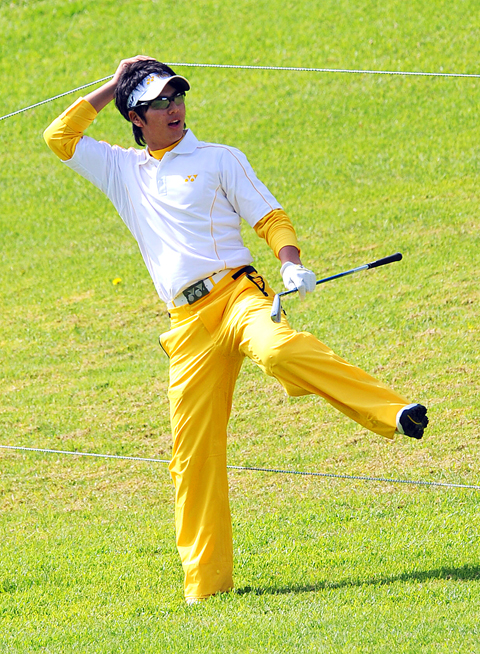
PHOTO: AFP
“Yo,” he said. “Repeat after me: Yo. Yo.”
And so it was that Ishikawa, a 17-year-old wunderkind, arrived as golf’s latest curiosity.
Ishikawa, who two years ago became the youngest player to win a Japanese tour event, signed last month with the marketing giant IMG. He has been granted exemptions to three PGA Tour events and has received an invitation to the Masters.
About 400 media members received credentials at Riviera, nearly double that for Tiger Woods’ last visit in 2006. Few golfers seemed to know much about Ishikawa, but they were curious. He seemed to relish it as he sat for the news conference. With his garish pants and his sunglasses resting atop a mop of black hair, he gave off the air of a rock star.
Ishikawa said his goal was to eventually win the Masters, that his idol was Woods, and that he did his best to focus on golf, not on all the attention.
Not that he minds.
“The best thing is I get 20 more bucks in my wallet,” he said of the fruits of celebrity.
And his colorful pants are “as important as a golf club.”
The most important piece of equipment probably lies between his ears. That is the difference between Woods and Ty Tyron, who in 2002 turned pro at age 17, and is now on the minor league Gateway Tour.
“I probably wouldn’t know which tee to go off if I was 17 trying to play on the PGA Tour,” said Hunter Mahan, who won the US Junior Amateur Championship in 1999, when he was 17. “I would probably have to call my mom and go: ‘What do I do? I want to eat. What do I do?’”
Jason Bohn knew what to do. He made a hole in one worth US$1 million while he was at the University of Alabama. To accept it, he turned pro. He was 29 when he earned his way onto the tour.
“Do you remember what you were like at that age?” asked Bohn, 35. “You’re completely fearless. The road I took — going through all the mini-tours, playing all the junk, sleeping in your car — is a little different.”
Moments after Bohn spoke from the fringe of the 18th green, Ishikawa rolled up in a golf cart and ambled into the interview area in the media tent.
“This is Barnum and Bailey,” he said. “It’s the greatest show on earth.”


“I don’t remember the moment, but ever since I was a kid, that’s the first thing I loved,” two-time NBA All-Star Isaiah Thomas said of his lifelong romance with basketball. However, that journey unfolded against the limitations of his size in a game where height often dictates opportunity — a reality he confronted throughout his career. At 175cm, Thomas is less than 2cm taller than the average Taiwanese adult male, while NBA players during his career stood at about 200cm on average. Compared with the NBA’s average career length of less than five years, Thomas’ 13-season career stands out as

Dakar and Rabat have longstanding ties, but relations have been strained since the Africa Cup of Nations (AFCON) final, which Senegal won in mid-January before being stripped of the title, which was transferred to Morocco. Now, the AFCON trophy is something of a thorn in the two countries’ sides. On Rue Mohamed V, the street where Moroccan vendors are based in the Senegalese capital, a police van is parked. “The police have been on high alert since the Confederation of African Football [CAF] decided to award the title to Morocco, but there have been no incidents,” a local resident said.

Top seeded Jessica Pegula on Friday once again fought back from a set down to reach the WTA Charleston Open semi-finals with a 3-6, 6-3, 6-2 win against Russia’s Diana Shnaider. Defending champion Pegula has lost the first set in all three of her matches at the tournament so far, but again dug deep to maintain her hopes of retaining the title. The world No. 5 from the US took 2 hours, 10 minutes to defeat 19th-ranked Shnaider, relying on a formidable service game that included eight aces. Shnaider battled well in the first two sets and broke early for a 2-0 lead

Cambridge on Saturday made it four wins in a row as they comprehensively defeated Oxford in the 171st University Boat Race on London’s River Thames. It was Cambridge’s seventh win in the past eight years of a rowing race between England’s two oldest universities first staged in 1829. A world-class Cambridge crew were heavy favorites for victory. However, four minutes into the race, the crews came close to a clash of oars which could have caused severe disruption, with Oxford repeatedly warned as both team chased faster conditions in the middle of the river. For the first time in the


 RSS
RSS