


After the smoke trails of fireworks have evaporated and the cheerleaders have put away their pompoms, India has begun to question whether its new billion-dollar cricket league is a sign of a nation breaking free of a colonial legacy or just a crass money-making machine.
There is little doubt the Indian Premier League (IPL), which ended on Sunday night with the winners, the Rajasthan Royals, bagging US$2 million in prize money, has changed the domestic game for good.
In India, it is said that cricket is more a religion than a sport. When India won the Twenty20 world cup last year, 2 million people took to the streets to welcome the young squad home.
Twenty20 also signifies a step change in attitude, which views speed, money and meritocracy stamped on a traditionally restrained and relaxed culture.
Twenty20 involves three hours of high-octane batting and bowling, accompanied by dancers and a booming Bollywood soundtrack.
Thousands have packed stadiums over the past six weeks to watch. The game’s razzmatazz has emptied cinemas and seen audiences for television soaps evaporate.
Bollywood films launched during the league have flopped, say multiplex owners, because people are too interested in Twenty20. Analysts say more than 250 million people have watched the league on TV.
Shopping patterns too have changed. Malls reported a 20 percent drop in visitors during the matches.
The IPL, say its detractors, is “the opium of the middle classes.”
“It is aimed at that upwardly mobile section of society who want something to do in between coming home from work and sleeping,” said Ramachandra Guha, a historian and author of an acclaimed book on Indian cricket.
He added that the infatuation with the new format has magnified some of the country’s worst traits: ingrained racism and sexism. Two black cheerleaders were allegedly prevented from performing at some games, “because of the color of their skin.” Others have complained of a torrent of lewd abuse from crowds.
The money in the IPL is staggering. Mukesh Ambani, the head of Reliance Industries and one of the world’s richest men, and the billionaire Vijay Mallya each paid about US$108 million for a franchise.
That is likely to be a wise investment. Mumbai stockbrokers say that within 10 years, each team’s annual revenue should be US$120 million.
In some way, the new game is a reflection of India’s emerging “consumerist meritocracy,” which emphasizes performance regardless of patriotism and politics.
“There is a sense of loyalty that is team-based and that is a new thing and probably a good thing for India,” said Mukul Kesavan, a writer and cricket columnist.

If the Wild finally break through and win their first playoff series in a decade, Minnesota’s top line likely will be the reason. They were all over the Golden Knights through the first two games of their NHL Western Conference quarter-finals series, which was 1-1 going back to Minnesota for Game 3 today. The Wild tied the series with a 5-2 win on Tuesday. Matt Boldy had three goals and an assist in the first two games, while Kirill Kaprizov produced two goals and three assists. Joel Eriksson Ek, who centers the line, has yet to get on the scoresheet. “I think the biggest

Bologna on Thursday advanced past Empoli to reach their first Coppa Italia final in more than half a century. Thijs Dallinga’s 87th-minute header earned Bologna a 2-1 win and his side advanced 5-1 on aggregate. Giovanni Fabbian opened the scoring for Bologna with a header seven minutes in. Then Viktor Kovalenko equalized for Empoli in the 30th minute by turning in a rebound to finish off a counterattack. Bologna won the first leg 3-0. In the May 14 final in Rome, Bologna are to face AC Milan, who eliminated city rivals Inter 4-1 on aggregate following a 3-0 win on Wednesday. Bologna last reached the
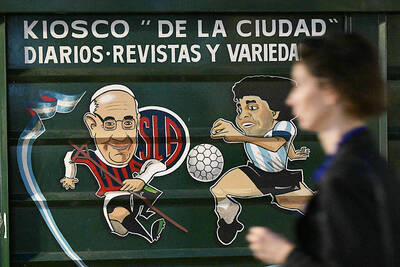
From a commemorative jersey to a stadium in his name, Argentine soccer organizers are planning a slew of tributes to their late “Captain” Pope Francis, eulogized as the ultimate team player. Tributes to the Argentine pontiff, a lifelong lover of the game, who died on Monday at the age of 88, have been peppered with soccer metaphors in his homeland. “Francisco. What a player,” the Argentine Football Federation (AFA) said, describing the first pope from Latin America and the southern hemisphere as a generational talent who “never hogged the ball” and who showed the world “the importance of having an Argentine captain,

Noelvi Marte on Sunday had seven RBIs and hit his first career grand slam with a drive off infielder Jorge Mateo, while Austin Wynn had a career-high six RBIs as the Cincinnati Reds scored their most runs in 26 years in a 24-2 rout of the Baltimore Orioles. Marte finished with five hits, including his eighth-inning homer off Mateo. Wynn hit a three-run homer in the ninth off catcher Gary Sanchez. Cincinnati scored its most runs since a 24-12 win against the Colorado Rockies on May 19, 1999, and finished with 25 hits. Baltimore allowed its most runs since a 30-3 loss to


 RSS
RSS