


As US President George W. Bush wrapped up his six-day visit to Asia yesterday, analysts gave their thumbs up to his determination to voice his firm support for Taiwan despite pressure from China to do otherwise.
"We felt gratified and relieved after watching Bush stick to his principles on the issue of Taiwan. He did not make any concessions, even after his meetings with the Chinese leaders in Beijing," said Cheng Tuan-yao (鄭端耀), research fellow at the Institute of International Relations in National Chengchi University.
While past trips to China by US presidents have produced agreements or statements that have damaged Taiwan's interests, Bush's visit only enhanced the nation's confidence in his administration, Cheng said.
"Bush has made the first correct step by spurning his predecessor's appeasement of China. Notably, he didn't restate the so-called `three nos' policy," said DPP legislator Parris Chang (
Former US president Bill Clinton agitated Taiwan when he gave the so-called "three nos" speech during his visit to China in 1998. The "three nos" include no support for an independent Taiwan; no recognition of "two Chinas'' or one China and a separate Taiwan; and no support for Taiwan's entry into international organizations that require members to be states.
"Bush has been very forthcoming in stating the US commitment to defend Taiwan against the possible use of force by China," said Chang, a specialist in international relations.
Bush reitered his desire for a peaceful settlement of the Taiwan issue several times during his trip to Beijing. The US president also declined to endorse China's version of a "peaceful unification" between Taiwan and China, reflecting the longstanding US position on cross-strait relations, analysts said.
"Of course he would not use the term of `peaceful reunification' ... because the American position is that relations between Taiwan and China should be open-ended," Chang said.
"The three communiques have not committed the US to peaceful reunification," he added.
China's Vice Foreign Minister Li Zhaoxing (
But Bush's refusal to respond to a similar push by a student yesterday during the question-and-answer session of his talk at Tsinghua University showed that the US president stuck to the US existing policy, according to analysts.
Cheng pointed out what he saw as the implications of Bush's remarks on missile defense.
"Bush said any missile-defense system was to protect friends and allies of the US from countries with massive destructive capabilities. Although he did not mention Taiwan directly, the implication of this remark seemed to be that Taiwan was not to be excluded," Cheng said.
Bush described Taiwan as a "good friend" of the US during his weekly radio address to the US public that aired last week within hours of his departure for Asia.
Bush's mention several times of the Taiwan Relations Act, the 1979 US law that pledged that the US would supply Taiwan with the defensive weapons it needed to fend off a Chinese attack, also reflected his firm support for Taiwan, analysts said.
China has tried to highlight and accentuate the Taiwan issue during Bush's trip to China, but the US agenda rested instead on anti-terrorism and China's proliferation of arms sale to countries like Iran and Pakistan, Chang argued.
But as Bush concluded his trip to Asia yesterday, it was clear that China failed to elicit from him a statement on the "three nos" and on opposition to Taiwanese independence, Chang said.
The US' rising concerns over China's military expansion and its appreciation for Taipei's support for the US-led war against terrorism drove Bush to stand firm in his support for Taiwan, the DPP legislator said.
The Pentagon's quadrennial defense review issued last September -- which highlighted the rising Chinese threat -- and the recent testimony by the CIA director to the US Senate on China's military modernization were indicative of the Bush administration's perception of China as a growing threat to US national security.
"These two reports seemed to indicate that the Bush administration took China's rising military threat more seriously than did the Clinton's administration. And therefore, the US is much more forthcoming in voicing its support for Taiwan," Chang said.
Fresh from his trip to Washington, where US government officials highlighted Taiwan's contribution to the war against terrorism, Chang said, "Even as a small country, we stood with the US at that critical moment, and the US appreciated that and has reciprocated what we've done."
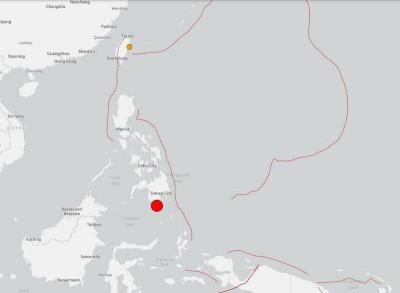
A magnitude 7.8 earthquake struck off the southern coast of Mindanao in the Philippines at 7:38am today, prompting the US Tsunami Warning System to issue an alert for neighboring countries, including Taiwan. The system issued a purple alert indicating a "tsunami threat." The potential threat zone includes Taiwan, the Philippines, Papua New Guinea, Yap and Palau. Philippine authorities were assessing the damage from the quake, with the office of civil defense seeking to verifying initial reports that 15 people had been killed and 129 injured in the region, mostly from falling debris. Arlene Hollero, disaster chief of Maasim town in the Philippines' Sarangani Province,
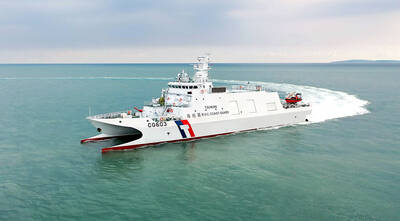
‘GRAY ZONE’ PRESSURE: Beijing’s activities are intended to create the deceitful impression that China has jurisdiction over the area around Taiwan, the CGA said Taiwan’s rights over its territorial waters and exclusive economic zone must not be violated by any country, the Mainland Affairs Council said yesterday, adding that it will not accept any unprovoked actions. The council issued the remarks in response to the China Coast Guard conducting maritime enforcement drills near eastern Taiwan and claiming to fully exercise China’s maritime administrative law enforcement authority. The Coast Guard Administration (CGA) has been closely monitoring the situation and is taking concrete steps to defend the nation’s sovereignty and secure its waters, the council said. China has no sovereign rights over the waters off eastern
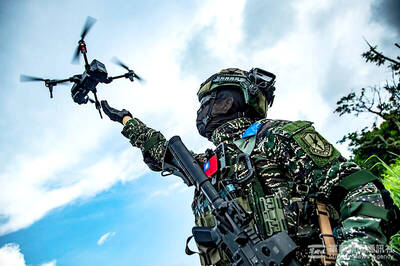
RESILIENCE: Taiwan plays a key role in semiconductors, energy, information infrastructure and advanced manufacturing, AIT Director Raymond Greene said Taiwan’s continued investment in deterrence and resilience remains vital, especially in uncrewed systems and other emerging technologies, American Institute in Taiwan (AIT) Director Raymond Greene said yesterday. Greene made the remarks at the annual National Strategic Summit on Supply Chain Resilience held by the Research Institute for Democracy, Society and Emerging Technology (DSET), a government-backed think tank. As Taiwan last year became the US’ fourth-largest trading partner and supply chain security is becoming more important, cooperation in emerging technologies continues to deepen between the two countries, he said. The US is committed to accelerating innovation, building key infrastructure, strengthening cooperation

The National Chungshan Institute of Science and Technology yesterday showcased its locally developed variants of the Vision 60 robotic patrol dog, which it plans to deploy on the nation’s outlying territories in the South China Sea. The variants were produced under the Joint Lab project — created by the institute and domestic companies — and assembled with domestically produced motors, lenses and artificial intelligence (AI) systems alongside licensed tech from the US, Missile and Rocket Systems Research Division deputy director Jen Kuo-kang (任國光) told the media event at a military base in Taipei’s Dazhi (大直) area. Taiwan has built up its strengths


 RSS
RSS