


Expressing his views on the media, President Chen Shui-bian (
"The media do pursue the truth," Chen writes, "but I wish the media would not only be crows that `caw' over tragic news, but also be magpies that cheer when there is happy news."
Chen made the remarks in the book The Premier Voyage of the Century (世紀首航), which will appear on bookshelves this week to mark his first 500 days in office.
Commenting on officials who were declared guilty of leaking confidential information to journalists, Chen said that reporters should bear national security in mind "because nothing would be left without the existence of the nation.
"I completely understand the concept of being a devoted reporter, but being the president, I have to put national security first, Chen writes."
In August, Major Liu Chih-chung (
Lo Chih-hao (
Chen also had a few words for TV talk shows, saying "everytime I think about the channels spending so much resource commenting on me, I think it is a shame."
Political call-in shows enjoy enormous popularity in Taiwan. A dozen political call-in programs are broadcast on approximately 10 cable channels.
A typical one-hour program combines the audience's call-in opinions and questions with those of politicians, scholars and journalists. Given that Taiwan's media is dominated by those who favor unification with China, most of the programs are critical of the Chen administration.
Attempting to point the media in a more neutral direction, President Chen offered guidelines for the media, calling them "the media's new middle way."
"The media should report more good news -- emphasizing stories that demonstrate the positive qualities of human nature," Chen writes. "The media must strike a balance between the speed with which it reports and the depth with which it does so."
The press must balance its freedom with the exercise of self-restraint; it must balance its coverage of Taiwanese news and overseas news, it must better balance its coverage of disasters and pleasant events, Chen states.
The president took a humorous approach in commenting on the media's frequent use of the phrase "said a high-ranking presidential official."
"Every morning, two military police officers go to the roof to raise the flag. These two officers are the highest-ranking presidential officials. Of course, they won't talk recklessly to outsiders," the president said.
"We can be sure that not all remarks made by unidentified presidential officials are credible."
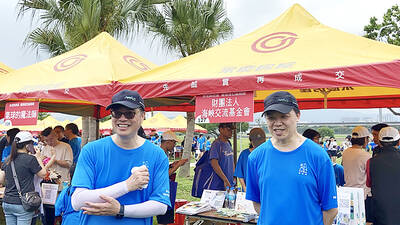
SECURITY: As China is ‘reshaping’ Hong Kong’s population, Taiwan must raise the eligibility threshold for applications from Hong Kongers, Chiu Chui-cheng said When Hong Kong and Macau citizens apply for residency in Taiwan, it would be under a new category that includes a “national security observation period,” Mainland Affairs Council (MAC) Minister Chiu Chui-cheng (邱垂正) said yesterday. President William Lai (賴清德) on March 13 announced 17 strategies to counter China’s aggression toward Taiwan, including incorporating national security considerations into the review process for residency applications from Hong Kong and Macau citizens. The situation in Hong Kong is constantly changing, Chiu said to media yesterday on the sidelines of the Taipei Technology Run hosted by the Taipei Neihu Technology Park Development Association. With

CARROT AND STICK: While unrelenting in its military threats, China attracted nearly 40,000 Taiwanese to over 400 business events last year Nearly 40,000 Taiwanese last year joined industry events in China, such as conferences and trade fairs, supported by the Chinese government, a study showed yesterday, as Beijing ramps up a charm offensive toward Taipei alongside military pressure. China has long taken a carrot-and-stick approach to Taiwan, threatening it with the prospect of military action while reaching out to those it believes are amenable to Beijing’s point of view. Taiwanese security officials are wary of what they see as Beijing’s influence campaigns to sway public opinion after Taipei and Beijing gradually resumed travel links halted by the COVID-19 pandemic, but the scale of
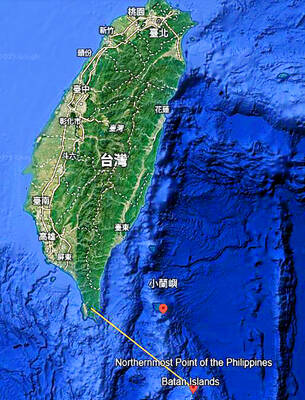
A US Marine Corps regiment equipped with Naval Strike Missiles (NSM) is set to participate in the upcoming Balikatan 25 exercise in the Luzon Strait, marking the system’s first-ever deployment in the Philippines. US and Philippine officials have separately confirmed that the Navy Marine Expeditionary Ship Interdiction System (NMESIS) — the mobile launch platform for the Naval Strike Missile — would take part in the joint exercise. The missiles are being deployed to “a strategic first island chain chokepoint” in the waters between Taiwan proper and the Philippines, US-based Naval News reported. “The Luzon Strait and Bashi Channel represent a critical access
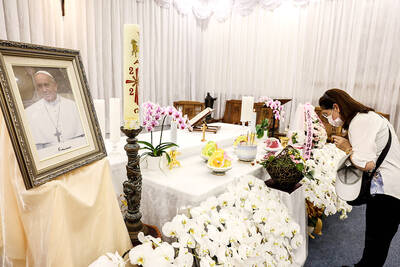
Pope Francis is be laid to rest on Saturday after lying in state for three days in St Peter’s Basilica, where the faithful are expected to flock to pay their respects to history’s first Latin American pontiff. The cardinals met yesterday in the Vatican’s synod hall to chart the next steps before a conclave begins to choose Francis’ successor, as condolences poured in from around the world. According to current norms, the conclave must begin between May 5 and 10. The cardinals set the funeral for Saturday at 10am in St Peter’s Square, to be celebrated by the dean of the College


 RSS
RSS