

Despite shutting down operations last week, the employees of the Independence Evening Post (
The party was organized by the workers' union. Neither Wang Shih-chieh (王世堅) nor Chang Fu-tai (張福泰), the paper's former and present chairmen, appeared at the gathering.
The union had been in charge of the paper's operations since capital-labor disputes erupted in mid-September and lasted until Oct 2, the last day of the Post's publication. Chang had also abandoned his post, saying his chairmanship was invalid.
"Originally it was to be a memorial service for the paper, but later we decided to part with our sorrow and throw a birthday party in the hope the paper would be restarted soon. We demand that the two owners of the paper [Wang and Chang] come out to shoulder responsibility in a timely manner," said Hsieh Chih-peng (
Hsieh added that protests would continue today and would last until the paper's pay disputes are solved.
Wu Feng-shan (吳豐山) and Hu Yuan-hui (胡元輝), two former presidents of the newspaper, were at the anniversary to give moral support to their previous employees.
Lauding the paper's achievements as a chronicler of Taiwan's democratization for more than half a century, they hoped the paper could be restarted after the controversies were resolved.
Swamped by financial difficulties, the country's oldest newspaper ceased publication a week ago, leaving nearly 300 employees jobless.
In mid-September, the newspaper's chairman position became vacant when Chang, a doctor of Chinese medicine who succeeded Wang on July 26, claimed that his appointment was illegitimate due to irregularities in the selection process.
Chang has stayed away from the business ever since, while Wang -- the chairman since last October -- said that he should no longer be responsible because he stepped down at the end of July.
On Sept. 14, the workers' union filed a lawsuit against Wang and Chang for what they said was the embezzlement of NT$8 million in workers' insurance fees and failure to pay salaries for two months.
Hearing no response from their evasive bosses, the employees launched a series of protests and have sought assistance from the Bureau of Labor Affairs of the Taipei City government.
Cheng Tsun-chi (
He requested the new and previous chairmen present their contracts and note when they changed hands. Cheng asked that whoever the legitimate manager is make a quick decision on whether the paper would continue operations. The bureau could then proceed to handle the disputes following legal procedures.
A few days after the paper's interruption of operations, Wang expressed his willingness to take the paper back, noting "his special feelings for the paper," under the condition that the union be "moderately adjusted."
But he quickly changed his mind, saying he could no longer deal with the paper's intransigent union, branding it a "mob."
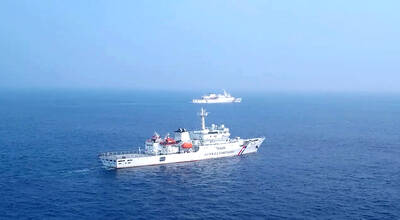
PATROL PARTNERS: The ‘Chiayi’ and the ‘Penghu’ departed for a two-day joint patrol of Palau’s exclusive economic zone, the CGA’s second diplomatic visit to the country The Coast Guard Administration (CGA) set a record for its southernmost deployment of a coast guard vessel as the vessels Chiayi and the Penghu reached Palau’s Pulo Anna Island on Saturday in a cooperative exercise between the two countries. The island, about 217 nautical miles (401km) southwest of Koror in the Palauan state of Sonsorol and 1,220 nautical miles from Taiwan’s southernmost point, Oluanpi (鵝鑾鼻), is the furthest south a CGA vessel has sailed. The two vessels are in Palau for the coast guard’s second diplomatic visit to the country. They docked at Malakal Harbor on Tuesday last week. The coast guard
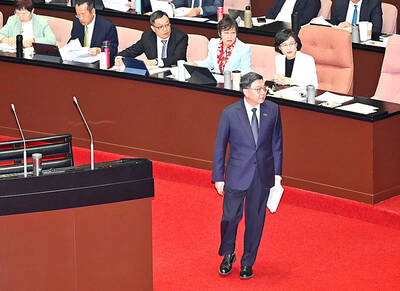
The government is monitoring online rumors that a pneumonic plague outbreak has spread from Russia into China, and it might enhance quarantine measures, Premier Cho Jung-tai (卓榮泰) said yesterday. During a legislative meeting, Democratic Progressive Party Legislator Wang Ting-yu (王定宇) said that rumors had circulated that the disease had spread across several Chinese provinces. He asked Cho whether the government was prepared to prevent the disease spreading to Taiwan, given the volume of traffic between the two sides, and how concerned the government was about the alleged outbreak. The Ministry of Health and Welfare had implemented border quarantine measures after briefing the Executive
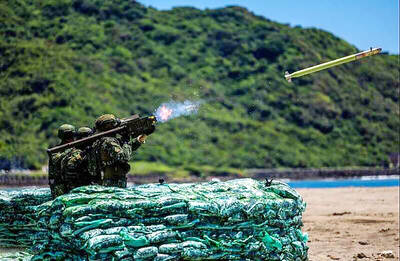
BATCH 1: The military has plans to assign the weapons to the army to defend Taiwan proper, as well as outlying islands and the navy for the Marine Corps, the official said Taiwan is to receive 500 Stinger missiles and 178 launchers from the US by the end of the year, the first batch under a planned two-stage acquisition totaling 2,621 missiles and 763 launchers, a defense official said yesterday on condition of anonymity. The portable missiles would play a vital role in the nation’s air defense capabilities, the source said. The army plans to deploy 2,235 missiles and 657 launchers to defend Taiwan proper and outlying islands, they said, citing military documents. The navy is allotted 295 missiles and 85 launchers to arm the Marine Corps and some surface vessels that lack air defense
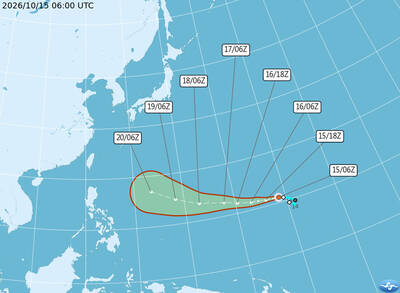
EAST OF GUAM: Tropical Storm Champi is forecast to strengthen into a typhoon, but its effect on Taiwan is uncertain due to the presence of a high-pressure system Tropical Storm Champi formed yesterday and has the potential to increase in strength, the Central Weather Administration (CWA) said yesterday. Forecasters are closely monitoring a Pacific high-pressure system that would dictate whether the storm turns north or moves toward Taiwan next week, the CWA said. The most likely scenario is that it turns northward after passing the Ryukyu Islands, CWA forecaster Cheng Chieh-jen (鄭傑仁) said. As of 8pm yesterday, Champi was east of Guam moving west-northwest at 20kph, CWA data showed. It had maximum sustained winds near the center of 72kph and gusts of up to 101kph, the data showed. If the Pacific high-pressure system


 RSS
RSS