


Taiwanese American Welly Yang (
The musical Making Tracks (鋪軌), which has already been a hit in the US, has touched the hearts of many locals with its story about Asian Americans tracing their history.
"For so long, Asians in America don't know what our history is ... and the story is about not forgetting your past," said 28-year-old Yang, producer, co-writer and a leading actor of the play.
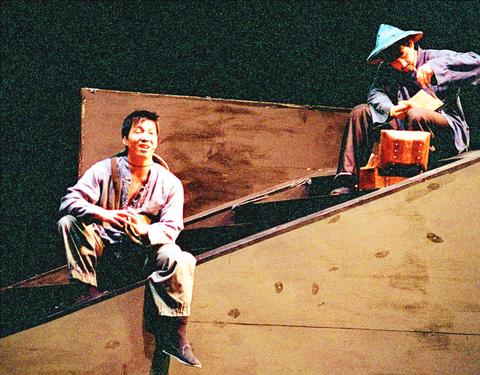
PHOTO: AFP
"I think Taiwanese people are doing just that [seeking identity]," he said.
Making Tracks was warmly received here as it made its Asian debut from Feb. 21 to March 4. Tickets for all 10 shows around the nation were nearly sold out, drawing some 13,000 people, according to the Taipei Philharmonic Foundation, sponsor of the show.
The play begins with a young Chinese immigrant working with thousands of other compatriot laborers to build railroads in the mountains of California in order to make enough money to bring his wife and child to America.
It concludes with a dying man, the immigrant's grandson-in-law from a Japanese family, handing over to his grandson Dylan a box unveiling the family's history of struggle, setback, prejudice, triumph and despair on the new land.
Twenty-one-year-old Dylan feels that he is brought closer to the spirit of his ancestors by the story of the family's struggles for a better life.
"Because of all the sacrifices that all generations made before so that we can be where we are today," Yang said.
He said it was significant to bring the drama to Taiwan, where many people had struggled during 50 years of Japanese colonial rule until 1945, followed by the KMT authoritarian rule.
"Many people here told me they were really moved by the story ... because it is kind of similar to what Taiwanese have been going through, trying to discover their own identity," Yang said.
Taiwan was ceded to Japan in 1895 by China in the Treaty of Shimonoseki during the Qing Dynasty. It was returned to the Chinese fold in 1945 at the end of World War II.
The pro-independence DPP won last year's presidential polls, ending a 52-year grip on power on Taiwan by the KMT, which fled China in 1949 during the civil war.
"The musical, though in English, appeals to Taiwanese audiences, because they feel they can relate to the characters and their stories," said Zan Tien-hao, a critic and columnist for Classical Music Magazine in Taiwan.
Born and raised in New York after his parents immigrated from southern Tainan in the 1960s, Yang said he became aware of his identity as an Asian American when he started acting in high school.
"To most of America, I still looked like a foreigner, and I was often limited to playing the roles of the gook, the geek and the gangster with funny accents," he said.
That was when Yang began his root-finding journey and founded Second Generation (2G) in 1997, a non-profit theater group comprising mostly Asian American artists which creates performances centered on Asian Americans.
"Being a Taiwanese American is like being a minority in a minority," Yang said, but he stressed that his multicultural upbringing has given him a broader perspective on performing art.
"As an artist, you want to be inspired by everything, and being exposed to different cultures helps you maintain that openness," he said.
Yang made his debut on Broadway at the age of 20 in the lead role of Thuy in Miss Saigon. He was also a television actor and a talk show host.
Second Generation plans to bring Making Tracks to Broadway in two years after its next Asian tour.
The show has previously been staged off-Broadway in New York and Seattle.
Yang's next project is to stage Taiwanese director Ang Lee's (
"One of the things that is impressive about Ang Lee is I don't think he is really interested in fame and recognition ... he is simply interested in doing his work and that is inspiring to me," Yang said.

‘NO SECURITY RISK’: The Railway Bureau reassured the public that the technicians’ activities were limited to technical guidance and did not involve sensitive systems The Railway Bureau yesterday said it had invited eight Chinese technicians to assist with an airport MRT construction project. The bureau issued the confirmation after an Internet user said Chinese nationals had entered the construction zone of Taiwan Taoyuan International Airport’s Terminal 3 project. They asked why “individuals from an enemy state” were allowed access to such a major national infrastructure project, which raised serious concerns over Taiwan’s industrial safety, sensitive systems and information security. The bureau’s Northern Region Engineering Branch Office said subcontractor Taiwan Handle Industrial Co (台灣手把工業) of the Taoyuan airport MRT’s “Contract No. CU05 Project A14 Station Civil, MEP &

The National Chungshan Institute of Science and Technology yesterday showcased its locally developed variants of the Vision 60 robotic patrol dog, which it plans to deploy on the nation’s outlying territories in the South China Sea. The variants were produced under the Joint Lab project — created by the institute and domestic companies — and assembled with domestically produced motors, lenses and artificial intelligence (AI) systems alongside licensed tech from the US, Missile and Rocket Systems Research Division deputy director Jen Kuo-kang (任國光) told the media event at a military base in Taipei’s Dazhi (大直) area. Taiwan has built up its strengths

TIT-FOR-TAT: The US allegedly revoked the visa of a Chinese national working at Xinhua News Agency in the US in response to Beijing’s expulsion of Vivian Wang The Presidential Office yesterday condemned China for expelling a New York Times correspondent from Beijing following the newspaper’s interview with President William Lai (賴清德), saying the move highlighted Beijing’s suppression of press freedom and its threat to international news media. Taiwan has noted a series of recent incidents in which Beijing used similar tactics to “threaten and pressure international media outlets and journalists,” Presidential Office spokeswoman Karen Kuo (郭雅慧) said in a statement. “This concerns not only press freedom and freedom of expression, but also the safety of journalists, and Taiwan and relevant partners are paying close attention to the situation,” she
NOT IMMEDIATE: Taiwan has a chance to appeal the proposed 10 percent tariff before it starts, while other countries face a 12.5 percent tariff from the trade office Taiwan is among 60 economies determined by the US to have failed to impose or enforce a ban on the importation of goods produced with forced labor, according to a notice released on Tuesday by the Office of the US Trade Representative (USTR), which proposed imposing an additional 10 percent or more tariff on them. The USTR in a statement said that following an investigation, it had determined under Section 301 of the Trade Act of 1974 that the failure of the 60 economies to impose and effectively enforce a prohibition on the importation of goods produced with forced labor is


 RSS
RSS