


Bo Yang (
Surrounded by family members, old friends and admirers, the long-time social critic spelled out his biggest wish, which was directed at Taiwan's younger generation.
"It's my deep hope our young people will be able to live with dignity. Dignity, as far as I'm concerned, can't be obtained through pride or wildness. Rather, it can only be established when we learn to always pay due respect to others," Bo Yang said.
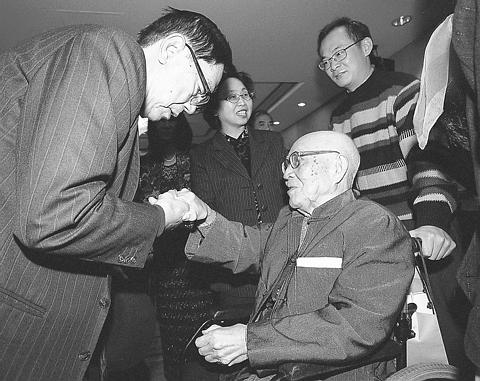
PHOTO: AP
Bo Yang, whose satirical essays about Chinese culture have made him one of the most famous writers in Chinese literature, was born in China in 1920. He fled to Taiwan in 1949 after the defeat of the KMT.
Born in a turbulent era, Bo Yang does not know precisely on which day he was born. The outspoken writer nominated March 4, 1968, as his "day of rebirth" -- the day his incarceration at the hands of the KMT regime began.
In the 1960s, Bo Yang wrote a series of essays for newspaper columns. But it was his translations of an English-language comic in 1967, which were seen by the Chiang Kai-shek (
Bo Yang was finally freed from the notorious "Devil Island" in 1977, after persistent efforts by Sun Kuan-han (
Sun, an aging friend of Bo Yang, also appeared at his birthday party yesterday. Looking over his family members and dozens of friends, the writer said he was happy and called himself the "luckiest person in the world."
"It's the most glorious moment of my life," Bo Yang said delightfully. "Life was tough to me and during it I narrowly escaped from death several times."
"But thank God I have so many friends who have always given me a hand whenever I was in despair," he said. "They have shown me a lot of mercy. I can't name them all, but soon I'll write something to spell out my gratitude to them."
Bo Yang has produced more than 100 books -- including essays, novels, history, and poetry -- since the beginning of his writing career in the 1950s.
His famous book The Ugly Chinaman (醜陋的中國人), a collection of lectures and essays focusing on the conflict between traditional Chinese culture and the values of an industrialized West, spurred furious debate in Chinese communities throughout the world, and prompted responses from editors around the world.
His experience as a political prisoner has made him a long-time human rights advocate. And his efforts in that direction produced results last December when the first human rights monument in Asia was officially inaugurated on Green Island off the southeastern coast of Taiwan. The monument, which stands near the beach, is inscribed with a poem by Bo Yang, who himself spent nearly a decade on the island jailed in a notorious maximum-security facility.
Establishment of a monument there fulfilled his dream to see the Taiwan government admit the cruel reality of its past regime, he said.
And at his birthday yesterday, Bo Yang saw another dream fulfilled -- a new anthology of his past writings was released to mark the special day.
LEVERAGE: China did not ‘need to fire a shot’ to deny Taiwan airspace over Africa when it owns ‘half the continent’s debt,’ a US official said, calling it economic warfare The EU has raised concerns about overflight rights following the delay of President William Lai’s (賴清德) planned state visit to the Kingdom of Eswatini after three African nations denied overflight clearance for his charter at the last minute. Taiwanese allies Paraguay and Saint Kitts and Nevis, as well as several US lawmakers and the Inter-Parliamentary Alliance on China (IPAC) condemned China for allegedly pressuring the countries. Lai was scheduled to fly directly to Taiwan’s only African ally from yesterday to Sunday to celebrate the 40th anniversary of King Mswati III’s accession and his 58th birthday, but Seychelles, Mauritius and Madagascar suddenly revoked
PROVOCATIVE: Chinese Deputy Ambassador to the UN Sun Lei accused Japan of sending military vessels to deliberately provoke tensions in the Taiwan Strait China denounced remarks by Japan and the EU about the South China Sea at a UN Security Council meeting on Monday, and accused Tokyo of provocative behavior in the Taiwan Strait and planning military expansion. Ayano Kunimitsu, a Japanese vice foreign minister, told the Council meeting on maritime security that Tokyo was seriously concerned about the situation in the East China and South China seas, and reiterated Japan’s opposition to any attempt to change the “status quo” by force, and obstruction of freedom of navigation and overflight. Stavros Lambrinidis, head of the EU delegation to the UN, also highlighted South China Sea
The final batch of 28 M1A2T Abrams tanks purchased from the US arrived at Taipei Port last night and were transported to the Armor Training Command in Hsinchu County’s Hukou Township (湖口), completing the military’s multi-year procurement of 108 of the tanks. Starting at 12:10am today, reporters observed more than a dozen civilian flatbed trailers departing from Taipei Port, each carrying an M1A2T tank covered with black waterproof tarps. Escorted by military vehicles, the convoy traveled via the West Coast Expressway to the Armor Training Command, with police implementing traffic control. The army operates about 1,000 tanks, including CM-11 Brave Tiger
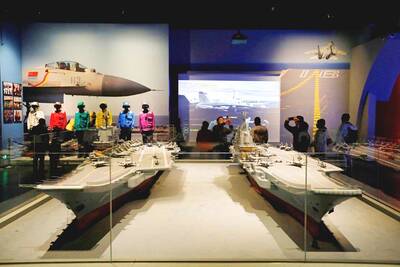
China on Wednesday teased in a video an aircraft carrier that could be its fourth, and the first using nuclear power, while making an allusion to Taiwan and vowing to further build up its islands, as it looks to boost maritime power, secure resources and bolster territorial claims. The video, issued on the eve of the 77th founding anniversary of the Chinese People’s Liberation Army Navy, featured fictional officers with names that are homophones of three commissioned aircraft carriers, the Liaoning (遼寧), Shandong (山東) and Fujian (福建). Titled Into the Deep, it showed a 19-year-old named “Hejian” (何劍) joining the group, sparking


 RSS
RSS