


At a media gathering to launch her new book yesterday, Lung Ying-tai (龍應台) said transforming herself from a writer and social critic to director of the Taipei City Government's new Bureau of Culture was no small task, but she hopes her undertakings will influence the Chinese-language community worldwide.
Lung, who calls her absence from from Taiwan since 1987 "exile," returned from her base in Germany just last Thursday. Today, she takes her post as head of the culture bureau, now under the auspices of a preparatory committee.
One day before her new assignment, however, Lung said she wanted to retain her role as a writer and interact with her readers.
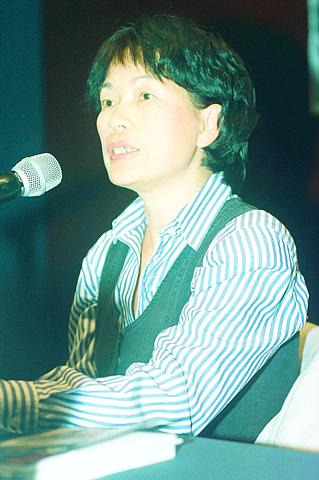
PHOTO: DAI LI-AN, LIBERTY TIMES
But the occasion yesterday perhaps gave her a taste of the future. Although she prefers to think of herself as an expert in "avoiding cameras and reporters," she was welcomed by just that -- a roomful of journalists -- together with her "readers."
"Sitting here, I have already started to adapt myself to my new role," Lung said.
"As a writer, I try to avoid TV coverage as much as I can because I am afraid of being recognized when I walk down the street. But as the director of the Bureau of Culture, I cannot do this. I have to articulate my concepts through the media so as to make myself understood," said Lung.
One of her colleagues offered her some words of caution at yesterday's event. Writer Yang Chao (楊照), who was invited to speak to the audience with Lung about her new book, warned of a "transformation" after taking her new post.
"Maybe three and a half years from now, she will be like [early 20th century writer and social critic] Lu Xun (
Lung, renowned for her sharp observations on social phenomena as well as her idealism, returned his comments with a smile.
"Perhaps from tomorrow [meaning today], I'll start attending the `cram school on darkness' ... In history, although idealistic, passionate people have ended up frustrated, I still appreciate a sort of human glory [in these precedents]; it's something I am willing to pursue," she said.
"Taipei nowadays sits at the center of the Chinese-language community worldwide, not at its margin. If the cultural projects in the city go well [after I lead the bureau], then my influence on the Chinese-language community will no longer be through my writings but through other means," she said.
Meanwhile, Lung said even her readers in China have shown concerns over the fact that a KMT-run city government is willing to recruit a writer like her -- someone famous for her criticism of the KMT -- as a civil servant.
The city's plan to establish the bureau had been aborted by partisan disputes in the city council under former mayor Chen Shui-bian (
The dispute was finally settled when Mayor Ma Ying-jeou (馬英九) beat Chen last December. The council decision passed a resolution to establish the bureau in July.
The bureau, which will begin operations in November, will be Taiwan's first cultural bureau at the local government level.

‘NO SECURITY RISK’: The Railway Bureau reassured the public that the technicians’ activities were limited to technical guidance and did not involve sensitive systems The Railway Bureau yesterday said it had invited eight Chinese technicians to assist with an airport MRT construction project. The bureau issued the confirmation after an Internet user said Chinese nationals had entered the construction zone of Taiwan Taoyuan International Airport’s Terminal 3 project. They asked why “individuals from an enemy state” were allowed access to such a major national infrastructure project, which raised serious concerns over Taiwan’s industrial safety, sensitive systems and information security. The bureau’s Northern Region Engineering Branch Office said subcontractor Taiwan Handle Industrial Co (台灣手把工業) of the Taoyuan airport MRT’s “Contract No. CU05 Project A14 Station Civil, MEP &

A US uncrewed surface vessel (USV) encountered multiple Chinese warships during an autonomous transit of the Taiwan Strait, US defense company Seasats said in a statement on Wednesday. Seasats announced that a Lightfish USV had completed the first autonomous transit of the Taiwan Strait. Over five days, the USV traversed the entire length of the Strait while constantly monitoring surface vessel traffic, the company said. The Lightfish encountered multiple Chinese warships, one of which was a Chinese People’s Liberation Army Navy (PLAN) Type 056 corvette, it said. The Chinese vessels were operating “well within Taiwan’s exclusive economic zone without transmitting their identity via the
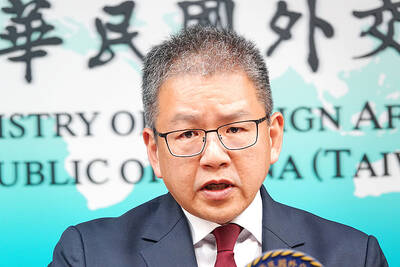
Taiwan is still in the process of assessing the possibility of recruiting workers from Eswatini, the Ministry of Foreign Affairs said yesterday, adding that its goal is to help Eswatini upgrade its vocational training centers. If there are plans to recruit workers from Eswatini, safeguarding national security, protecting public health and ensuring the employment rights of Taiwanese would be prerequisites, Department of West Asian and African Affairs Director-General Yen Chia-liang (顏嘉良) told a news conference. Key considerations would also include filling labor shortages in specific industries, and fostering bilateral professional and technical exchanges, he said. Yen was asked about the progress of labor
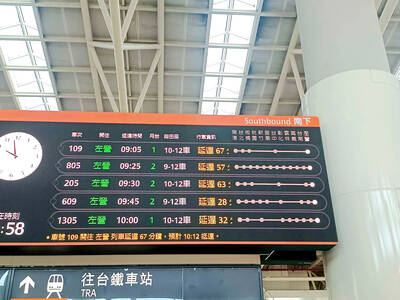
The nation’s usually punctual high-speed rail system yesterday was hit by major disruptions after all scheduled services were canceled and replaced with three hourly trains offering only non-reserved seating, affecting more than 200,000 passengers. Preliminary findings indicate the disruption was caused by a faulty power module in a track switch control cabinet, Taiwan High-Speed Rail Corp (THSRC) said, adding that as a full system inspection could only be conducted after operations end for the day, a decision on whether normal service would resume today would be announced before the first train departs. During a routine inspection early yesterday, a switch signal abnormality


 RSS
RSS