


Hit South Korean boyband Wanna One are to officially break up following four final concerts between today and Sunday. To bid farewell to their fans overseas, the very last concert at the Gocheok Sky Dome in Seoul on Sunday will be broadcast live in selected movie theaters in several countries or regions, including Taiwan, Japan and Hong Kong.
Wanna One is a limited-time boyband formed by the 11 winners of the 2017 singing competition Produce 101 — including Kang Daniel, Park Ji-hoon, Lee Dae-hwi, Kim Jae-hwan, Ong Seong-wu, Park Woo-jin, Lai Kuan-lin, Yoon Ji-sung, Hwang Min-hyun, Bae Jin-young and Ha Sung-woon. The 17-year-old Lai from Taiwan is a particular favorite among local fans.
The group quickly became a K-pop sensation, conquering countless fans worldwide with mega hits such as Energetic, Burn It Up and Beautiful. After their 18-month-long contract ended on Dec. 31, most of the members are to pursue solo careers, and Lai is set to enter showbiz in China.

Photo: AFP
照片:法新社
(Eddy Chang, Taipei Times)
南韓人氣男團Wanna One於今日至週日舉辦四場告別演唱會,之後該團將正式解散。為了向海外粉絲道別,週日在首爾高尺天空巨蛋的最終場次,亦將在某些國家或地區獲選的戲院現場直播,其中包括台灣、日本和香港等地。
Wanna One是個期間限定的男團組合,十一位成員自二○一七年歌唱競賽節目《Produce 101》脫穎而出,他們是︰姜丹尼爾、朴志訓、李大輝、金在奐、邕聖祐、朴佑鎮、賴冠霖、尹智聖、黃旼炫、裴珍映、河成雲。在這些成員中,來自台灣的賴冠霖更是深受本地粉絲的喜愛。
該團迅速走紅而成為引領韓流的組合,並以他們的暢銷金曲,包括《Energetic》、《Burn It Up》、《Beautiful》征服全球歌迷。在限期十八個月的合約於去年十二月三十一日到期後,大部分成員將單飛追求個人演藝事業,賴冠霖則預計進軍中國演藝圈。
(台北時報張聖恩〉
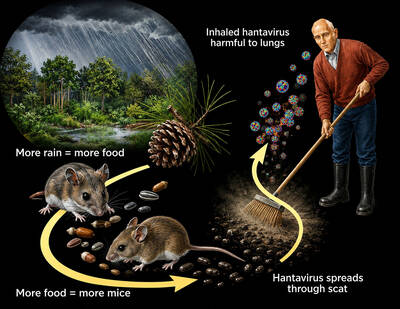
An outbreak aboard a cruise ship of a rare rodent-borne illness called hantavirus has left three passengers dead and sickened others, but global health officials say the risk to the general public remains low because the germ does not easily spread between people. “This is not the next COVID, but it is a serious infectious disease,” said Maria Van Kerkhove, director of epidemic and pandemic preparedness at the World Health Organization (WHO). “Most people will never be exposed to this.” The virus usually spreads when people inhale contaminated residue of rodent droppings. Hantaviruses have been around for centuries and are thought to

Have you ever wondered how people navigate the world when they can’t see a map? For individuals with visual impairments, conventional maps are nearly impossible to use. This is where tactile maps come in — essential tools that allow people to “see” the world through touch. A tactile map is specially designed with raised lines, textures, and symbols to represent geographical features such as roads, rivers, and buildings. Users explore it with their fingertips. However, these maps are not exclusively for people with visual disabilities. They serve as valuable multisensory learning tools that enhance spatial understanding for everyone, making

A growing green movement allows hotel guests to fund tree planting projects simply by opting out of daily room cleans. This approach turns an ordinary hotel stay into a direct contribution to nature. Founded in the Netherlands, the nonprofit “Hotels for Trees” operates on the principle that one skipped cleaning equals one new tree. It has planted more than 750,000 trees since 2021. Similarly, Sarnia Hotels in Guernsey donates £2 per refused clean. Since 2024, over 3,300 services have been cancelled, raising sufficient money to plant 1,100 native trees and hedgerows. Simplicity has been central to this success.

1. 他病了三天。 ˇ He has been sick for three days. χ He has been sick since three days. 註︰這裡現在完成時態 have / has been 表示從過去某一時日到現在的一段時間存在的行為或狀態,與它連用的時間副詞應為 「for +若干時」,如 for a year, for three hours 等,意思是歷時多少。 2. 他自從星期三以來都很忙。 ˇ He has been busy since Wednesday. χ He has been busy from Wednesday. 註︰「自從……以來」,該用 since。說從某一天(某一時刻)到某一天(某一時刻)才用 from,如 from Monday till Friday。 3. 房間角落裡散放著一些零星物件。 ˇ There were some odds and ends lying in the corner of the room. χ There were some odds and ends lying at the corner of the room. 註︰「在房間角落裡」該用介詞 in。例如: He stood in the corner. There is a lamp in the corner of the room. at the corner 指房子外部的拐角。例如: A little boy


 RSS
RSS