


Exploring marine environments, underwater robots tend to be a bull trout in a china shop, disturbing marine life with their bulk and disruptive propulsion. Enter SoFi, the soft, agile robotic fish with a delicate demeanor.
Scientists said on March 21 they have created a remote-controlled robot that swims quietly through coral reefs and schools of fish and uses a fisheye lens — of course — to capture high-resolution photos and video with a camera built into its nose.
Dubbed SoFi, it can swim forward, move up and down, turn and change speeds, propelling itself by wiggling its tail side to side like a real fish, a motion created by pumping water with a small motor into two balloon-like tail chambers. SoFi, built with a generic fish design, is white, weighs less than 1.6kg and is about 47cm long.
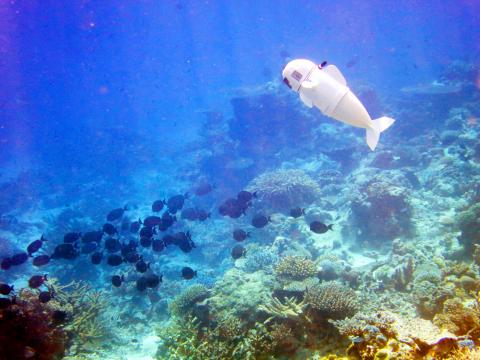
Photo: Reuters
照片:路透
SoFi’s “soft artificial muscle” tail is made of silicone elastomer, a type of rubber. Its nose houses the electronic elements. It has two side fins for maneuvering.
“I chose SoFi, pronounced like Sophie, as a name because it not only abbreviates the word Soft Fish, but it also reminded me of a girl I liked a lot and had a crush on in high school,” said study lead author Robert Katzschmann, a robotics researcher and PhD candidate at the Massachusetts Institute of Technology’s Computer Science and Artificial Intelligence Laboratory (CSAIL).
“The name is mellifluous just like the way the robot glides and undulates in water,” added roboticist Daniela Rus, CSAIL’s director.
SoFi is operated using a waterproofed Super Nintendo controller by a diver who can be almost 21m away. CSAIL researchers tested SoFi in South Pacific coral reefs and coastal waters near Taveuni, Fiji’s third-largest island, as well as in an MIT pool.
The untethered robot navigates for up to 40 minutes at depths reaching almost 18m.
Existing autonomous underwater vehicles typically are tethered to boats and powered by propellers or jets that can disrupt the natural environment. SoFi swims alongside fish and other marine creatures without sending them fleeing.
“The robot can be used as a marine biology instrument and also to measure pollution in coastal waters, to create maps, to do inspection, to monitor and track,” Rus said.
“This hopefully serves as inspiration for many more soft robotic creatures to come, both on land and in water,” Katzschmann added.
The research was published in the journal Science Robotics.
(Reuters)
每當科學家探索海洋環境時,在水下作業的機械總像是一條在瓷器店裡游來游去的巨型公牛鱒,龐大笨重的身軀以及具破壞性的推進器,每每對海洋生命造成干擾。風度翩翩、身軀柔軟而靈巧的機械魚蘇菲,就此應運而生。
科學家於三月二十一日表示,他們已經打造出一條遙控機械魚,能夠安靜地悠游於珊瑚礁之間,悄悄地穿越重重魚群。裝設在機械魚鼻子裡面的相機,則能夠捕捉高解析度的照片與影片。當然,這相機使用的是「魚眼」鏡頭。
被取名為蘇菲的這條機械魚,既能往前游、又可以上下移動、還可以轉彎或改變速度。蘇菲就像是一條真魚,藉由左右擺動尾鰭向前推進。實際上,它的運動原理來自於一個小小的馬達,如同幫浦一般,將海水汲取到尾部兩個像氣球般的空間,再將水排出來獲得動能。蘇菲的造型設計就像是一條普通的魚,外觀為白色,重量不超過一點六公斤,長約四十七公分。
科學家用矽膠這種合成橡膠材料,做出構成蘇菲尾鰭的柔軟人造肌肉。它的魚鼻子裡面裝有許多電子元件。魚身還裝有一對胸鰭,能夠藉此進行活動。
這份研究的主要作者羅伯‧卡茲許曼表示:「我選擇SoFi這個發音像是蘇菲的名字,是因為它不僅僅是『柔軟的魚』(Soft Fish)的縮寫,還會讓我想起高中時一見鍾情,深深迷戀上的一位女孩子。」卡茲許曼是麻省理工學院計算機科學與人工智慧實驗室的博士候選人,專長研究領域為機械(人)學。
該實驗室的主持人丹妮愛拉‧茹斯補充說道:「這個名字發音聽起來流暢悅耳,就像是這條機械魚在水中順暢地滑行起伏。」
蘇菲是由一台經過防水保護設計的超級任天堂手持搖桿控制,負責的潛水員可以從二十一公尺外進行操縱。該實驗室的研究人員在斐濟第三大島塔韋烏尼島周圍的珊瑚礁、該島嶼的近岸水域,以及麻省理工學院的人造池裡測試蘇菲的性能。
這條機械魚不受任何傳輸線束縛,巡航時間可長達四十分鐘,探測深度則可達十八公尺。
目前的水下自動探測機械通常都會跟船隻相連接,動力來源則多為螺旋槳或噴射引擎,會對自然環境造成干擾。蘇菲能夠跟其它魚類和海洋生物一起悠游水中,不會把它們嚇跑。
實驗室主持人茹斯說:「這條機械魚可以作為海洋生物學的研究工具,也能夠測量近岸海水中的污染程度、繪製海底地圖、進行探勘、監測,以及追蹤。」
卡茲許曼補充說:「希望這條機械魚能夠啟發其他科學家設計出更多的軟性機械生物,供陸上以及水中研究使用。」
這份研究報告發表於學術期刊《科學機械學》。
(台北時報章厚明譯)

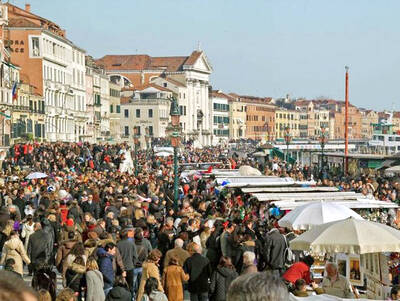
As global travel rebounds following the COVID-19 pa ndemic, the longstanding issue of overtourism has returned stronger than ever. Throughout 2024, numerous popular destinations worldwide struggled with tourist numbers that far exceeded their infrastructural and environmental capacities. Not only does this surge congest streets and pollute landscapes, but it also endangers cultural sites and disrupts the daily lives of residents. In response to the growing problem of “overtourism,” various nations have adopted diverse strategies, some of which have sparked controversy. Venice, Italy, has not hesitated to take bold action; since 2024, the city has implemented one of the

In an effort to fight phone scams, British mobile phone company O2 has introduced Daisy, an AI designed to engage phone con artists in time-wasting conversations. Daisy is portrayed as a kindly British granny, exploiting scammers’ tendency to target the elderly. Her voice, based on a real grandmother’s for authenticity, adds to her credibility in the role. “O2” has distributed several dedicated phone numbers online to direct scammers to Daisy instead of actual customers. When Daisy receives a call, she translates the scammers’ spoken words into text and then responds to them accordingly through a text-to-speech system. Remarkably, Daisy

A: This year’s Met Gala, the Metropolitan Museum of Art’s fundraiser, is coming on the first Monday of May. B: The event, featuring a lineup of stars, is often praised as fashion’s Oscars. A: Some Asian stars, like Taiwanese pop diva Jolin Tsai, have also attended in the past. B: What are the theme and dress code this time? A: This year’s theme is “Superfine: Tailoring Black Style.” It’s the first time since 2003 that the theme is focusing on menswear. The dress code is “Tailored for You.” A: 哇今年的大都會博物館慈善晚宴「Met Gala」,即將在5月第一個星期一登場。 B: 這可是被譽為「時尚奧斯卡」的年度盛事,許多巨星都會參加耶。 A:

A: Isn’t the Met Gala, the Metropolitan Museum of Art’s fundraiser, chaired by Vogue editor-in-chief Anna Wintour? B: Yeah, the blockbuster “The Devil Wears Prada” is allegedly based on her story. A: This year’s four co-chairs are actor Colman Domingo, F1 driver Lewis Hamilton, rapper A$AP Rocky and Louis Vuitton men’s creative director Pharrell Williams. B: And basketball superstar LeBron James is the honorary chair. A: I can’t wait to see the lineup of stars on the red carpet. A: 大都會博物館慈善晚宴「Met Gala」,是《時尚》雜誌全球總監安娜溫圖為該館服裝學院主辦的募款活動吧? B: 對啊,電影《穿著普拉達的惡魔》據說是以她為範本。 A: 今年晚宴共同主席還有:演員柯爾曼多明哥、F1賽車手路易斯漢米頓、饒舌歌手A$AP洛基、LV男裝創意總監菲董。 B: 籃球巨星勒布朗詹姆斯則是榮譽主席。 A: 紅毯上的全球星光真令人期待! (By Eddy Chang, Taipei Times/台北時報張迪)


 RSS
RSS