


Balloon rockets氣球火箭
What you will need
Sticky tape
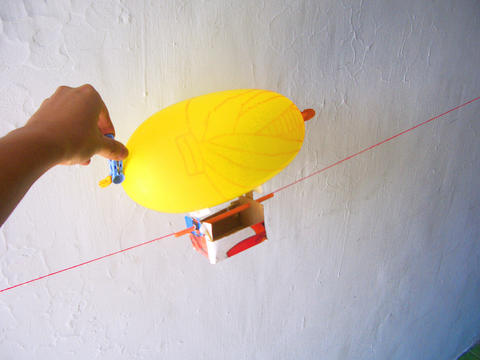
PHOTO: CATHERINE THOMAS, TAIPEI TIMES
A balloon (a long skinny one or shiny one works best)
A clothes peg
A strawv
An old cereal box (or some thin cardboard/stiff paper)
A paper or plastic cup
A long piece of fishing line (Be very careful with this as it is very hard to see once hung up. Smooth string will also work fine.)
Some small items to use as cargo
Scissors
A stopwatch or a watch with a second hand (optional)
*Blow up the balloon to check how big it is. Secure the mouth with the clothes peg.
*Using the cereal box, tape and straw, build a small container to carry your cargo. Think about the size of your balloon and cargo. NOTE: The straw will have the fishing line threaded through it to create the track for your rocket, so include it in a way that allows this!
*Thread the fishing line through the straw.
*Attach the container to the balloon using the tape. Don't use much tape on the balloon.
*Take one end of the fishing line and tape it to the wall at around chest height (be careful, the tape might remove paint from walls.)
*You can either attach the other end of the line to something or hold it. NEVER leave fishing wire up when you are not there. It can cause accidents.
*Put your cargo in the container. Unclip the clothes peg and watch your rocket go. If you have problems check the Further Ideas box.
所需物品:
一個膠布
一個氣球(長條狀或表面磨光的為佳)
一只衣夾子
一根吸管
一個不要的麥片盒(或是薄的厚紙板)
一個紙杯或塑膠杯
一條長的釣魚線(小心使用,因為釣魚線懸掛後就不容易看清楚;你也可以使用圓滑的硬線)
充當貨物的一些小物品
剪刀
一只碼錶或是有秒針的手錶(非必要)
*把氣球吹到適當大小,再用衣夾子把氣球口夾緊。
*用麥片盒、膠布和吸管製造一個裝貨物的小容器。想一想氣球與貨品應該多大才適合。(註︰釣魚線會通過吸管,做為氣球的軌道,所以要想一想吸管的位置該如何擺置!)
*將釣魚線穿過吸管。
*用膠帶把容器貼到氣球上。別貼太多膠帶在氣球上。
*拿起釣魚線的一端,把它貼在牆上距你胸部高度的地方。(小心膠帶可能會讓牆壁掉漆。)
*在釣魚線的另一端繫上物品,或是用手抓住。當你不在場時,絕對別把釣魚線懸起,可能會發生意外。
*把貨物放入容器中。鬆開衣夾子,看火箭飛衝。
(翻譯︰賴美君)
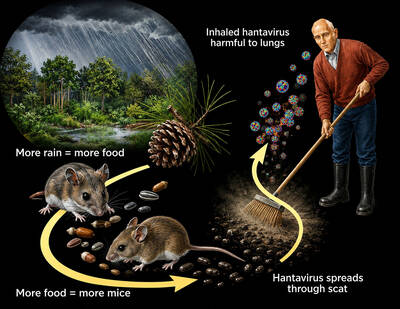
An outbreak aboard a cruise ship of a rare rodent-borne illness called hantavirus has left three passengers dead and sickened others, but global health officials say the risk to the general public remains low because the germ does not easily spread between people. “This is not the next COVID, but it is a serious infectious disease,” said Maria Van Kerkhove, director of epidemic and pandemic preparedness at the World Health Organization (WHO). “Most people will never be exposed to this.” The virus usually spreads when people inhale contaminated residue of rodent droppings. Hantaviruses have been around for centuries and are thought to
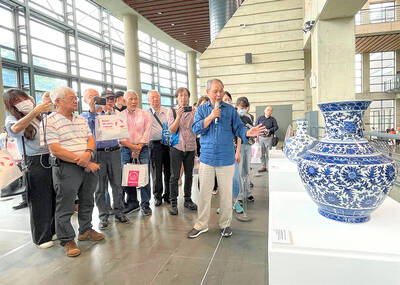
A: Apart from the Danjiang Bridge in New Taipei City, the MRT Sanying Line (Light Blue Line) will open in June. B: Is that the new line leading to Yingge District, the ceramic town? A: Yup, the line will connect the Yingge Ceramics Museum and the Old Streets in Sanxia and Yingge Districts. B: The eastward extension of the Tamsui-Xinyi Line (Red Line) that goes through Taipei’s Xinyi District will also open in June. A: Plus, Taoyuan’s Aerotropolis Line (Green Line) will partially open by the end of the year. In the future, it will connect the

1. 他病了三天。 ˇ He has been sick for three days. χ He has been sick since three days. 註︰這裡現在完成時態 have / has been 表示從過去某一時日到現在的一段時間存在的行為或狀態,與它連用的時間副詞應為 「for +若干時」,如 for a year, for three hours 等,意思是歷時多少。 2. 他自從星期三以來都很忙。 ˇ He has been busy since Wednesday. χ He has been busy from Wednesday. 註︰「自從……以來」,該用 since。說從某一天(某一時刻)到某一天(某一時刻)才用 from,如 from Monday till Friday。 3. 房間角落裡散放著一些零星物件。 ˇ There were some odds and ends lying in the corner of the room. χ There were some odds and ends lying at the corner of the room. 註︰「在房間角落裡」該用介詞 in。例如: He stood in the corner. There is a lamp in the corner of the room. at the corner 指房子外部的拐角。例如: A little boy
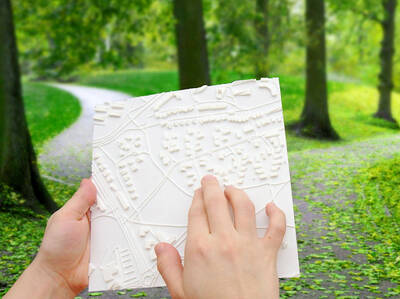
Have you ever wondered how people navigate the world when they can’t see a map? For individuals with visual impairments, conventional maps are nearly impossible to use. This is where tactile maps come in — essential tools that allow people to “see” the world through touch. A tactile map is specially designed with raised lines, textures, and symbols to represent geographical features such as roads, rivers, and buildings. Users explore it with their fingertips. However, these maps are not exclusively for people with visual disabilities. They serve as valuable multisensory learning tools that enhance spatial understanding for everyone, making


 RSS
RSS