


It's one of the first distinctions visitors to France learn to make: the title "Mademoiselle" for young, unmarried women, and "Madame" for other women.
But now a feminist group is trying to scrap the traditional French equivalent of the English "Miss" with an online petition for it to be outlawed, leaving only "Madame" for all adult French women.
"The USA and Great Britain are more advanced than us on this subject," says the petition, put out by a 40-year-old psychoanalyst and supported by the group Les Chiennes de Garde (which means "The Female Guard Dogs" in English).

PHOTO: AP
They argue that France is now ready for change like the English "Ms," which was first introduced into English a couple of decades ago in an effort to get rid of "Mrs" and "Miss."
The petition's author said she resolved to attack the use of "Mademoiselle" when she was forced to sign the title before her name while recently buying an apartment.
She argues on the Web site www.lapetition.com/sign1.cfm?numero=1099 that "Mademoiselle" is discriminatory because it differentiates between women who are sexually available and those who are not, whereas the simple "Monsieur" applied to all adult men does not.
As a result, the petition calls for "Madame" to be used in all cases.
The petition is due to be submitted to the French minister for sexual equality, Catherine Vautrin, within the next few months.
So far, the petition has more than 2,300 electronic signatures, according to Le Parisien newspaper. (AFP)
遊訪法國,首先要學會分別以「Mademoiselle」稱呼年輕未婚女子,以「Madame」稱呼其他女子。
但現在有女性主義團體正連署一份網路請願書,籲請政府明令廢除「Mademoiselle」這個相當於英文「Miss」的傳統用法,只保留適用全法國成年女性的「Madame」。
請願書寫到,「美國和英國在這方面比我們還先進」。該請願書是由一名四十歲的心理分析學家所發表,並得到 Les Chiennes de Garde(英文的意思是「女性看門狗」)團體的支持。
她們主張,法國現在能迎接如英文「Ms」的用法改變。為了擺脫「 Mrs」和「Miss」的用法,英文早在幾十年前就開始使用「Ms」。
請願書的作者說,最近因購買公寓時被迫在名字前簽上「Mademoiselle」,便決心挑戰「Mademoiselle」的用法。
她在網站 www.lapetition.com/sign1.cfm?numero=1099 上主張,「Mademoiselle」將女性依性行為合宜性作區分,有歧視意味,反觀適用所有成年男子的「Monsieur」便無這層意涵。
請願書因此呼籲對女性一律使用「Madame」。
這份請願書預計在未來幾個月內提交給法國性別平等部部長凱薩琳*弗川。
巴黎人報指出,截至目前為止,這份電子請願書有超過兩千三百人連署。 (法新社/翻譯:鄭湘儀)

Taiwan Travelogue, the novel by Taiwanese author Yang Shuang-zi and translated into English by Lin King, won the prestigious International Booker Prize in London on May 19. It marks the first time a Taiwanese literary work has received the International Booker Prize, setting a historic milestone both for Taiwanese literature and for the award itself. Prior to this achievement, Taiwan had only once appeared on the Booker radar, when Taiwanese author Wu Ming-yi was longlisted for the Booker Prize in 2018 with The Stolen Bicycle. The International Booker Prize honors works of fiction translated into English and published in the UK or Ireland.

A: While Taiwan is celebrating the 7th anniversary of legalizing same-sex marriage, a poll shows that the support rate for same-sex marriage rose sharply from 37.4 percent seven years ago to 69.9 percent last year. B: Actually, I’m a bit curious about the size of Taiwan’s LGBT population. A: I’m not sure. But if we take a Gallup poll in the US as an example, 9.3 percent of American adults identified as LGBT in 2024. B: Wow, is it because the Americans are relatively open? In many other countries, the figures hover around 5 percent. A: Based on this,
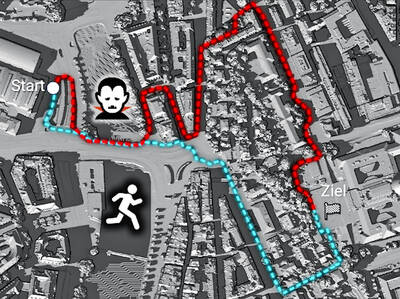
As climate change and urbanization push city temperatures higher, walking outdoors is becoming increasingly uncomfortable in many parts of the world, especially when prolonged time spent in sunlight is involved. As a result, outdoor lovers are now seeking cooler, shaded walking routes. However, most mainstream map apps still do not __1__ shaded footpaths. Enter routing.osm.ch — a Swiss web-based route planner that introduces a novel solution to this problem. Its “Vampire mode,” named after the legendary creatures’ fear of being __2__ natural light, was developed by a Swiss research team led by Professor Stefan Keller. The platform combines open data from

Cities around the world are testing “robotaxis,” hoping that autonomous vehicles will ease traffic and reduce emissions. However, recent analyses suggest these expectations may be overly optimistic. According to consulting firm Kearney, robotaxis could actually make congestion worse rather than better. Because self-driving rides are expected to be cheaper and more convenient than traditional taxis, more people may choose them over walking, biking, or using public transportation. This shift would put more cars on already crowded roads. Another concern is “deadheading,” which refers to robotaxis traveling without passengers between rides. Since autonomous fleets need to reposition themselves throughout the day, these


 RSS
RSS