

Democratic Progressive Party (DPP) Legislator Puma Shen (沈伯洋), the party’s candidate for Taipei mayor, on Wednesday canceled an in-person election-eve rally amid a dispute over road usage rights, with Shen’s campaign manager, Legislator Rosalia Wu (吳思瑤), yesterday saying that the campaign team would instead move the election-eve event online.
The controversy began on Wednesday night, when Shen said in a video statement that he would cancel and tear down the stage constructed for his final campaign rally.
Shen made the announcement following criticism that lane closures implemented from Wednesday morning around the rally site on Renai Road, Sec 4, near Sun Yat-sen Memorial Hall were causing traffic congestion.
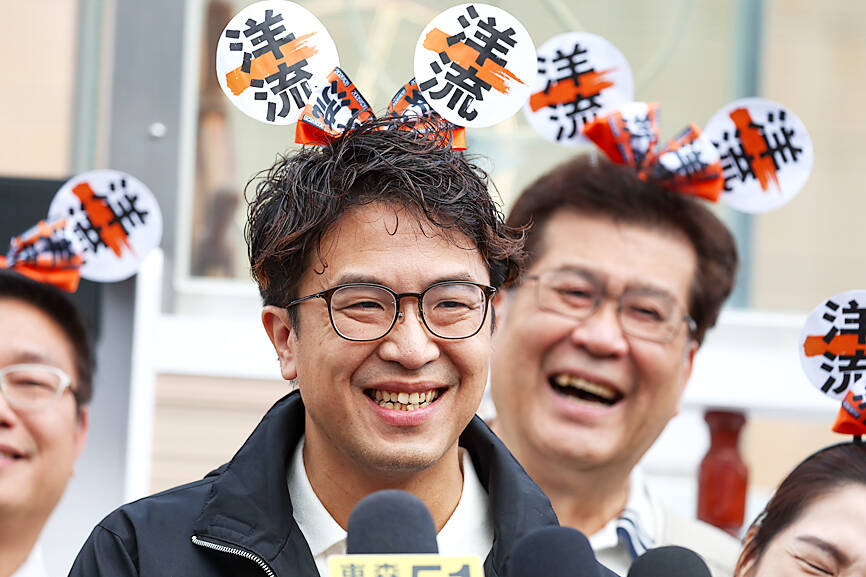
Photo: CNA
Shen said that his campaign had chosen the Renai Road location because other potential sites, such as Ketagalan Boulevard, City Hall Road and near DPP headquarters on Beiping E Road, had all been booked.
DPP supporters said that the other sites were intentionally booked by political rivals.
They cited public application logs, which showed that private individuals booked usage rights to the roads within seconds of them becoming available last month, but had not applied to hold events there.
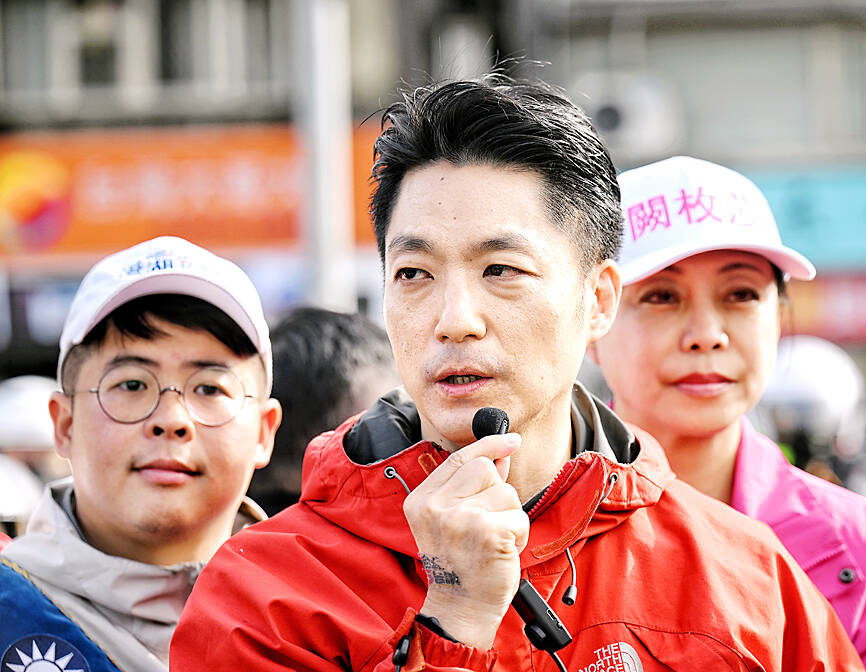
Photo: Fang Pin-chao, Taipei Times
After Shen’s announcement, Taipei Mayor Chiang Wan-an’s (蔣萬安) campaign said in a statement early on Thursday that it had reserved use of City Hall Road today ahead of an election night event.
However, given the situation, the campaign said Chiang was willing to allow Shen to use City Hall Road for his rally today.
Chiang yesterday said he did not want any camp to have regrets over the election, reiterating that if Shen was willing, he could give up his road-use permit for City Hall Road today so Shen could hold his election-eve rally there.

Photo: Screen grab from Puma Shen’s YouTube channel
Shen declined Chiang’s offer to hold a rally on City Hall Road, saying it was not logistically feasible.
Because City Hall Plaza itself cannot be used for political rallies, crowds would inevitably spill over onto Renai Road and disrupt traffic, he said.
Wu yesterday said the decision to cancel the in-person election-eve rally had put the campaign team through an emotional roller coaster.
Following a brief exchange of views on Wednesday, the team reached a clear consensus: The public must come first, Wu said.
Although members felt disappointed and frustrated, they did not struggle much with the decision, she said, adding that whenever faced with a difficult choice, they returned to their principle of putting citizens first, which made the decision easier.
Emotions briefly ran high, given the number of campaign staff, performers and video production professionals who had devoted their time and effort to preparing the event, she said.
The team regretted that the hard work would not come to fruition as planned, but would find a new way to organize the election-eve rally and move forward, Wu added.
Later last night, Shen and former president Tsai Ing-wen (蔡英文) explained the revised arrangements in a livestream.
The election-eve rally was originally scheduled to take place tonight, but plans have been overhauled and the event will now be held as a livestream from 7pm to 10pm, he said.
People are encouraged to get together and watch the livestream, he said.
A system will be launched later to mark locations where groups can gather to watch, he said, adding that each group will appear as a shining star on a map.
“We hope people across Taipei will tune in together, turning the entire city into a sky full of stars,” he said.
Chen Chih-chung (陳致中), son of former president Chen Shui-bian (陳水扁), said on social media yesterday that Taiwan’s election history includes a candidate whose election-eve rally was forced to be canceled, but who went on to win the presidency.
That candidate was his father, he said.
On March 19, 2004, Chen Shui-bian was campaigning in Tainan when he was shot and rushed to hospital for treatment. His election-eve campaign rally was canceled, but he went on to narrowly win that year’s presidential election.
Additional reporting by Chang Tsai-chien
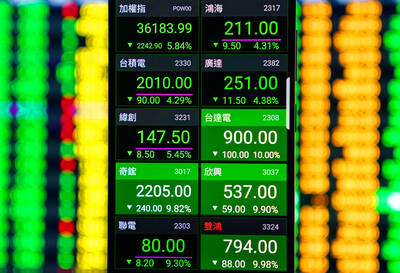
VOLATILITY: The decline in Taiwan’s stock market largely mirrored global markets, and there are no problems with the nation’s economy, the Ministry of Finance said The Financial Supervisory Commission (FSC) yesterday announced that it had further tightened short-selling restrictions after the country’s stock market suffered heavy losses in recent sessions amid global volatility in artificial intelligence (AI)-related stocks. In a statement, the FSC said it had prohibited short-selling of stocks whose prices fell in the previous trading session, marking the first time since 2015 that the commission had imposed such a blanket restriction. The latest measure tightens a restriction announced on Thursday that prohibited short-selling of stocks that had fallen 3.5 percent or more in the previous trading session. The new rule is aimed at

The Legislative Yuan yesterday passed a bill to give NT$20,000 (US$607.24) to members of the public, with the Chinese Nationalist Party (KMT) voting for it, while Taiwan People’s Party (TPP) lawmakers opposed it and Democratic Progressive Party (DPP) legislators running for local office did not vote. The bill, proposed by the KMT caucus, passed 50-46, with all eight TPP lawmakers voting against it. DPP lawmakers at the session also voted against the bill, but the rare show of agreement between the DPP and the TPP failed to block its passage, with 13 DPP lawmakers absent. Almost all of the absent DPP lawmakers were
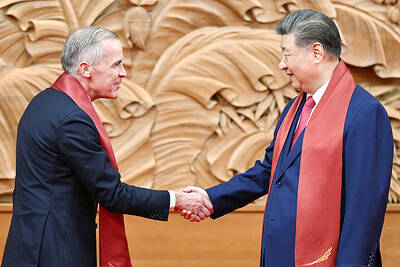
CALL FOR COLLABORATION: ‘We have a high respect of Prime Minister [Mark] Carney’s vision, and we want to be part of this vision,’ the deputy minister of foreign affairs said Canadian Prime Minister Mark Carney risks exposing Canada to the very economic coercion he has cautioned against by deepening trade ties with China, Deputy Minister of Foreign Affairs Chen Ming-chi (陳明祺) said on Saturday, adding that Taiwan has learned the hard way that dependence on Beijing comes with consequences. “We worry. We worry,” Chen said in an interview at the Halifax International Security Forum in Nova Scotia when asked about Carney’s efforts to improve relations with China. Carney has said that major powers are using economic integration as a weapon, citing US tariffs and China’s restrictions on critical minerals. He
STRONG BIPARTISAN SUPPORT: It is the established policy of the US Congress that Taiwan’s future should be decided by its people, US Representative Ami Bera said Bipartisan congressional groups are expected to continue supporting Taiwan in the next US Congress, incoming US House of Representatives Foreign Affairs Subcommittee on East Asia and the Pacific chairman Ami Bera said, reaffirming the longstanding US congressional position that Taiwan’s future should be decided by its people. Bera made the remarks at a seminar hosted by the Washington-based Global Taiwan Institute titled: “If China Seizes Taiwan: Implications for the United States and the World.” The new US Congress is scheduled to take office on Jan. 3, and the Democratic representative from California is expected to chair the subcommittee. Bera said


 RSS