

Taiwan’s economy is forecast to grow 12.34 percent this year and 6.45 percent next year, as sustained global investment in artificial intelligence (AI) continues to fuel exports, business investment and household consumption, the Taiwan Institute of Economic Research (TIER, 台經院) said yesterday.
The Taipei-based think tank raised its forecast for this year and released its projection for next year, citing stronger-than-expected AI investment by US technology giants, despite mounting concerns over the sustainability of the boom and increased volatility in global financial markets.
The AI trend is unlikely to reverse, although the industry is shifting from an investment arms race toward more measured expansion, TIER president Chang Chien-yi (張建一) said at a forum in Taipei.
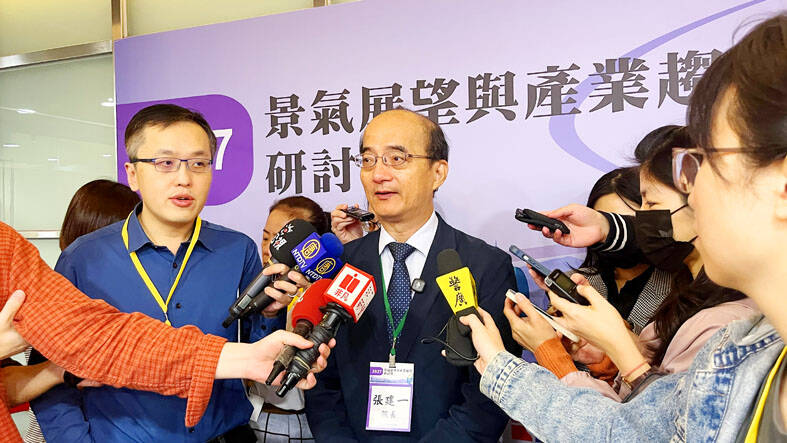
Photo: Liao Chia-ning, Taipei Times
“Occasionally tapping the brakes does not mean the car will stop,” Chang said, adding that moderation in AI investment does not mean the boom is coming to an end.
He described last week’s market sell-off as a short-term correction that could put the industry’s growth on a more sustainable footing.
The results of last week’s US midterm elections could prompt technology companies to reassess their data center expansion plans and improve coordination with local communities, ultimately benefiting the industry’s long-term development, Chang said.
However, AI demand is expected to remain strong in the near term, as many orders have already been secured and many data center projects have obtained permits or are already under construction, he said.
The commitments should sustain growth through the first half of next year, Chang said.
The outlook for the second half would depend on whether market concerns ease, with AI investment likely to keep growing, but at a slower pace than over the past two years, he said.
Broader AI adoption would sustain demand for Taiwan’s semiconductor, advanced packaging and server supply chains, underpinning exports and private investment, TIER said.
Stronger corporate earnings should also bolster household spending by supporting income growth, it said.
Private investment and consumption have emerged as additional growth drivers alongside exports, making Taiwan’s economy more resilient, despite conflicts in the Middle East, TIER Economic Forecasting Center director Gordon Sun (孫明德) said.
Consumer prices are forecast to rise 2.05 percent this year and 1.94 percent next year, with international oil and raw-material prices expected to stabilize next year, TIER said.
The duration of conflicts in the Middle East and the strength of AI investment would be the two main factors shaping Taiwan’s economic outlook, Sun said.
Continued data center expansion and a return to normal shipping through the Strait of Hormuz would support a more optimistic scenario, while a prolonged regional conflict could pose challenges, he said.
Separately, the controversy over an extramarital affair acknowledged by Nvidia Corp CEO Jensen Huang (黃仁勳) is unlikely to derail the broader AI industry or have a major impact on Taiwan’s AI supply chain, even if it damaged his reputation, Chang said.
What investors should closely watch is whether competition from Advanced Micro Devices Inc and other rivals could erode Nvidia’s gross margin, he said.
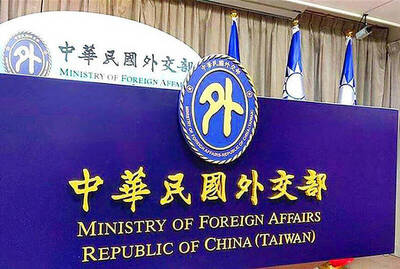
RESTRICTING TAIWAN: Beijing is using coercion and economic incentives to force other countries to accept its claims on Taiwan, the MOFA said The Ministry of Foreign Affairs (MOFA) said yesterday it would close its representative office in Papua New Guinea and stop buying liquefied natural gas (LNG) from the country, citing Chinese pressure. Papua New Guinea’s minister of foreign affairs in July said the government had decided to close Taiwan’s representative office in the country immediately, winning praise from China, although the office had remained open in the interim. Taiwan has decided to shut the office and withdraw all personnel on the basis of national dignity, diplomatic autonomy and the country’s overall interests, the MOFA said, adding that the government will reassess and adjust
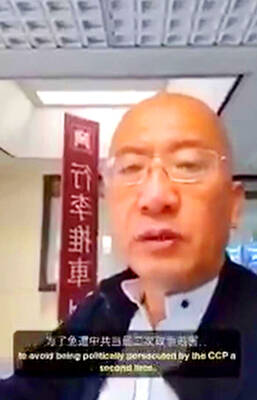
Chinese national Cheng Wanjun (程萬軍), who was at Taiwan Taoyuan International Airport after arriving on a connecting flight from Thailand on Monday and sought asylum in Taiwan, was deported to Thailand early yesterday, the National Immigration Agency (NIA) said. In a video circulating on X, Cheng identified himself as a former host at China Central Television (CCTV) and said he was seeking temporary humanitarian protection in Taiwan. Cheng said he was sentenced to six years in prison after he was recorded and reported to authorities in 2019 for criticizing “a ruler who loses his country.” After his release, he was forced to go
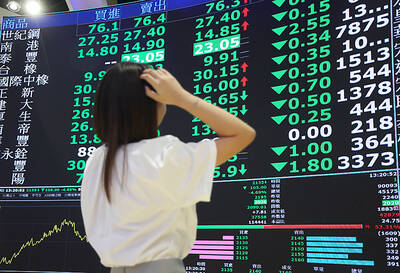
PLUMMETING: The TAIEX plunged 3,737.67 points in early session yesterday, the largest intraday drop in history, and closed down 1,873.08 points due to AI data center concerns The government yesterday authorized the activation of its NT$500 billion (US$15.26 billion) National Stabilization Fund (NSF) to support local shares, as the stock market experienced significant fluctuations while uncertainties in the international political and economic situation continue. The NSF’s steering committee may use the fund to intervene in the market to prop up local shares, the Ministry of Finance said in a statement. Once the fund is activated next week, it would be the 10th time the NSF has intervened in the market. Separately, the Financial Supervisory Commission (FSC) yesterday announced temporary curbs on short selling shares and other measures to help
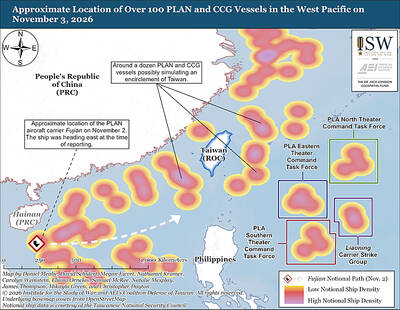
COORDINATED: More than 100 Chinese ships have been reported in the west Pacific, with two main clusters seen between Taiwan and its neighbors, the report said China might be conducting a major, unannounced military exercise simulating the isolation of Taiwan that is larger than the Chinese People’s Liberation Army’s (PLA) “Justice Mission 2025” exercise, the American Enterprise Institute and the Institute for the Study of War said in a joint report released on Friday. The rumored military exercise includes PLA forces from the eastern, northern and southern theater commands, possibly representing an effort to coordinate surface combatants from all three coastal theater commands into a single far-seas operation, the report said. The report cited National Security Council Secretary-General Joseph Wu (吳釗燮), who on Tuesday last week said


 RSS