

The fifth plenum of the Chinese Communist Party’s (CCP) 20th Central Committee and Taiwan’s election debates highlighted a stark contrast between China’s centralization of power and Taiwan’s democracy, Mainland Affairs Council (MAC) Deputy Minister Shen Yu-chung (沈有忠) said yesterday.
Differences in political systems are the most fundamental issue in cross-strait relations, which have nothing to do with similarities in culture, language or ethnicity, he said.
Shen made the remarks at a forum held by the Secure Taiwan Associate Corporation to discuss possible developments in China’s domestic political situation following the fifth plenum, and their implications for Taiwan.
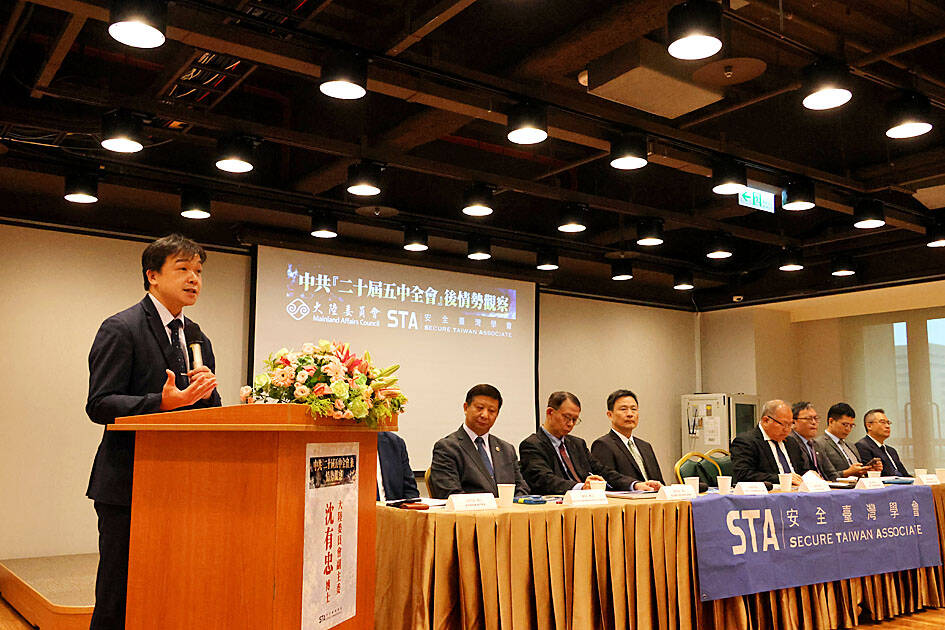
Photo: Fang Wei-li, Taipei Times
The theme of the plenum, which concluded on Thursday last week, was “unswerving promotion of the full and rigorous party self-governance,” a move by Chinese President Xi Jinping (習近平) to further bolster the CCP’s leadership and consolidate his authority ahead of next year’s 21st CCP National Congress, Shen said.
The MAC’s analysis of the plenum can be summarized into four points, he said.
First, the “Xi Jinping thought on party building” was established as a political guiding principle, further consolidating Xi’s unchallengeable position as the party’s leader, Shen said.
The plenum confirmed earlier decisions to expel 33 officials from the party, including former senior military leaders Zhang Youxia (張又俠) and Liu Zhenli (劉振立), he said, adding that accusations against them, including failing to implement central policies and engaging in duplicity and disloyalty, demonstrated that anyone who is insufficiently loyal to Xi or deviates from his ideology and directives would be purged.
Second, the MAC believes that “strict party governance” aims to ensure the CCP’s long-term rule and preserve its one-party dictatorship, Shen said.
Whether it is political, organizational, integrity or work discipline, all rules must be based on monitoring and ensuring that party members and officials obey the CCP, he said, adding that the development of China’s constitutional system, and the protection of people’s rights and interests take a back seat to the goal of consolidating the CCP’s one-party rule.
Third, the promotion of “the party’s self-revolution” represents a rejection of external oversight by the public, media and civil society, Shen said.
Although the authenticity of posts that students from more than 10 Chinese universities had allegedly signed a petition calling for the abolition of the indefinite term for the president remains unverified, they signaled that the party’s leadership is not subject to any external oversight, he said.
Xi might respond to academic activities or social movements with further legal measures or intensified surveillance, he added.
The CCP has fully internalized its oversight mechanisms within the party’s disciplinary and supervisory systems, rejecting democratic checks and balances in the name of “self-correction within the party,” he said.
Fourth, moves to eliminate dissenting voices have paved the way for Xi to secure a fourth term at next year’s 21st National Congress, Shen said.
The number of Central Committee members and alternate members absent from the plenum reached a new high since the era of Mao Zedong (毛澤東), he said.
Large-scale purges of senior party, government and military officials over the past few years have removed potential political obstacles to Xi’s ambitions, ensuring he can continue on to a fourth term with the party’s full endorsement, he added.
While the plenum unfolded in Beijing, many in Taiwan were focused on the mayoral debates in Taipei and Kaohsiung, highlighting the fundamental differences between the political systems on the two sides of the Strait, Shen said.
The CCP’s fifth plenum demonstrated the consolidation of power and the growing dominance of Xi’s leadership, he said, adding that Taiwan’s lively mayoral debates would be impossible in China.
Shen urged Taiwanese to recognize these institutional differences and unite against authoritarian aggression, build a shared commitment to protecting freedom, democracy and national sovereignty to ensure that Taiwan can continue to deepen its democracy, prosperity and development amid the CCP’s multifaceted pressure campaign.
With local elections entering their final campaign phase, the government would continue to closely monitor developments within the CCP and shifts in its power structure, while preventing and exposing various forms of Chinese election interference, he said.
It will also continue to counter China’s cognitive warfare, transnational repression and attempts to infiltrate and divide Taiwanese society, while defending national sovereignty, freedom, security and the democratic way of life, he added.

Taiwanese gymnast Tang Chia-hung (唐嘉鴻) on Sunday won gold in the men’s horizontal bar final at the Artistic Gymnastics World Championships in Rotterdam, the Netherlands. Tang scored 14.966 in the final. He had advanced to the final in second place with a score of 14.566 points in qualifying, with a difficulty score of 6.000 and an execution score of 8.566. In the final, he raised his difficulty score to 6.600, the highest among the eight finalists. Although he did not fully steady himself on landing, his score was still enough to claim the gold medal. Taiwan had previously won two silver medals and

EYE ON 2027: The US military has placed equipment, materiel and personnel on the islands near China, a US officer said while warning about the threat from China The US Army Pacific (USARPAC) is deploying forces and equipment across the region based on the assumption that Beijing could possess the military capability and the intent to invade Taiwan by next year, a top US commander said on Tuesday. Speaking at the TechNet Indo-Pacific conference in Honolulu, US General Ronald Clark said that the threat posed by the so-called “Davidson window” is “still valid,” US military newspaper Stars and Stripes reported on Wednesday. The term stems from a 2021 warning by Admiral Philip Davidson, then-head of the US Indo-Pacific Command, that the threat of Chinese military action against Taiwan could materialize
CALL FOR NEW MEASURES: Transnational repression should not just be treated as violation of individual rights, but as offenses against national interests, an official said Any Hong Kongers who collaborate with China to carry out transnational repression in Taiwan would have their Taiwanese citizenship or residency revoked, an official familiar with the matter said yesterday. The comment came after the Taipei District Prosecutors’ Office on Oct. 7 issued arrest warrants for two Hong Kongers, who allegedly in 2024 hired a Taiwanese private investigation agency to surveil Democratic Progressive Party (DPP) Legislator Puma Shen (沈伯洋). Two Taiwanese private investigators, Cheng Yung-chin (鄭永津) and Hsieh Yi-chen (謝乙辰), were indicted on charges of illegally collecting and using personal data under the Personal Data Protection Act (個人資料保護法), alongside two

‘ONE CHINA’ DECISION: A Cabinet spokesperson said that Pakistan had pandered to Beijing, and disregarded international rules and reality with the overflight ban The first Taiwanese commercial aircraft since restrictions were lifted flew over Pakistan yesterday morning following an abrupt U-turn by authorities to approve permits that were briefly revoked due to Islamabad’s “one China” policy. EVA Airways (長榮航空) Flight 65 from Taipei to Vienna entered Pakistani airspace at about 3:30am local time, Flightradar24 tracking data showed. All other Europe-bound EVA Air and China Airlines (華航) flights that departed late on Wednesday night into early yesterday morning opted to use Russian airspace, or go via India. The airlines had been forced to detour, including flying over Russia, since Sunday, after Pakistan shut its airspace to Taiwanese


 RSS