

The Ocean Affairs Council (OAC) yesterday said it is funding a National Cheng Kung University (NCKU) team to develop an artificial intelligence (AI)-powered system to coordinate different types of drones to enable wide-area maritime surveillance and sustained monitoring.
Developing a multilayered coast guard surveillance network and enhancing maritime domain awareness are core strategies to address maritime law enforcement needs and various forms of “gray zone” harassment from China, the council said.
Regional conflicts in the past few years have shown that drone technology has evolved from single-aircraft operations to coordinated missions involving multiple types of drones and fleets operating in swarms, it said.
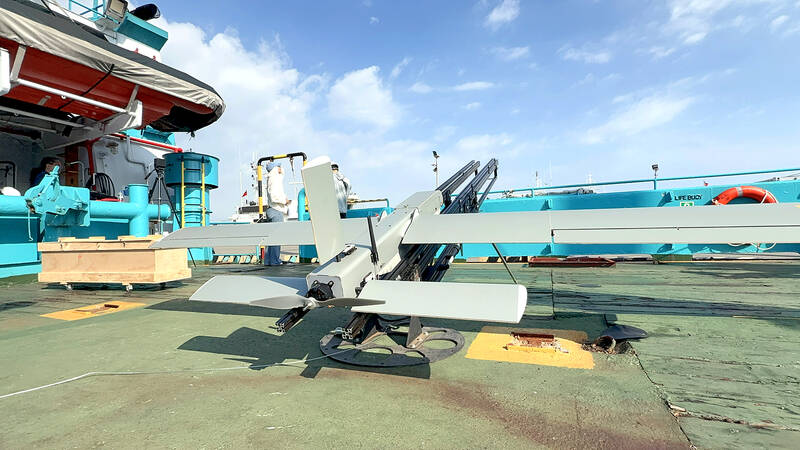
Photo courtesy of the Ocean Affairs Council
The AI-powered drone swarm system being developed by the research team achieved a breakthrough by coordinating different drone fleets, providing wide coverage and continuous monitoring over territorial waters, the council said.
“This system would bolster Taiwan’s maritime defense, rescue capabilities and whole-of-society defense resilience,” it said. “It has laid a solid technical foundation to build a smart and multilayered coast guard patrol system and demonstrated Taiwan’s research and development capacity in marine technology and smart aerospace sectors.”
The team, led by the university’s aeronautics and astronautics associate professor Chueh Chih-che (闕志哲), built an intelligent multiple drone operating system by integrating AI, vertical takeoff and landing fixed-wing drones, flight dynamics, and swarm coordination and control technology.
The team explored the strengths and control models of three types of drones used in the project — Jump 20, V-Bat and Flexroter — through 3D shape modeling, aerodynamic parameter analysis and “six degrees of freedom” flight simulation, the council said.
The team further used AI multi-agent reinforcement learning technology to enable multiple drones to autonomously assign missions, plan flight paths and coordinate with one another, flying in formation like a flock of geese.
To improve formation flexibility and flight safety, the research team incorporated “leader-follower formation control” and “intelligent dynamic obstacle avoidance,” enabling the drone swarm to adjust its flight path according to mission requirements and autonomously respond in real time to sudden environmental changes or obstacles, the council said.
The team has completed simultaneous flight simulations of two drone fleets, comprising a total of 20 drones, it said.
To avoid drone swarm collisions, the team has incorporated into its control algorithm the 3D separation distance and a minimum vertical separation of 30.5m, the council said.
The team would further test the reliability and feasibility of drone fleets under different marine environments by conducting hardware-in-the-loop and prototype integration tests, as well as real-world flight tests over open water, it said.

FRIDAY, SATURDAY: While Typhoon Champi might weaken, officials warned about large waves, while some transport services and tourist spots have been affected Typhoon Champi is forecast to have the greatest effect on Taiwan tomorrow and on Saturday, with a sea warning issued late last night and a land warning expected afternoon today, the Central Weather Administration (CWA) said yesterday. The storm’s projected track has shifted slightly westward and it could begin moving away from Taiwan toward Japan’s Kyushu island on Saturday, with the warnings potentially lifted as early as Saturday afternoon, CWA forecaster Chang Cheng-chuan (張承傳) said. As of yesterday afternoon, Champi was about 910km east-southeast of Oluanpi (鵝鑾鼻), Taiwan proper’s southernmost point, CWA data showed. Its maximum sustained winds had weakened slightly to
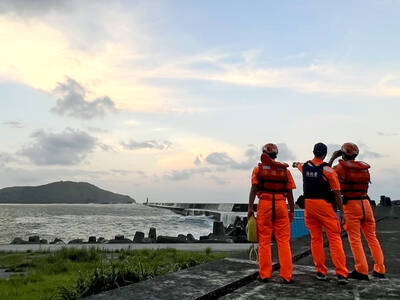
The Coast Guard Administration (CGA) yesterday urged China not to exploit typhoons to assert jurisdiction over the Taiwan Strait. The CGA issued the remarks after it found that China was shadowing eight Japan Coast Guard ships that sheltered in Taiwan proper’s western waters due to Typhoon Champi. Eight Japan Coast Guard (JCG) vessels sailed southward along the Taiwan Strait median line from 6am on Thursday, reaching waters southwest of Penghu County’s Cimei Island (七美島), outside Taiwan’s contiguous zone, which extends 24 nautical miles (44.4km) from the territorial sea baseline, it said. As the Japanese ships prepared for the typhoon, they were followed by
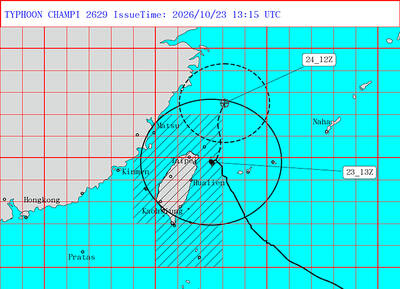
STAY CAUTIOUS: Rain is expected to begin easing this afternoon, but a CWA forecaster said that if the storm stalls or loops on its approach, heavy winds are likely Typhoon Champi, which caused widespread damage and injuries, and prompted road closures and evacuations across Taiwan yesterday, is expected to continue to bring heavy rain this morning, with up to 900mm of rain forecast for mountainous areas of New Taipei City, Taoyuan and Yilan County, the Central Weather Administration (CWA) said yesterday. At one point a super typhoon and one of the strongest storms in the Pacific this year, Champi was packing gusts of about 191kph near its center as of 8:30pm, the CWA said. Taipei, New Taipei City, Keelung, Taoyuan, Hsinchu city and county, Taichung; and Yilan, Miaoli, Changhua, Nantou, Yunlin
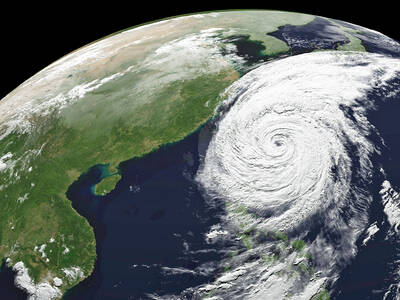
TOTAL COVERAGE: Champi’s outer band is expected to blanket the entire nation, with the center coming closest tonight or tomorrow before leaving tomorrow evening School and work across most of the nation has been canceled today, as Typhoon Champi is expected to skirt the northeast edge of Taiwan proper. As of 9pm, all municipalities except for Kinmen County had announced cancelations. Taitung County last night announced closures on Green Island (綠島) and Orchid Island (Lanyu, 蘭嶼), but did not announce for the rest of the county until 6am today. Stock market settlements scheduled for today would be postponed to the next business day, the Taiwan Stock Exchange said. The announcements came after the Central Weather Administration (CWA) yesterday expanded its land warning for Champi to 19 regions


 RSS