

Hackers with links to China compromised a regional organization in Fiji, the Pacific nation’s US embassy said yesterday, warning that governments and telecommunication networks in the region were also being targeted.
Fiji is emerging as a major telecommunications hub in the Pacific islands, as Google expands a network of subsea cables connecting the US military outpost of Guam, US defense ally Australia, French Polynesia and the mainland US, via Fiji’s capital, Suva.
Fijian Minister of Police and Communication Ioane Naivalurua said he was reviewing the situation after the US embassy announced that a “regional organization in Suva” had its network hacked between July and August.
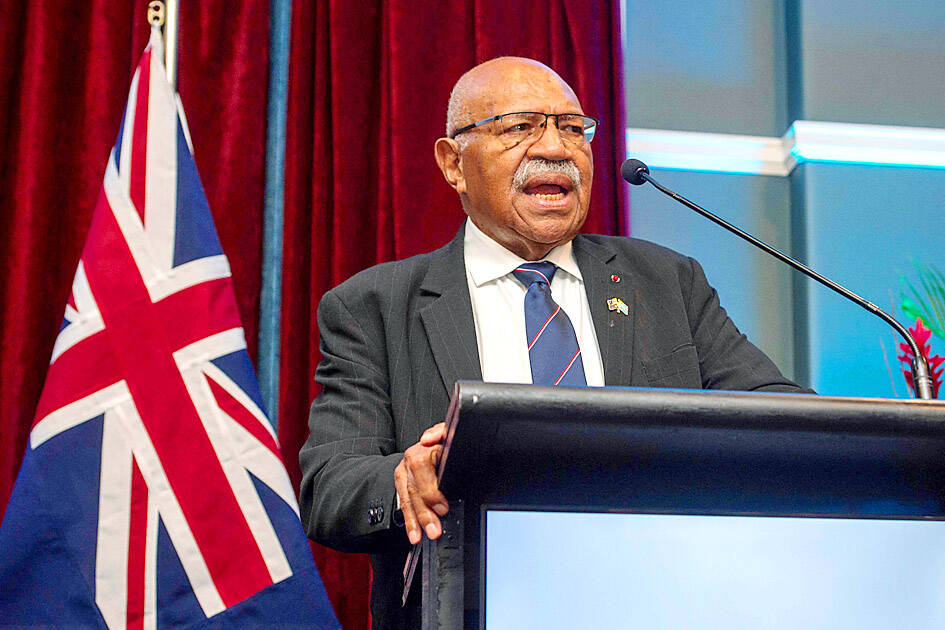
Photo: AFP
“Hackers with links to China maintained access to the organization’s network over several days,” the embassy said in a statement posted on Facebook, without identifying the organization.
US officials have previously urged cable host Fiji to boost cybersecurity to guard against data risks from China.
Naivalurua said that police were investigating the reported attack and urged governments, organizations and the private sector to “take preventative action and harden the security of their respective digital systems.”
In Beijing, Chinese Ministry of Foreign Affairs spokeswoman Mao Ning (毛寧) said the ministry was not aware of the case, but that it “firmly opposes hacking activities and cracks down on them in accordance with the law.”
“At the same time, we also oppose using cybersecurity issues to smear China,” Mao told a regular briefing.
Fiji’s government on Friday asked the US to provide evidence for its claim last week that a Chinese state agency employee living in Fiji had paid bribes on behalf of Beijing.
The US Department of State accused the man living in Suva of “significant corruption.”
The US embassy yesterday pointed to action taken by the FBI in August to combat China-sponsored hackers targeting critical infrastructure in the US.
The FBI action “matters directly for the Pacific,” the embassy said.
A group of hackers called QTFY included former members of China’s military, working for a company paid by the Chinese Ministry of State Security, had targeted NASA, the US Department of Energy and power companies, an FBI affidavit said.
China-linked hackers were targeting foreign governments, organizations and telecommunications networks in the Pacific islands, the embassy wrote on Facebook.
The region’s political bloc, the Pacific Islands Forum, said it was not the organization that had been hacked.
“While the Pacific Islands Forum Secretariat is not affected, cybersecurity is increasingly important to the Pacific as the region’s digital security is closely linked to its economic resilience, national sovereignty, regional security, and wellbeing of Pacific communities,” a forum spokeswoman said.
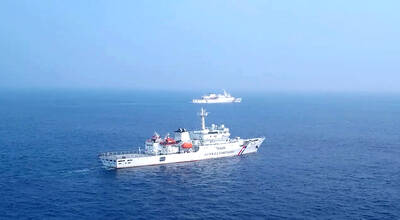
PATROL PARTNERS: The ‘Chiayi’ and the ‘Penghu’ departed for a two-day joint patrol of Palau’s exclusive economic zone, the CGA’s second diplomatic visit to the country The Coast Guard Administration (CGA) set a record for its southernmost deployment of a coast guard vessel as the vessels Chiayi and the Penghu reached Palau’s Pulo Anna Island on Saturday in a cooperative exercise between the two countries. The island, about 217 nautical miles (401km) southwest of Koror in the Palauan state of Sonsorol and 1,220 nautical miles from Taiwan’s southernmost point, Oluanpi (鵝鑾鼻), is the furthest south a CGA vessel has sailed. The two vessels are in Palau for the coast guard’s second diplomatic visit to the country. They docked at Malakal Harbor on Tuesday last week. The coast guard
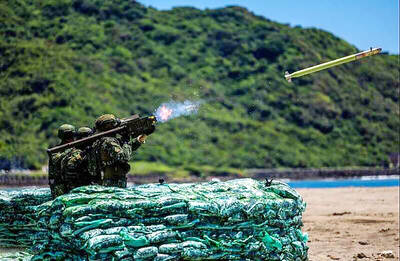
BATCH 1: The military has plans to assign the weapons to the army to defend Taiwan proper, as well as outlying islands and the navy for the Marine Corps, the official said Taiwan is to receive 500 Stinger missiles and 178 launchers from the US by the end of the year, the first batch under a planned two-stage acquisition totaling 2,621 missiles and 763 launchers, a defense official said yesterday on condition of anonymity. The portable missiles would play a vital role in the nation’s air defense capabilities, the source said. The army plans to deploy 2,235 missiles and 657 launchers to defend Taiwan proper and outlying islands, they said, citing military documents. The navy is allotted 295 missiles and 85 launchers to arm the Marine Corps and some surface vessels that lack air defense

The European Parliament on Wednesday adopted a recommendation on EU-China political relations that rejected China’s efforts to restrict Taiwan’s participation in international organizations and exchanges. The recommendation, addressed to the European Council, the European Commission and EU High Representative for Foreign Affairs and Security Policy Kaja Kallas, includes several references to EU-Taiwan relations and expresses support for closer ties, saying they would bring positive benefits and have strategic importance. Describing Taiwan as a valuable partner in trade and technology, the European Parliament said it “rejects China’s attempts to coerce international organizations, third countries and other actors into restricting Taiwan’s international participation and
‘EQUALS’: The ROC and PRC are not subordinate to each other, which is the consensus among Taiwanese, who are the only ones who can decide Taiwan’s future, MOFA said Taiwan yesterday urged China to stop its hostile rhetoric toward Taiwan as the US welcomed President William Lai’s (賴清德) commitment to Taiwan Strait stability in his Double Ten National Day speech. Lai on Saturday described Taiwan as a “city upon a hill” and said that “Taiwan cherishes peace, but we will not give up our freedom. We are open to exchanges, but will not accept subordination.” China’s Taiwan Affairs Office said Lai’s speech “disregards facts, distorts the truth, misleads the public and reveals ulterior motives.” Taiwan is part of China and Taiwan’s future “can and must be decided jointly by all the


 RSS
RSS