

Taiwan yesterday condemned China for interfering in other nations’ sovereignty and foreign policy through political coercion after Beijing sanctioned ministers from Paraguay and Belize over their diplomatic relations with Taiwan.
Paraguay and Belize are two of just 12 countries to maintain formal diplomatic relations with Taiwan.
At a routine news briefing in Beijing yesterday, Chinese Ministry of Foreign Affairs spokeswoman Mao Ning (毛寧) said the sanctions against Paraguayan Minister of Information and Communication Technologies Gustavo Villate and Belizean Minister of Foreign Affairs Francis Fonseca were designed to “penalize them and serve as a warning to others.”
Photo: Lu Yi-hsuen, Taipei Times
“Certain politicians in Paraguay and Belize have willingly served as pawns of the Taiwan authorities in their attempts to seek independence through external support,” she said.
The measures against the Latin American ministers include the freezing of their assets in China, visa denials and the banning of Chinese organizations from doing business with them, the Chinese Ministry of Foreign Affairs said earlier.
The ministers had “taken a series of egregious actions and statements ... damaging China’s core interests,” it said, adding that the sanctions were to “safeguard national security” and “oppose separatist activities.”
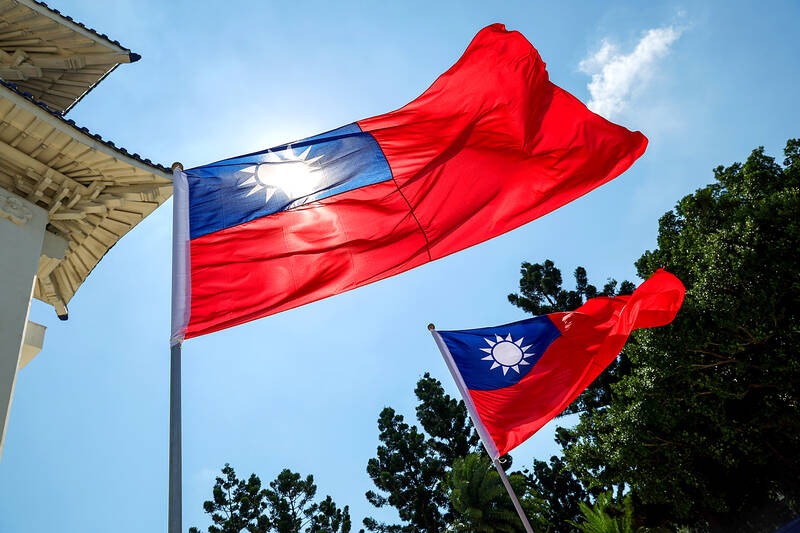
Photo: Ritchie B. Tongo, EPA
The move comes two days after Taiwan celebrated the Double Ten National Day, with President William Lai (賴清德) delivering a speech that promoted the nation’s increasing investment in defense.
Villate marked the Double Ten National Day on social media saying: “Paraguay reaffirms its relationship of friendship and cooperation, based on shared values and principles: the self-determination of peoples, human rights and democracy.”
Fonseca last month met Minister of Foreign Affairs Lin Chia-lung (林佳龍) in Belize.
In June, Villate met Deputy Minister of Foreign Affairs Chen Ming-chi (陳明祺) in Paraguay.
Neither the Paraguayan minister of communications nor the Belizean foreign ministry immediately responded to requests for comment outside of regular office hours.
In Taipei, the Ministry of Foreign Affairs condemned China’s sanctions against the two minister, describing the Chinese Ministry of Foreign Affairs’ statement as utterly absurd.
The move openly interfered in other countries’ sovereignty and foreign policy, violated the principles of international law, and showed Beijing’s attempt to force other nations to submit to its political agenda through intimidation and transnational repression, it said.
The foreign ministry reiterated that Taiwan is a sovereign, independent country, and that it and the People’s Republic of China are not subordinate to each other. This is an internationally recognized fact and an objective reality across the Taiwan Strait, it said, adding that China has no right to interfere in Taiwan’s diplomatic relations.
It said Taiwan’s engagement with countries such as Belize and Paraguay has always been based on equality, mutual benefit and respect for each other’s sovereignty, principles it described as a consensus in the international community and a fundamental norm of international relations.
China’s coercive tactics only expose its high-handed and unreasonable behavior, make the world more aware of Beijing’s efforts to undermine the international order through hegemonic practices, and strengthen Taipei’s diplomatic allies in their resolve to support Taiwan, it said.
Hung Pu-chao (洪浦釗), director of the Center for Global Strategy and Democratic Resilience at the University of Taipei, said that Chinese President Xi Jinping (習近平) last month said at the BRICS summit that international rules should be written collectively by all countries, and that the logic of “might makes right” no longer works and should have been abandoned long ago.
By Xi’s own standards, China’s latest actions amount to the very power politics that Xi himself has said should be abandoned, Hung said.
The sanctions also show how China uses its domestic laws as a tool to exert pressure on other countries, he added.
Additional reporting by Chen Yu-fu
PATROL PARTNERS: The ‘Chiayi’ and the ‘Penghu’ departed for a two-day joint patrol of Palau’s exclusive economic zone, the CGA’s second diplomatic visit to the country The Coast Guard Administration (CGA) set a record for its southernmost deployment of a coast guard vessel as the vessels Chiayi and the Penghu reached Palau’s Pulo Anna Island on Saturday in a cooperative exercise between the two countries. The island, about 217 nautical miles (401km) southwest of Koror in the Palauan state of Sonsorol and 1,220 nautical miles from Taiwan’s southernmost point, Oluanpi (鵝鑾鼻), is the furthest south a CGA vessel has sailed. The two vessels are in Palau for the coast guard’s second diplomatic visit to the country. They docked at Malakal Harbor on Tuesday last week. The coast guard
BATCH 1: The military has plans to assign the weapons to the army to defend Taiwan proper, as well as outlying islands and the navy for the Marine Corps, the official said Taiwan is to receive 500 Stinger missiles and 178 launchers from the US by the end of the year, the first batch under a planned two-stage acquisition totaling 2,621 missiles and 763 launchers, a defense official said yesterday on condition of anonymity. The portable missiles would play a vital role in the nation’s air defense capabilities, the source said. The army plans to deploy 2,235 missiles and 657 launchers to defend Taiwan proper and outlying islands, they said, citing military documents. The navy is allotted 295 missiles and 85 launchers to arm the Marine Corps and some surface vessels that lack air defense
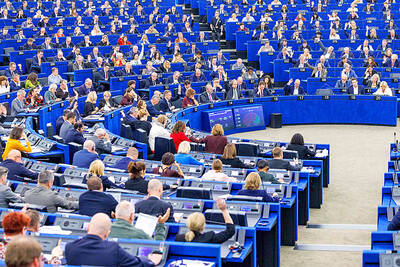
The European Parliament on Wednesday adopted a recommendation on EU-China political relations that rejected China’s efforts to restrict Taiwan’s participation in international organizations and exchanges. The recommendation, addressed to the European Council, the European Commission and EU High Representative for Foreign Affairs and Security Policy Kaja Kallas, includes several references to EU-Taiwan relations and expresses support for closer ties, saying they would bring positive benefits and have strategic importance. Describing Taiwan as a valuable partner in trade and technology, the European Parliament said it “rejects China’s attempts to coerce international organizations, third countries and other actors into restricting Taiwan’s international participation and
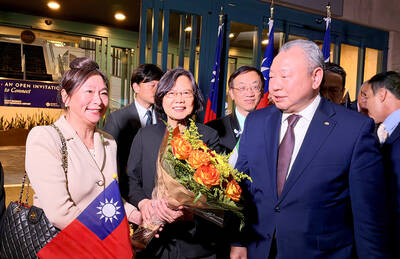
Former president Tsai Ing-wen (蔡英文) on Monday arrived in San Francisco, receiving a warm welcome from hundreds of overseas Taiwanese as she launched a week-long visit. Accompanied by Representative to the US Alexander Yui (俞大?), and head of Taiwan’s San Francisco office Wu Chih-hsiang (伍志翔), Tsai arrived at her hotel, waving, smiling and giving high-fives to Taiwanese compatriots amid cheers of “Taiwan’s democracy involves you and me” to welcome her to the San Francisco Bay Area. It is Tsai’s first visit to the US since she left office in May 2024 after serving two four-year terms as president. Tsai is today to deliver


 RSS
RSS