

Taiwan offers the global democratic community much more than just semiconductors, former president Tsai Ing-wen (蔡英文) told an audience at Stanford University’s Hoover Institution in San Francisco on Thursday, while defending her “boring” leadership style as a necessary asset to find common ground.
Tsai spoke about how Taiwan has managed differences, responded to crises and built societal resilience.
Discussions about Taiwan often focus on semiconductors, artificial intelligence (AI), cross-strait relations, the risk of conflict and occasionally touch on its popular food and drinks, she said.
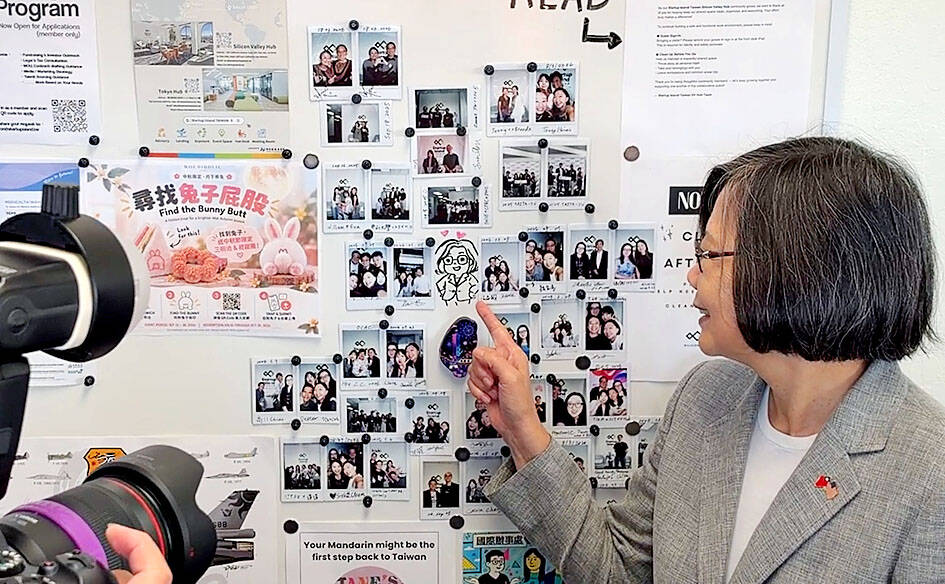
Photo: CNA
However, those topics are only part of the story, Tsai said, pointing to the nation’s 23 million people and their experience of building a democracy under challenging circumstances.
“That experience has shaped who we are and continues to shape how we approach the future,” she said.
Democracies face growing challenges from outside and within, as increasingly sophisticated authoritarian influence campaigns coincide with domestic populism and political polarization, she said.
The domestic divisions make it harder to reach a consensus on how to respond to outside threats, she added.
Tsai also warned that advances in AI have lowered language barriers, making it easier to spread disinformation across borders.
“Ill-intentioned actors, especially from outside, use social media platforms to spread false and misleading information to drive a wedge between fellow citizens, between societies and their governments, and even between countries,” she said.
However, decades of external pressure and intense domestic political competition have taught Taiwan how to safeguard democracy while keeping its institutions open and its society resilient, Tsai said.
Taiwan has moved from authoritarian rule to its first direct presidential election in 1996 to become the vibrant democracy it is today, she said.
“That transition taught us how to confront deep political differences without allowing those differences to make democratic progress impossible,” she said.
Managing relations with China has required preparedness and restraint, Tsai said, adding that decades of pressure from Beijing have made Taiwan more resilient and pragmatic.
Although Taiwanese hold differing views on what form relations with China should take, there is a consensus on maintaining the cross-strait “status quo,” avoiding unnecessary provocation, and protecting Taiwan’s democracy and security, she said.
“Democracy, resilience and partnership are the foundation of our collective future,” Tsai said, adding that no amount of threats or coercion would shake Taiwan’s determination to engage with and contribute to the world.
While some people described her as “boring” during her time as president, Tsai said that “being boring can be useful” in an era of increasing political polarization in which provocation attracts more attention than restraint.
This is especially true when needing to ensure Taiwan’s security while finding enough common ground to keep democracy moving forward, she added.
Tsai arrived in the US on Monday and is scheduled to return to Taiwan tomorrow.
Additional reporting by Su Yung-yao
SHIFTING COOPERATION: With the new arrangement, US representatives would be able to participate directly in defense discussions, including weapons procurement Taiwan-US military cooperation is deepening, with the Pentagon expected to station personnel at the Ministry of National Defense (MND), sources said. The NT$470 million (US$14.77 million) joint program is scheduled to run from this year through 2028, under which the Pentagon would dispatch representatives from the Office of the Under Secretary of Defense for Policy and the Institute for Defense Analyses, a senior military official said on condition of anonymity, adding that one representative from each organization would be stationed at the ministry’s headquarters. The Office of the Under Secretary of Defense for Policy is one of the US’ bodies responsible for
The Presidential Office today condemned China's transnational repression after an alleged Chinese foreign agent was arrested in California yesterday on suspicion of surveilling President William Lai's (賴清德) son, Lai Ting-yu (賴廷與), the FBI said. The 34-year-old woman, named Wanying Heather Zhang (張婉瑩), was arrested on suspicion of acting as an unregistered foreign agent, US news agency CBS reported. She was apprehended at Los Angeles International Airport yesterday attempting to fly to Shanghai, it said. This represents a “typical case” of China’s transnational repression, Presidential Office spokeswoman Karen Kuo (郭雅慧) said today. "Our country expresses the strongest condemnation of such barbaric conduct that
Former president Tsai Ing-wen (蔡英文) on Monday arrived in San Francisco, receiving a warm welcome from hundreds of overseas Taiwanese as she launched a week-long visit. Accompanied by Representative to the US Alexander Yui (俞大?), and head of Taiwan’s San Francisco office Wu Chih-hsiang (伍志翔), Tsai arrived at her hotel, waving, smiling and giving high-fives to Taiwanese compatriots amid cheers of “Taiwan’s democracy involves you and me” to welcome her to the San Francisco Bay Area. It is Tsai’s first visit to the US since she left office in May 2024 after serving two four-year terms as president. Tsai is today to deliver
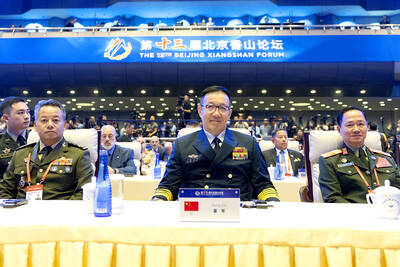
Light attack aircraft and military vehicles have arrived at a new China-Laos joint training facility announced on Tuesday last week, according to satellite images reviewed by Reuters. The images, taken by commercial satellite provider Vantor, show what security analysts believe are eight K-8 light attack jets and more than two dozen support vehicles on a runway that is still being built — China’s latest expansion of its overseas military presence. Taken on Wednesday last week — the day after the Chinese Ministry of National Defense announced it had set up the facility at Ban Keun outside the capital, Vientiane — the images


 RSS
RSS