

The New Taipei District Prosecutors’ Office has indicted 10 people for allegedly using forged documents and bogus ties to National Chungshan Institute of Science and Technology (NCSIST) to procure controlled chips for military applications and smuggle them to China and Hong Kong.
The suspects were indicted on charges including aggravated fraud for potentially helping enhance China’s military capabilities, threatening national security and damaging Taiwan’s international reputation, prosecutors said.
They allegedly disguised the chips’ country of origin and their status as controlled products to smuggle them abroad, making about NT$360 million (US$11.33 million) in illicit profits, the indictment says.
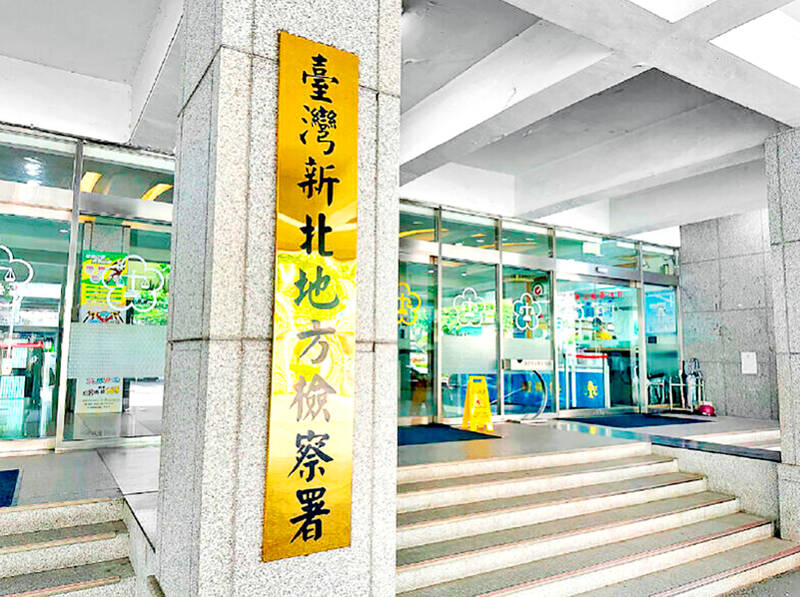
Photo: Taipei Times
Beginning in 2017, ADWELL Technology Inc (優活創意科技) head Chen Chien-hsiung (陳建雄) and other codefendants allegedly imported semiconductors from abroad using forged NCSIST documents, while providing assurances that the products would not be exported or resold to entities subject to US sanctions, prosecutors said.
Once in Taiwan, they repackaged and relabeled the chips as made in Taiwan and used other methods to disguise their origin so they would not be subject to export restrictions before selling them to entities in China and Hong Kong, including shell companies they had established, prosecutors said.
That scheme generated about NT$120 million in illicit profits, they said.
The defendants illegally exported more than 10 types of controlled chips manufactured by Texas Instruments and Analog Devices from the US, the Philippines, Malaysia and South Korea, prosecutors said, adding that the chips could be used in military applications involving radar, electronics, ultrasound systems, antenna arrays and uncrewed military aircraft.
Under export-control regulations, buyers must provide an end-user statement verifying the ultimate recipient, intended use and destination of the products.
Manufacturers and authorized distributors will refuse transactions involving overseas customers, including those in China, prosecutors said.
Another group, allegedly led by Hygge Investment Ltd (享得投資) head Lai Chin-lan (賴金蘭), used similar methods, starting in 2019, to sell controlled chips certified for US military specifications to entities in Hong Kong, generating about NT$130 million in illicit profits, the indictment said.
A third person, Hui Chung Telecommunications (匯眾通信) and ZhanKai Technology Co (展開科技) head Yuan Tung-tai (袁同台), allegedly placed orders through the companies he controlled in Taiwan, and similarly submitted false declarations and disguised the products’ origins before shipping them to a company he had established in Hong Kong, prosecutors said.
The company then resold the chips to buyers in China and Hong Kong, they said.
One type of chip Yuan sold was intended for use in uncrewed military aircraft, they said, adding that he earned more than NT$100 million in illicit profits.
Prosecutors are seeking a 10-year prison sentence for Chen, eight years for Yuan and six years for Lai.
They are also seeking a six-year prison sentence for Zkey Technology Inc (華謚科技) head Chiang Kun-cheng (蔣昆成), and sentences ranging from one to three years for the remaining six defendants: Chen’s brother, Chen Chien-hui (陳建輝); former ADWELL head Chen Chien-wei (陳健偉); Stone Engine Technology Co (石擎科技) and WTG Technology Co (睿虎科技) head Wang We-feng (王維鋒); Kplus Technology Ltd (凱盟資通) head Tsen-Tien-chi (曾恬綺); EcoLumina Technologies Inc (晟明科技) head Tsai Yu-shu (蔡玉書); and HGT Application Inc (洪巨科技) head Hung Chun-min (洪俊民).
A source familiar with the investigation said the types of chips smuggled by Chen Chien-hsiung could be used in radar, missile guidance, uncrewed aerial vehicle flight-control and electronic warfare systems.
Despite the national security implications, the illegal trafficking of semiconductors and advanced electronic equipment, including artificial intelligence (AI) servers and dual-use chips, does not currently contravene the National Security Act (國家安全法), the source said, speaking on condition of anonymity.
Authorities can deter entities only when they illegally transfer military or advanced technologies to hostile foreign powers or countries subject to export restrictions, they said.
Taiwan urgently needs more sophisticated mechanisms that emphasize prevention rather than relying on punishment after violations have occurred, the source said.

The Philippine Coast Guard yesterday said it has deployed its largest vessel and an aircraft to challenge a Chinese research ship operating off northern Batanes near Taiwan, adding that a Chinese coast guard vessel had also moved in. The Philippine operation “disrupted the vessel’s unauthorized marine scientific research and compelled it to leave its loitering position,” said Jay Tarriela, Philippine Coast Guard spokesperson on South China Sea issues. The Philippine Coast Guard said the BRP Teresa Magbanua and an aircraft were deployed to counter the Chinese vessel, which it said had remained about 37 nautical miles northwest of Itbayat Island since Monday. The
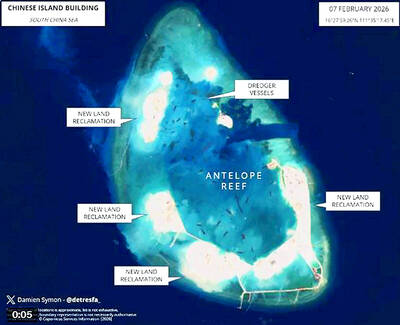
RUNWAY: Analysts said the first aircraft landing is expected by the middle of next year, while Chinese state media said it would serve civilian needs Chinese construction of a runway on Antelope Reef (Lingyang Reef, 羚羊礁) in the Paracel Islands (Xisha Islands, 西沙群島), is well under way with analysts estimating it could be completed by the middle of next year, strengthening Beijing’s military control over the disputed South China Sea. Satellite images reviewed by Reuters show grading work, piles of gravel and concrete, and compaction cranes in operation to build a full-scale runway that military attaches and security analysts say could be one of China’s most important offshore bases in the region. The images, taken on Friday last week by commercial satellite imagery provider Vantor, also show

SHIFTING COOPERATION: With the new arrangement, US representatives would be able to participate directly in defense discussions, including weapons procurement Taiwan-US military cooperation is deepening, with the Pentagon expected to station personnel at the Ministry of National Defense (MND), sources said. The NT$470 million (US$14.77 million) joint program is scheduled to run from this year through 2028, under which the Pentagon would dispatch representatives from the Office of the Under Secretary of Defense for Policy and the Institute for Defense Analyses, a senior military official said on condition of anonymity, adding that one representative from each organization would be stationed at the ministry’s headquarters. The Office of the Under Secretary of Defense for Policy is one of the US’ bodies responsible for

The Presidential Office today condemned China's transnational repression after an alleged Chinese foreign agent was arrested in California yesterday on suspicion of surveilling President William Lai's (賴清德) son, Lai Ting-yu (賴廷與), the FBI said. The 34-year-old woman, named Wanying Heather Zhang (張婉瑩), was arrested on suspicion of acting as an unregistered foreign agent, US news agency CBS reported. She was apprehended at Los Angeles International Airport yesterday attempting to fly to Shanghai, it said. This represents a “typical case” of China’s transnational repression, Presidential Office spokeswoman Karen Kuo (郭雅慧) said today. "Our country expresses the strongest condemnation of such barbaric conduct that


 RSS
RSS