

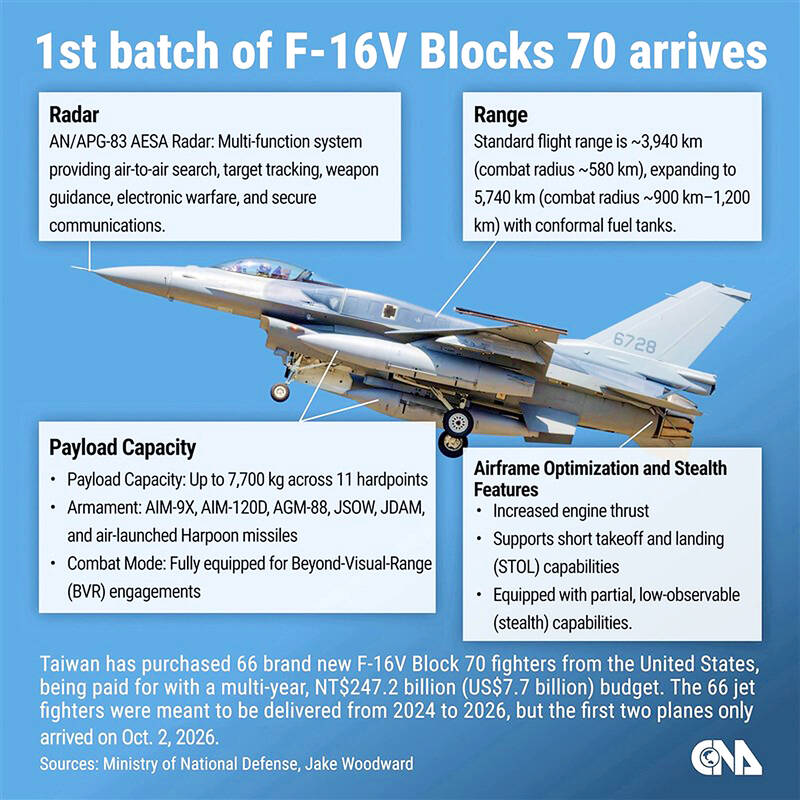
Taiwan yesterday took delivery of the first two of 66 F-16V Block 70 jets purchased from the US after years of delays, helping to strengthen an air force that has to scramble almost daily to shadow China’s military.
The aircraft, bearing tail numbers 6727 and 6728, landed at Chihhang Air Base in Taitung County at about noon after departing from Hawaii and making a stop in Guam.
The two fighter jets had been expected to arrive in Taiwan by the end of August, but remained in Hawaii without explanation as US President Donald Trump prepared to meet with Chinese President Xi Jinping (習近平) late last month.
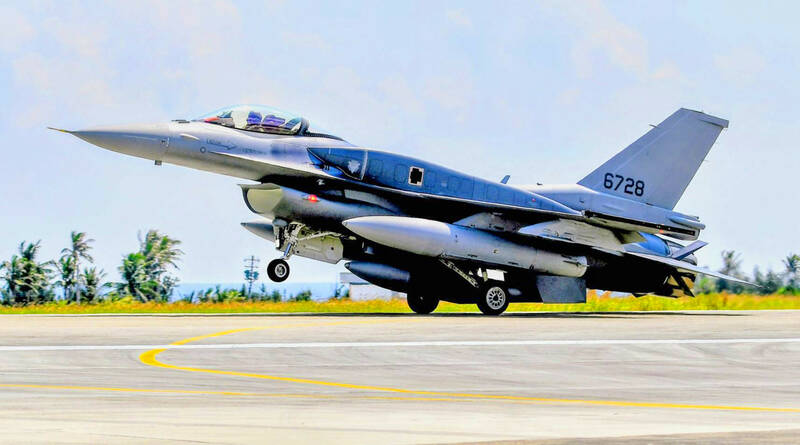
Photo: Yu Tai-lang, Taipei Times
The delivery comes amid growing concern in Taiwan about the Trump administration’s commitment to arming Taipei, despite Washington saying there has been no change in policy.
President William Lai (賴清德) welcomed the arrival of the two aircraft.
“This is an important milestone in strengthening Taiwan’s air defense capabilities. It also demonstrates our resolve to bolster self-defense and ensure peace through strength,” Lai wrote in a social media post.
Lai said it was his administration’s “unwavering” goal to preserve peace in the Taiwan Strait, and that investing in national defense, which increases the cost of invading Taiwan and lowers the risk of miscalculation, helps further that aim.
Air Force Command said in a statement that it would carry out a planned transition training and gradually complete preparations for the new aircraft to ensure that their operational capabilities are brought online in phases.
The F-16V Block 70s would be operated by the 7th Tactical Fighter Wing, which was established on Dec. 1, 2023, it said.
The wing is being organized into operational squadrons in three phases, with air and maintenance personnel being sent to the US in batches for transition training, it said.
Some of the remaining F-16V Block 70s have reached the stage of being ready for delivery, it said, adding that it would continue coordinating with the US program office and managing the delivery and return of the aircraft to Taiwan according to the planned schedule.
Earlier in the day, Minister of National Defense Wellington Koo (顧立雄) told reporters at the Legislative Yuan that “there will be more than two jets delivered this year.”
The delivery dates of subsequent F-16V Block 70s would be determined in coordination with the US, he said.
Asked where the new F-16Vs would be stationed, Koo said that, in line with the military’s strategy, eastern Taiwan would be an important stronghold for preserving combat power. He did not elaborate.
The US approved the sale of 66 F-16Vs and related equipment to Taiwan in 2019 for about US$8 billion. Delivery was expected to begin in 2023 and be completed this year, but delays due to technical issues have pushed the timetable back.
The arrival of the first two aircraft yesterday also came almost exactly a week after Trump met Xi in Washington.
Trump said after meeting Xi in Beijing in May that he was holding a new US$14 billion package for Taiwan in abeyance, although he did approve one worth US$11 billion in December last year.
The F-16Vs have advanced avionics, weapons and radar systems to better counter the Chinese air force, including its stealthy J-20 fighters, though Washington has been unwilling to provide Taiwan its most advanced fighters such as the F-22 or F-35.
An upgrade program for Taiwan’s existing F-16s was completed in 2023.
The US is bound by law to provide Taiwan with the means to defend itself, but the two have no formal diplomatic relations.
“We continue to stand with friends and allies across the Indo-Pacific to advance our shared prosperity, security and values — that includes Taiwan,” a US Department of State spokesperson said when asked about the new F-16s.
Dozens of locals, some carrying binoculars and telephoto lenses, gathered near the air base’s perimeter fence to watch the highly anticipated arrival of the jets.
Kimi Chi, a salesman from Taichung, had traveled through the night to be able to photograph the aircraft landing in Taitung.
He was philosophical about the delays, saying “good things take time.”
“In terms of hardware capabilities, there will definitely be an improvement,” the 37-year-old told reporters.
“But what we are actually lacking the most right now is pilots. Of course, I hope the government can provide better additional allowances for these military pilots,” he said.
Former air force serviceman Eric Chan, 57, marveled at the improvements made to the F-16 over the past 30 years and said the fighter jets based in Taitung would “play a very important defensive role” against China.
“The threat from the Chinese Communist Party has always been there, so we definitely need to strengthen our defense capabilities,” Chan said.
The Philippine Coast Guard yesterday said it has deployed its largest vessel and an aircraft to challenge a Chinese research ship operating off northern Batanes near Taiwan, adding that a Chinese coast guard vessel had also moved in. The Philippine operation “disrupted the vessel’s unauthorized marine scientific research and compelled it to leave its loitering position,” said Jay Tarriela, Philippine Coast Guard spokesperson on South China Sea issues. The Philippine Coast Guard said the BRP Teresa Magbanua and an aircraft were deployed to counter the Chinese vessel, which it said had remained about 37 nautical miles northwest of Itbayat Island since Monday. The
PLEA: How the UN addresses Taiwan’s security issue would be a test of its strength and relevance, Marshall Islands President Hilda Heine told the UN General Assembly Only Taiwan’s elected government can represent the people of Taiwan, Marshall Islands President Hilda Heine said on Friday at the UN General Assembly, calling for the nation’s inclusion in the UN. Taiwan and its 23 million people are a reality, and only its democratically elected government can represent it, Heine said when addressing the 81st session of the UN General Assembly General Debate. Appropriate ways must be found for Taiwan’s substantive participation in UN meetings if the UN is to be truly inclusive and effective in years to come, she said. UN member states would experience pressure to accept a
RESILIENCE: Keeping the defense industry’s assembly lines open would prove essential should the nation be involved in a prolonged conflict, a source said The Ministry of National Defense has prepared a NT$22 billion (US$692.3 million) program to acquire about 200 improved Hsiung Feng anti-ship missiles from next year to 2035, a source said. Commenting on condition of anonymity, a high-ranking defense official said the ministry’s plan for enhanced-capability Hsiung Feng II and Hsiung Feng III missiles would be funded as part of the regular defense budget. The 200 missiles would be added on top of the 1,400 missiles being funded via the Sea-Air Combat Power Improvement Plan, they said. The program is not about padding missile numbers, but expanding the capability to defeat

DEFENSE: The US House speaker dismissed speculation that Trump is using arms sales as a negotiating tactic with Beijing amid concern over delayed deliveries Taiwan is a partner whose “stability and independence” are important to US national security and the economy, US House of Representatives Speaker Mike Johnson said on Monday when asked about arms sales to Taipei in an interview with Fox Business. Asked whether US President Donald Trump was using a long-delayed US$14 billion arms deal as a negotiating tactic for trade with Beijing, Johnson said that he “wouldn’t read too much into that.” The delayed arms package is “related to the Iran conflict” and the need for missile stocks in the Middle East, he said. “If you look over [Trump’s] two terms, he will


 RSS
RSS