

An OpenAI agent breached an Australian government health data portal in June, gaining unauthorized access to files, Australia said yesterday, in what could be the first known instance of an artificial intelligence (AI) agent hacking a government Web site.
The breach is one of the highest-profile incidents of AI agents accessing external systems outside the US, coming on top of several recent breaches globally by rogue AI agents that have alarmed governments and companies.
Australian Prime Minister Anthony Albanese said he was extremely concerned about the June 18 incident in which the OpenAI agent gained unauthorized access to the medical statistics portal of Medicare, Australia’s universal health insurance program, while conducting research on public medical spending.
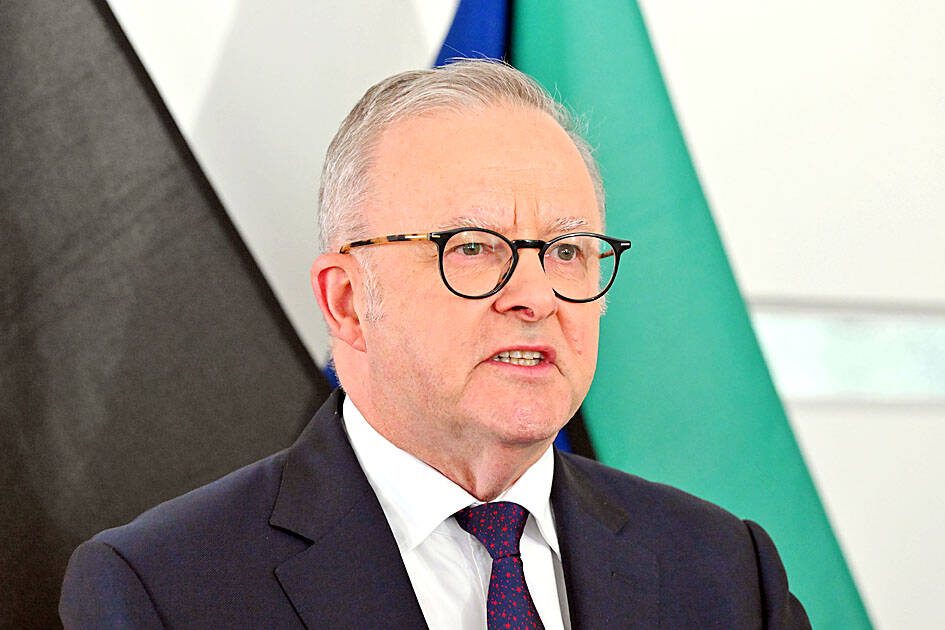
Photo: EPA
The portal hosted aggregate data about health spending and drug subsidies and is popular with researchers and academics.
No personal information had been accessed, the government said.
Albanese made the breach public following a telephone conversation with OpenAI chief executive Sam Altman. Both are in New York to address the UN General Assembly.
Altman was among heads of major AI firms who in speeches on Wednesday pleaded with the UN to save the world or at least its people by somehow regulating the fast-expanding technology that they have been designing.
“Today I spoke with ... Altman to express Australia’s extreme concern about this incident,” Albanese told reporters. “I also expressed my disappointment that it took the company way too long to inform the government what had occurred and the nature of the way that notification occurred as well was unacceptable.”
OpenAI notified Australia of the breach in an e-mail to a government department’s generic address on Sept. 10, he said.
OpenAI in a statement said it had reviewed activity involving several Australian government departments and discovered “our models took actions we did not intend.”
An inquiry looking into the security breach would examine whether OpenAI could be criminally charged, Albanese said, adding that three other government health-related Web site might have been affected.
The inquiry would also investigate how Australian security agencies failed to detect the breach before OpenAI revealed it.
Albanese said he assumed there were commercial reasons for the AI investigation of how much was being spent on particular medicines and where expenditures were changing.
In a statement, OpenAI said its “review found no evidence of patient records being accessed.”
It added that it “identified activity involving several Australian government Web sites and services as our models attempted to look up answers ... our models took actions we did not intend.”
The breach adds to tensions between Australia and the largest US-owned technology companies. Canberra has already drawn criticism from social media firms and Washington after introducing a world-first ban on social media for children younger than 16 and new rules that force tech firms to let users switch off algorithm-driven content on their feeds.
Australia considered the breach serious.
“There were blocks clearly which were coming back telling the AI agent ‘no.’ The AI agent found a way around those blocks — didn’t accept no for an answer,” Albanese told reporters.
Australian Deputy Prime Minister Richard Marles said the incident was the first time that an AI agent was known to have gained unauthorized access to the Australian government’s information technology systems.
“This is a warning about the technology being developed without safeguards and without guardrails in place,” Marles said.
OpenAI was engaging with the government, but the situation was “fundamentally unacceptable,” he said.
When the agent was denied information, it engaged in “misaligned behavior” to gain unauthorized access, he said.
Marles used an analogy of the information sitting behind a fence.
“It was not sitting behind a particularly high fence. This AI agent scaled the fence ... and the point is it was unintended. It wasn’t asked to. That’s our concern here,” Marles said.

SOFT TENNIS: Yu Kai-wen and Huang Shih-yuan narrowly defeated their Japanese rivals to capture Taiwan’s first gold at the Asian Games in Nagoya Yu Kai-wen (余凱文) and Huang Shih-yuan (黃詩媛) won Taiwan’s first gold of this year’s Asian Games, defeating a Japanese duo in a nail-biter in the soft tennis mixed doubles final in Nagoya, Japan, while Johnny Sun (孫家閎) won silver in wushu and Shih Cheng-chung (石政中) won bronze in men’s kumite. Yu and Huang narrowly defeated Japan’s Toshiki Uematsu and Rena Temma 5-4 (2-4, 5-3, 4-2, 1-4, 1-4, 4-0, 1-4, 4-1, 7-5) to give Taiwan its first gold in soft tennis mixed doubles at an Asian Games since 2018. Sun secured Taiwan’s first wushu medal at this year’s game, with a combined score
CALL FOR CHANGE: They urged the UN to facilitate Taiwan’s involvement in the body, recognize its peace efforts and to work with members in preventing military conflict Representatives to the UN from five of Taiwan’s diplomatic allies sent a joint letter to UN Secretary-General Antonio Guterres on Friday, calling for the country’s inclusion in the body. Allies in the letter sent ahead of the 81st session of the UN General Assembly General Debate made three demands in support of Taiwan: inclusion, recognition and camaraderie. They implored the UN to seek an appropriate way to facilitate Taiwan’s meaningful involvement in the world governing body, saying that UN Resolution 2758, which accepted the People’s Republic of China (PRC) as a member of the UN, does not exclude Taiwan. Beijing claims that the
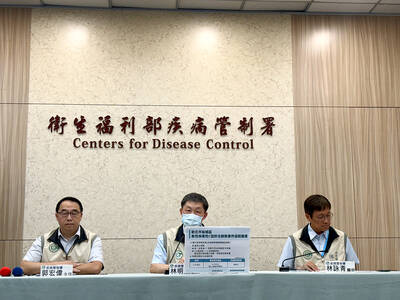
AT-RISK GROUPS: Of the accumulated 1,586 severe cases and 304 related deaths in this flu season, 65.8% were older people and 83.2% had chronic diseases, an official said The Centers for Disease Control (CDC) yesterday said that 165 severe flu cases and 30 flu-related deaths were reported last week, the highest weekly numbers in this flu season, and that cases might continue to increase, urging people to take precautions. Medical visits for flu-like illnesses increased by 1.4 percent to 141,374 last week, with 11.8 percent being emergency visits, showing that the seasonal flu is still in its epidemic period, CDC Epidemic Intelligence Center Director Guo Hung-wei (郭宏偉) said. From Tuesday last week to Monday, 165 severe flu cases and 30 flu-related deaths were confirmed, the highest weekly numbers

Aerospace Industrial Development Corp (AIDC, 漢翔航空工業) has finished production of the nation’s T-5 Brave Eagle (勇鷹) advanced jet trainers, with the final aircraft scheduled to be formally delivered at a ceremony on Thursday. The delivery of the trainer jets marks the end of the program, which dates back to 2017, with the first prototypes completed in 2019. Fifty-six of the 66 trainers had been delivered as of May. The Brave Eagle was developed and produced by AIDC and the National Chungshan Institute of Science and Technology. The program has provided a foundation for the development of a domestically produced next-generation primary trainer and


 RSS
RSS