

US senators on Tuesday urged US President Donald Trump to “stand with Taiwan” and not let China influence US support for Taiwan’s defense, ahead of his planned meeting with Chinese President Xi Jinping (習近平) in Washington.
“We can’t let President Xi leave stronger than when he arrived. That is not diplomacy, it’s weakness,” the senators said in a statement.
Xi is to visit the US until Friday, his first trip to New York in 11 years. They are reportedly expected to discuss arms sales to Taiwan, artificial intelligence and the conflict in Iran.
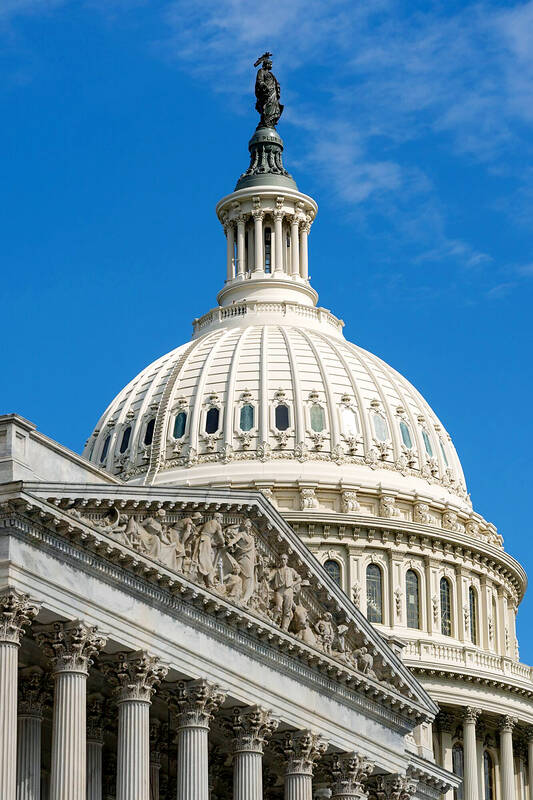
Photo: Bloomberg
Seven US senators, all Democrats, signed the statement: Senate Foreign Relations Committee ranking member Jeanne Shaheen, Senate Committee on Defense Appropriations ranking member Chris Coons, Senate Committee on Appropriations Vice Chairwoman Patty Murray, Senate Committee on Armed Services ranking member Jack Reed, Senate Select Committee on Intelligence Vice Chairman Mark Warner, Elizabeth Warren and Andy Kim.
“The People’s Republic of China presents a greater threat to American security and prosperity than ever before,” the statement said, urging Trump to end China’s access to advanced chips and manufacturing equipment, press Beijing to stop supporting Russian President Vladimir Putin’s war in Ukraine and confront Xi on supplying resources to Iran.
“The Chinese military continues its pressure campaign against our vital democratic partner Taiwan as President Trump has retreated from longstanding security commitments,” it said.
Separately, Ministry of National Defense deputy spokesman Chiao Fu-chun (喬福駿) yesterday said Taiwan would continue to maintain close contact with the US to promote the implementation of arms sales according to plan.
Trump in December last year approved an US$11 billion package for Taiwan, the largest ever. However, after visiting Beijing in May, he said that a second US$14 billion package was being held in abeyance.
Xi is expected to press Trump to halt sales when the two of them meet in Washington this week.
Speaking to reporters in Tainan during a media trip, Chiao said that maintaining security and stability in the Indo-Pacific region was a “common interest of democratic nations.”
“The US government and Congress have repeatedly expressed their support for Taiwan’s ability to defend itself,” he added. “We will continue to maintain close contact with the US Department of Defense and continue to promote the implementation of arms sales according to plan.”
President William Lai (賴清德) has embraced Trump’s call for US allies to spend more on their defense.
While the US is Taiwan’s most important arms supplier, Taipei has its own weapons development programs, producing platforms from submarines and fighter jets to long-range missiles.
Washington’s policy toward Taiwan remains unchanged, US Department of State Chinese-language spokesman Jakob Lengacher told Voice of America in an interview.
Washington continues to support Taiwan’s meaningful participation in international organizations, including APEC, he said.
Lengacher reiterated that the US opposes unilateral changes to the “status quo” by either side of the Taiwan Strait and remains committed to maintaining peace and stability in the region.
Additional reporting by Reuters
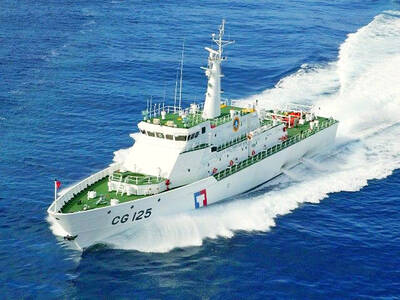
GEOPOLITICAL SIGNIFICANCE: The CGA’s nonmilitary role makes it a tool to avert diplomatic issues, an official said, while confirming the donation of a ship to Manila Coast Guard Administration (CGA) ships are scheduled to sail to the Philippines bearing the words “Taiwan Coast Guard” in a high-profile visit in October next year, the first such visit by a Taiwanese maritime law enforcement vessel to the Southeast Asian nation, the agency said yesterday. The CGA also confirmed that it had donated one of its decommissioned patrol vessels to the Philippines in a rare transfer of a retired ship to a nondiplomatic ally. The Republic of China (ROC) Navy last made such a visit in 1974, shortly before the Philippines switched diplomatic recognition to the People’s Republic of China in
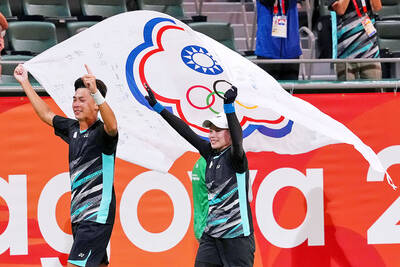
SOFT TENNIS: Yu Kai-wen and Huang Shih-yuan narrowly defeated their Japanese rivals to capture Taiwan’s first gold at the Asian Games in Nagoya Yu Kai-wen (余凱文) and Huang Shih-yuan (黃詩媛) won Taiwan’s first gold of this year’s Asian Games, defeating a Japanese duo in a nail-biter in the soft tennis mixed doubles final in Nagoya, Japan, while Johnny Sun (孫家閎) won silver in wushu and Shih Cheng-chung (石政中) won bronze in men’s kumite. Yu and Huang narrowly defeated Japan’s Toshiki Uematsu and Rena Temma 5-4 (2-4, 5-3, 4-2, 1-4, 1-4, 4-0, 1-4, 4-1, 7-5) to give Taiwan its first gold in soft tennis mixed doubles at an Asian Games since 2018. Sun secured Taiwan’s first wushu medal at this year’s game, with a combined score
CALL FOR CHANGE: They urged the UN to facilitate Taiwan’s involvement in the body, recognize its peace efforts and to work with members in preventing military conflict Representatives to the UN from five of Taiwan’s diplomatic allies sent a joint letter to UN Secretary-General Antonio Guterres on Friday, calling for the country’s inclusion in the body. Allies in the letter sent ahead of the 81st session of the UN General Assembly General Debate made three demands in support of Taiwan: inclusion, recognition and camaraderie. They implored the UN to seek an appropriate way to facilitate Taiwan’s meaningful involvement in the world governing body, saying that UN Resolution 2758, which accepted the People’s Republic of China (PRC) as a member of the UN, does not exclude Taiwan. Beijing claims that the
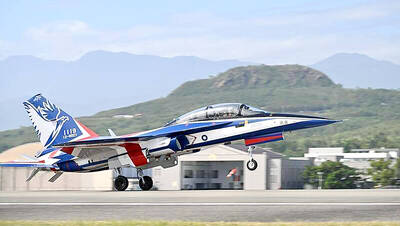
Aerospace Industrial Development Corp (AIDC, 漢翔航空工業) has finished production of the nation’s T-5 Brave Eagle (勇鷹) advanced jet trainers, with the final aircraft scheduled to be formally delivered at a ceremony on Thursday. The delivery of the trainer jets marks the end of the program, which dates back to 2017, with the first prototypes completed in 2019. Fifty-six of the 66 trainers had been delivered as of May. The Brave Eagle was developed and produced by AIDC and the National Chungshan Institute of Science and Technology. The program has provided a foundation for the development of a domestically produced next-generation primary trainer and


 RSS
RSS