

The Executive Yuan yesterday approved expanded subsidies for residents of long-term care facilities, allocating NT$16.62 billion (US$526.82 million) to the plan expected to benefit about 105,000 people.
Under the new plan, the maximum monthly subsidy for people with moderate to severe disabilities residing in long-term care facilities would rise from NT$10,000 to NT$15,000, while the annual cap would increase from NT$120,000 to NT$180,000, the Cabinet said.
The program would accept applications under the updated scheme from Monday next week, with the subsidy adjustments applying retroactively from Jan. 1, it said.

Photo: CNA
The central government also plans to provide a monthly accommodation subsidy of NT$5,000 for people with moderate to severe physical or mental disabilities living in specialized disability care facilities, the Cabinet said.
Previously, eligibility for the program was assessed on an annual basis, with beneficiaries required to stay in a facility for more than 180 days to receive a full year’s subsidy. Those who stayed for fewer than 180 days were not eligible.
Under the revised scheme, subsidies would be calculated monthly, with applicants eligible for one month’s subsidy if they reside in a facility for at least half of the calendar days in a given month, the Cabinet said.
Eligible facilities include nursing homes, psychiatric nursing homes, senior welfare institutions, disability welfare institutions, veterans’ homes and long-term care service facilities.
The government would also shorten reimbursement times by increasing the disbursement schedule to twice a year, the Cabinet said.
Application, review and disbursement procedures have been streamlined to ensure faster and more stable payments, Premier Cho Jung-tai (卓榮泰) said.
The Ministry of Health and Welfare and local governments have been instructed to complete administrative preparations as soon as possible, and step up public outreach to ensure applications and reviews proceed smoothly and subsidies can be disbursed at the earliest opportunity, he said.
Taiwan has become a “super-aged” society, with the number of people aged 65 or older exceeding 4.77 million as of the end of July, accounting for 20.5 percent of the population, Cho said.
Of those 4.77 million, 16.47 percent have disabilities and 7.99 percent have dementia, Deputy Minister of Health and Welfare Lu Chien-te (呂建德) said.
To meet rapidly growing long-term care needs, the government this year launched the Long-Term Care 3.0 program, investing NT$115.3 billion in its first year, Cho said.
The program aims to enhance coordination between medical and care services, while expanding support for people with moderate to severe disabilities and their families, he said.
The health ministry’s revised scheme would focus on reducing financial burdens and streamlining administrative procedures, he added.

Taiwan, which accounts for more than half of the global outsourced semiconductor assembly and testing market, is well-positioned to develop copackaged optics (CPO) and manufacture precision silicon photonics chips, the Ministry of Economic Affairs said yesterday. Silicon photonics are emerging as a mainstream optical communications technology and is seen as key to overcoming bottlenecks in AI computing power. The technology is a key project under the government’s New 10 Major AI Infrastructure Projects, with industry, government, academia and research institutions working to overcome critical technological hurdles and build a self-reliant silicon photonics supply chain, the ministry said. Nvidia Corp in March invested US$4
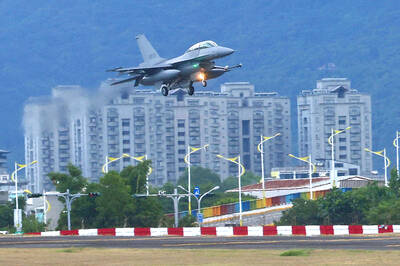
The air force plans to build 26 more hardened aircraft shelters as the number of F-16Vs stationed along Taiwan’s east coast is expected to reach 120 when the final shipment of 66 jets procured from the US arrives. The incoming jets would be stationed at Chihhang Air Base in Taitung County, augmenting the F-16V Block 20s operated by the 5th Tactical Fighter Wing in Hualien County, officials said yesterday. The air force plans to allocate more than NT$6.88 billion (US$218.1 million) from next year to 2031 to build the shelters in Hualien and Taitung as part of the implementation of a “one

NO LIMITS: More legislation expanding Beijing’s control over the movement of people, money and information raises risks for Taiwanese travelers and businesses, officials said China is set to implement several laws in the coming months that expand the definition of national security, creating greater risks for Taiwanese traveling to or doing business in China, Taiwanese officials said yesterday. Beijing’s Ethnic Unity and Progress Promotion Law took effect on July 1, while a draft “Internet Information Service Management Measures” finished its public consultation on Aug. 2, but has yet to be adopted. China’s Regulations of the State Council on Exit and Entry Administration are to take effect on Tuesday next week, while amendments to its National Defense Mobilization Law and the Ministry of Public Security’s Measures
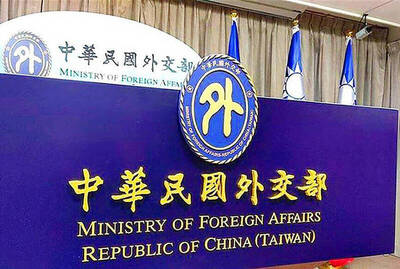
China’s continued efforts to inject geopolitical rivalry into the region and disrupt Pacific nations’ discussions of regional issues warrant greater international attention, a foreign affairs official said yesterday. Minister of Foreign Affairs Lin Chia-lung (林佳龍) last week led a delegation to diplomatic ally Palau to attend events related to the 55th Pacific Islands Forum (PIF) summit. However, the absence of some member-state leaders has been interpreted by some people as a sign of fracturing in Pacific unity. Thirteen PIF members were represented by their heads of state or government, while Fiji, New Caledonia, Vanuatu and Samoa sent ministerial-level representatives, a diplomatic official


 RSS
RSS