

President William Lai’s (賴清德) administration plans to allocate more than NT$40 billion (US$1.26 billion) next year to develop 10 major artificial intelligence (AI) projects, with a goal of training at least 500,000 AI professionals by 2040.
Lai yesterday met with the VIS Mars robotics team, which represented Taiwan at the FIRST Tech Challenge robotics tournament in Turkey in June. He praised the students for overcoming a major setback when customs detained their competition equipment after they arrived in Turkey.
Unable to access their robot, the team collected discarded components and borrowed tools from other teams to assemble a replacement robot before the competition. They won four qualification matches and earned the tournament’s highest match points.
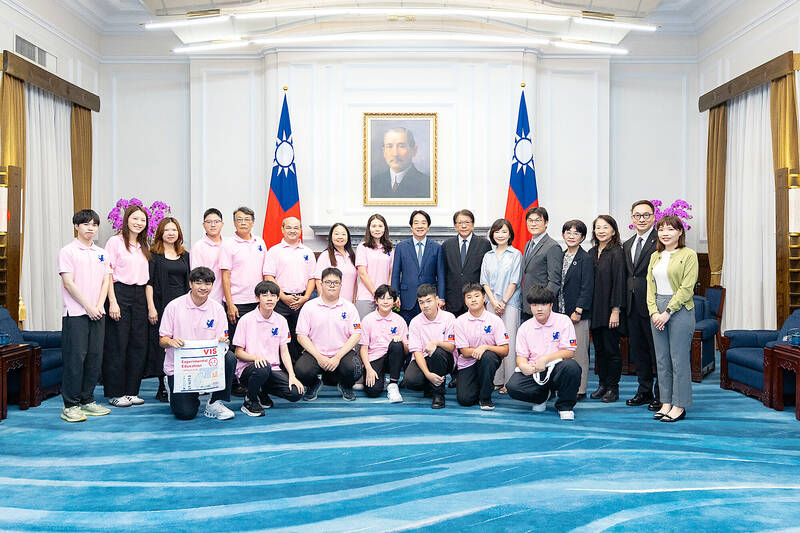
Photo courtesy of the Presidential Office
Lai said the students’ ability to adapt under pressure reminded him of the fictional character MacGyver.
Team captain Ray Shang (商泱瑞) said their greatest strength was not their equipment, but their ability to rethink, adapt and solve problems regardless of the circumstances.
Lai said technology education and talent development remain key government priorities.
The government launched the AI Talent Ark Project this year to nurture talent through fundamental education, professional development and data-driven approaches. The initiative, together with the 10 major AI projects, aims to build a large AI talent pool, promote smart applications across industries and strengthen Taiwan’s competitiveness.
Shang said the team’s experience showed that perseverance and teamwork were more important than having perfect equipment.
The team had advanced through competitions in Hong Kong and the Netherlands before facing its biggest test in Turkey.
Meanwhile, Minister of Digital Affairs Lin Yi-ching (林宜敬) said Taiwan could accumulate computing capacity of at least 10,000 graphics processing units (GPUs) within a year through private investment in AI computing centers under a build-own-operate (BOO) project launched by the ministry.
Technological sovereignty does not mean developing every technology domestically, he said.
Instead, Taiwan should focus on critical technologies, particularly sovereign AI and low-Earth-orbit (LEO) satellite communications, he said.
Sovereign AI means AI systems used in Taiwan should understand Taiwanese perspectives, society and languages. The ministry is therefore developing a Taiwan sovereign AI training corpus by making government-owned datasets available to local and international researchers.
AI computing centers should be located in Taiwan so that AI models can operate under Taiwanese laws and regulations, Lin said, adding that the ministry has designated such centers as major public infrastructure eligible for private investment.
LEO satellite communications are another priority, he said.
Taiwan needs independent communication capabilities, as submarine cables could be disrupted during conflict or “gray zone” harassment.
Although Starlink has shown limited interest in Taiwan’s commercial market because of its strong 4G and 5G coverage, Lin said LEO technology remains essential to Taiwan’s technological sovereignty and national resilience.
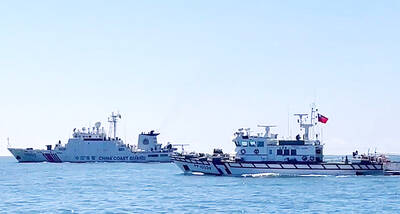
China deployed a record number of coast guard, scientific research and other ships near Taiwan’s waters last month, the Coast Guard Administration (CGA) said, as Beijing dials up pressure on Taipei. The coast guard warned of an increasingly severe situation, as analysts say the increased activity is part of China’s bid to map the region for submarine warfare. The number of Chinese ships detected around Taiwan proper soared to a record 244 last month — an average of nearly eight every day, official data showed. That compares with 55 ships detected in June and 30 in May, and 58 in July last year. In
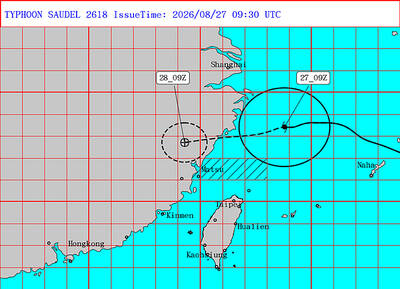
Taiwan is bracing for heavy rain in the south and rough seas around outlying Lienchiang County (Matsu), as Typhoon Saudel passes north toward eastern China, with forecasters yesterday warning of localized flooding over the next two days. Saudel is expected to pass closest to Taiwan today, when its outer rain bands are forecast to brush past Matsu, before making landfall at about noon in China’s Zhejiang Province and weakening significantly, the Central Weather Administration said. The storm’s outer bands, combined with strengthening southwesterly winds, are expected to bring heavy rain to southern and southeastern Taiwan today, it said. As the storm approaches Matsu,

LIMITED: The bill’s NT$40bn annual spending cap would prevent Taiwan from effectively building up its drone combat capabilities, National Defense Minister Wellington Koo said The legislature yesterday rejected the Executive Yuan’s NT$210 billion (US$6.62 billion) special budget proposal to buy military drones and instead passed its own plan, which earmarks NT$40 billion per year over six consecutive years. The Executive Yuan said its plan to buy about 210,000 drones by 2031 could not wait, as the wars in Ukraine and Iran showed the importance of uncrewed systems in modern warfare amid a rising threat from China. However, the Chinese Nationalist Party (KMT) and Taiwan People’s Party (TPP) used their opposition majority to pass a bill providing NT$240 billion through annual budgets over six years, with annual

INCREASING IMBALANCE: The percentage of working-age people is expected to shrink to 42.3% of the population, while older people would comprise 52.9%, the agency said Taiwan’s population is projected to shrink by almost half over the next five decades, intensifying labor shortages and placing a growing drag on economic growth as the technology-intensive economy confronts a rapidly aging workforce. The population is expected to fall to 12.15 million by 2075, a 48 percent decline from this year, National Development Council projections released yesterday showed. The decline would fundamentally alter Taiwan’s workforce. From 2037, more than half of the working-age population is projected to be aged between 45 and 64, signaling the end of an era when the economy could rely on a relatively large labor force. The shift


 RSS
RSS