

New Zealand’s security agency yesterday said it disrupted an attempt by a Chinese state-linked observatory to install satellite-tracking infrastructure in the country, highlighting the case in its annual assessment of an increasingly dangerous espionage environment.
The New Zealand Security Intelligence Service (NZSIS) said that Purple Mountain Observatory, an organization based in China with close ties to the government in Beijing, had sought to install ground-based space infrastructure through a local company that was likely unaware that the equipment could collect intelligence of military value.
The agency did not identify the New Zealand company or detail how the plans was disrupted.
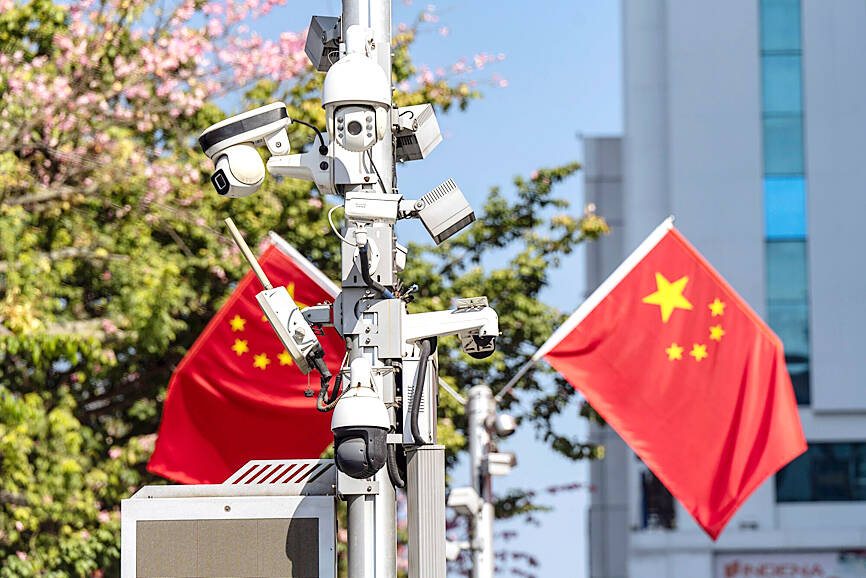
Photo: Bloomberg
The warning appeared in the agency’s Security Threat Environment 2026 report, which said China was the only country New Zealand had detected conducting espionage “at scale.”
“Our last report described the threat environment as being the most challenging of recent times,” NZSIS Director-General Andrew Hampton said. “The kinds of malign behaviors and activities we have seen over the past 12 months are proving even more threatening for a country like New Zealand given its size and location in the South Pacific.”
The Chinese embassy in New Zealand did not responded to a request for comment and the observatory did not respond to an e-mailed request for comment.
NZSIS said China’s intelligence services were the most active espionage threat it faced, while cautioning that the finding should not prevent New Zealand organizations from trading or collaborating with Chinese entities.
It urged an “eyes wide open” approach to overseas business and research ties.
Beijing’s national security laws could compel Chinese nationals and organizations to comply with intelligence-service requests, including by handing over data, intellectual property or system access, the agency said.
In the Purple Mountain case, NZSIS assessed that any data collected would have been passed to the Chinese government willingly.
New Zealand’s location in the South Pacific makes it attractive for ground-based systems that track satellites, space debris and other scientific data, NZSIS said.
It is also a member of the “Five Eyes” security grouping, which includes the US, the UK, Canada and Australia.
Foreign states were targeting New Zealand government agencies, companies, universities and researchers for nonpublic information, innovative technology and intellectual property, NZSIS said.
Methods included cyberintrusions, recruitment of insiders, academic partnerships, front companies and commercial intermediaries.
Geopolitical rivalry, competition over technology and supply chains, foreign interference targeting diaspora communities, and the use of artificial intelligence to spread polarizing or deceptive content were compounding risks, it said.
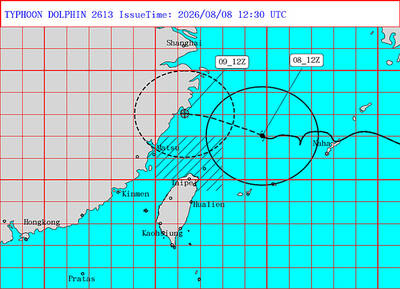
Typhoon Dolphin was expected to make its closest approach to Taiwan yesterday afternoon through today before continuing west toward China, the Central Weather Administration (CWA) said yesterday, forecasting that mountainous areas of Hsinchu and Miaoli could receive the heaviest rainfall, with precipitation expected to reach 350mm to 500mm. The rain could fall within a single day, raising the risk of torrential downpours, the agency warned. The likelihood of a land warning for Taiwan proper has been ruled out, while the chance of a land warning for outlying Lienchiang County has fallen from the previous day’s estimate, it added. If Dolphin’s track and
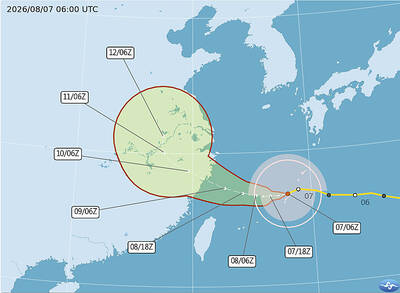
The Central Weather Administration (CWA) issued a sea warning for Typhoon Dolphin at 2:30pm yesterday, as the storm steadily moved toward the waters north of Taiwan, with heavy or extremely heavy rain expected over the weekend in the central mountains and the north. As of 5pm yesterday, Dolphin was about 680km east-northeast of Taipei and moving west at 10kph, with maximum sustained winds of 144kph and a storm radius of 280km, CWA data showed. While the typhoon has slowed slightly, it remains within forecast expectations and would not be longer than previously predicted, CWA forecaster Chu Mei-lin (朱美霖) told a news conference. The

CHINESE THREAT: The military also simulated repelling an attack on Penghu and transporting military vehicles from Hualien to Yilan to reinforce defenses in the north The government yesterday slowed mobile Internet coverage for a large swathe of the central part of Taiwan proper for the first time during annual war games, simulating communication disruption in the event of a Chinese attack or natural disaster. Taiwan, which has long lived with the threat of a Chinese invasion, holds air raid drills along with its war games every year, clearing people from the streets for 30 minutes. During the Internet “throttling” drill, centered on Taichung, only basic mobile phone services worked, although other functions, including ATMs, traffic signals, landlines and fixed-line Internet services, were not affected. Air raid sirens rang

‘IRONIC’: The Nagasaki memorial calls for the abolition of nuclear weapons and peace, but it sided with China, which has been threatening peace in the Strait, an official said Taipei yesterday protested the seating arrangement at the Nagasaki atomic bombing memorial ceremony, saying that the Nagasaki City Government’s decision to place its representative outside the diplomatic delegation area slighted Taiwan’s national status and played into Beijing’s efforts to suppress the nation. Representative to Japan Lee Yi-yang (李逸洋) said he declined to attend the event, because the seat placement deliberately diminished Taiwan’s status and dignity, with Chen Ming-chun (陳銘俊), head of the Fukuoka Branch of the Taipei Economic and Cultural Office in Osaka, attending in his place. Taiwan is known worldwide for its commitment to peace and democracy, Lee said, adding that


 RSS
RSS