

Russian President Vladimir Putin yesterday visited Russia’s far-eastern Kuril Islands for the first time, prompting protests by Japan which also claims the territory.
Russian-Japanese relations have long been dogged by the contested islands, known in Japan as the Northern Territories and seized by the Soviet Union in 1945.
The Kremlin posted a video of Putin on one of the Kurils’ four main islands, with Russian media saying he visited a fish-processing plant and was given caviar.
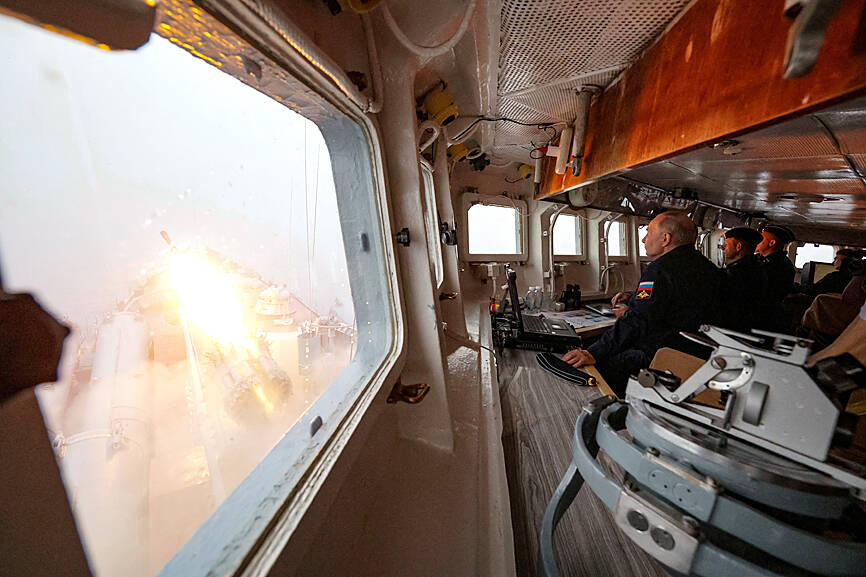
Photo: Gavriil Grigorov, Sputnik via Reuters
It was the first visit by a Russian president since Dmitry Medvedev in 2010.
“The Northern Territories are an inherent part of Japan’s territory, both historically and under international law,” Japanese Prime Minister Sanae Takaichi told reporters.
Putin’s visit “offends the sentiments of the Japanese people and is absolutely unacceptable,” she said, adding that it “made it more difficult to restore relations in the medium to long term.”
Putin traveled to the Kurils after visiting the nearby Russian island of Sakhalin on Wednesday, where Russia’s navy was conducting drills.
In Sakhalin, Putin, 73, held a meeting “on ensuring the security of Russia’s eastern borders,” RIA Novosti said.
Japanese Minister of Foreign Affairs Toshimitsu Motegi yesterdat summoned Russian Ambassador to Japan Nikolai Nozdrev to lodge a “strong protest” against Putin’s surprise move.
Motegi told the ambassador in the meeting that Putin’s visit would “have an extremely negative impact on Japan-Russia relations” already complicated by Moscow’s invasion of Ukraine, the ministry said in a statement.
Ties between Japan and Russia — which fought a war in 1904-1905 — have worsened since the full-scale conflict in Ukraine began in 2022.
Japan has joined other G7 countries in sanctioning Russia and giving money and nonlethal defense aid to Kyiv.
Putin on Wednesday called Japan’s sanctions “unprovoked.”
“Japan has identified Russia as a main source of threats. I would like to point out that we are not threatening Japan... On the contrary it has territorial claims against our country,” Putin said.
Russia and China have also moved closer, with their navies and air forces conducting joint exercises in areas around Japan, promoting frequent scrambles by Japanese jets.
North Korea, which this month termed Japan’s military buildup a “transformation into a war state,” has also sent troops and artillery shells to help Russia’s war against Ukraine.
Japan’s latest defense white paper issued this month again highlighted growing risks from all three countries.
The New York Times last month reported that Russia had turned Japan into a “den of spies” and a key source of dual-use technology needed for its war in Ukraine.
The Soviet Union took the strategically located volcanic archipelago north of Hokkaido in the final days of World War II and has maintained a military presence there ever since.
The contested isles are part of the volcanic Kuril archipelago, which runs in a broad arc from Russia’s Kamchatka peninsula down to Japan’s main northern island Hokkaido.
Their population of about 20,000 Russians lives in a harsh climate, but the islands have mineral deposits including gold and silver, and rich fishing grounds.
After the islands were occupied in 1945, Moscow deported their Japanese population of about 17,000 people.
The islands then acquired strategic importance, providing air and sea bases during the Cold War as the Soviet Union confronted the US and Japan.
“The Kurils have been fortified with Bastion coastal defense missile systems and SU-35 fighter aircraft. These provide Russia with instruments of control over sea lanes in the region, as well as leverage against Japan’s claim to the islands,” University of Tokyo Graduate School of Public Policy professor Yee Kuang-heng said.
“Putin’s visit may be a reminder of the cards he holds and also his displeasure with Japan’s continuing sanctions on Russia imposed after the invasion of Ukraine,” Heng said.
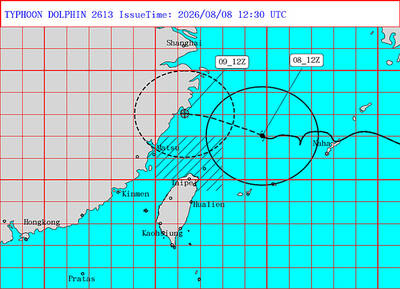
Typhoon Dolphin was expected to make its closest approach to Taiwan yesterday afternoon through today before continuing west toward China, the Central Weather Administration (CWA) said yesterday, forecasting that mountainous areas of Hsinchu and Miaoli could receive the heaviest rainfall, with precipitation expected to reach 350mm to 500mm. The rain could fall within a single day, raising the risk of torrential downpours, the agency warned. The likelihood of a land warning for Taiwan proper has been ruled out, while the chance of a land warning for outlying Lienchiang County has fallen from the previous day’s estimate, it added. If Dolphin’s track and
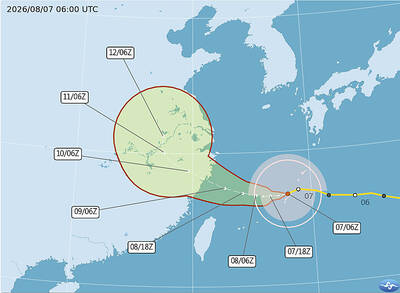
The Central Weather Administration (CWA) issued a sea warning for Typhoon Dolphin at 2:30pm yesterday, as the storm steadily moved toward the waters north of Taiwan, with heavy or extremely heavy rain expected over the weekend in the central mountains and the north. As of 5pm yesterday, Dolphin was about 680km east-northeast of Taipei and moving west at 10kph, with maximum sustained winds of 144kph and a storm radius of 280km, CWA data showed. While the typhoon has slowed slightly, it remains within forecast expectations and would not be longer than previously predicted, CWA forecaster Chu Mei-lin (朱美霖) told a news conference. The
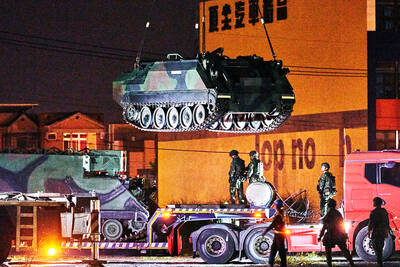
CHINESE THREAT: The military also simulated repelling an attack on Penghu and transporting military vehicles from Hualien to Yilan to reinforce defenses in the north The government yesterday slowed mobile Internet coverage for a large swathe of the central part of Taiwan proper for the first time during annual war games, simulating communication disruption in the event of a Chinese attack or natural disaster. Taiwan, which has long lived with the threat of a Chinese invasion, holds air raid drills along with its war games every year, clearing people from the streets for 30 minutes. During the Internet “throttling” drill, centered on Taichung, only basic mobile phone services worked, although other functions, including ATMs, traffic signals, landlines and fixed-line Internet services, were not affected. Air raid sirens rang
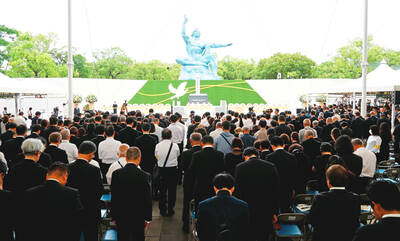
‘IRONIC’: The Nagasaki memorial calls for the abolition of nuclear weapons and peace, but it sided with China, which has been threatening peace in the Strait, an official said Taipei yesterday protested the seating arrangement at the Nagasaki atomic bombing memorial ceremony, saying that the Nagasaki City Government’s decision to place its representative outside the diplomatic delegation area slighted Taiwan’s national status and played into Beijing’s efforts to suppress the nation. Representative to Japan Lee Yi-yang (李逸洋) said he declined to attend the event, because the seat placement deliberately diminished Taiwan’s status and dignity, with Chen Ming-chun (陳銘俊), head of the Fukuoka Branch of the Taipei Economic and Cultural Office in Osaka, attending in his place. Taiwan is known worldwide for its commitment to peace and democracy, Lee said, adding that


 RSS
RSS