

Taiwan last month detected artificial intelligence (AI)-assisted cyberattacks on government agencies coming from overseas, but the affected bodies successfully "handled" the incident, the Ministry of Digital Affairs said today.
Taiwan has over the past few years complained about China's "hybrid warfare" — from daily military drills near the nation to disinformation campaigns and cyberattacks — as Beijing ramps up military and political pressure to force Taipei to accept its claims of sovereignty.
Chinese cyberattacks on Taiwan's key infrastructure from hospitals to banks last year rose 6 percent from the previous year to an average of 2.63 million attacks a day, the National Security Bureau said in January, adding that some of the hacks were synchronized with military drills in "hybrid threats" to paralyze the nation.

Photo: Reuters
The ministry said in a statement that its cybersecurity monitoring units last month detected an "abnormal attack" targeting government agencies, and beginning July 20, its National Institute of Cyber Security issued a series of warning alerts while it investigated.
The investigation results showed the attacks displayed clear characteristics of an "overseas source," with hackers employing a hybrid approach that combined manual operations with AI agent-assisted attacks, such as Open Claw, it said.
"The relevant attack sources, methods, and scope of impact have all been fully investigated, and the affected units have successively completed their handling," the ministry added.
In response to this new type of AI-derived cybersecurity threat, the government has established protective guidelines and reinforced system monitoring across agencies to block attacks early, the ministry said.
The statement did not mention China, and China's Taiwan Affairs Office did not immediately respond to a request for comment on the attack.
The ministry’s statement came a day after the Israeli cybersecurity company Dream said in a blog post that it had uncovered an AI-driven hacking campaign that stole credentials and other data from an unnamed government in Asia.
A team of AI agents worked together to extract scores of passwords from unidentified officials, steal personnel records from the country’s justice ministry, and scan its nuclear safety agency for vulnerabilities over the course of four days, Dream said.
Dream, which said it was able to reconstruct the hacking campaign after recovering the agents' "complete operational workspace," declined to share the data or name the government when approached by Reuters, but the Financial Times, which was the first media outlet briefed on Dream's findings, identified the target agencies as Taiwanese.
The threat of AI-assisted hacking campaigns has been growing for years, but ramped up dramatically over the past few months after top AI labs released models, such as Anthropic's Mythos, which can rapidly conduct reconnaissance, identify vulnerabilities and take advantage of them.
The spy campaign illustrates just how quickly AI-assisted hackers can hit their mark, said Cris Thomas, a researcher who works as a security advocate at the code security company Semgrep.
However, Thomas cautioned against exaggerating the power of AI agents.
"There's still a human in there somewhere. Somebody had to choose who to attack, had to establish an objective and give it a directive. It's not totally 100% autonomous. There was a capable operator in charge that did that," he said.
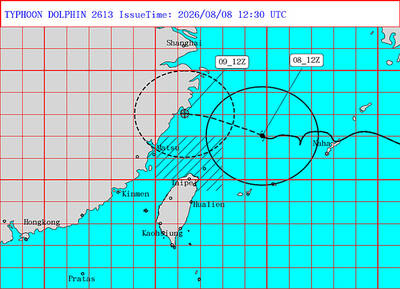
Typhoon Dolphin was expected to make its closest approach to Taiwan yesterday afternoon through today before continuing west toward China, the Central Weather Administration (CWA) said yesterday, forecasting that mountainous areas of Hsinchu and Miaoli could receive the heaviest rainfall, with precipitation expected to reach 350mm to 500mm. The rain could fall within a single day, raising the risk of torrential downpours, the agency warned. The likelihood of a land warning for Taiwan proper has been ruled out, while the chance of a land warning for outlying Lienchiang County has fallen from the previous day’s estimate, it added. If Dolphin’s track and
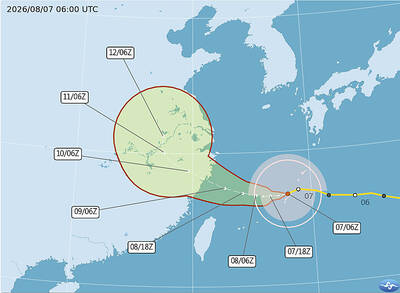
The Central Weather Administration (CWA) issued a sea warning for Typhoon Dolphin at 2:30pm yesterday, as the storm steadily moved toward the waters north of Taiwan, with heavy or extremely heavy rain expected over the weekend in the central mountains and the north. As of 5pm yesterday, Dolphin was about 680km east-northeast of Taipei and moving west at 10kph, with maximum sustained winds of 144kph and a storm radius of 280km, CWA data showed. While the typhoon has slowed slightly, it remains within forecast expectations and would not be longer than previously predicted, CWA forecaster Chu Mei-lin (朱美霖) told a news conference. The

‘IRONIC’: The Nagasaki memorial calls for the abolition of nuclear weapons and peace, but it sided with China, which has been threatening peace in the Strait, an official said Taipei yesterday protested the seating arrangement at the Nagasaki atomic bombing memorial ceremony, saying that the Nagasaki City Government’s decision to place its representative outside the diplomatic delegation area slighted Taiwan’s national status and played into Beijing’s efforts to suppress the nation. Representative to Japan Lee Yi-yang (李逸洋) said he declined to attend the event, because the seat placement deliberately diminished Taiwan’s status and dignity, with Chen Ming-chun (陳銘俊), head of the Fukuoka Branch of the Taipei Economic and Cultural Office in Osaka, attending in his place. Taiwan is known worldwide for its commitment to peace and democracy, Lee said, adding that
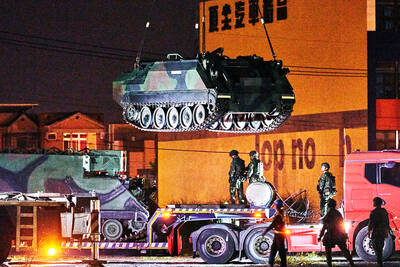
CHINESE THREAT: The military also simulated repelling an attack on Penghu and transporting military vehicles from Hualien to Yilan to reinforce defenses in the north The government yesterday slowed mobile Internet coverage for a large swathe of the central part of Taiwan proper for the first time during annual war games, simulating communication disruption in the event of a Chinese attack or natural disaster. Taiwan, which has long lived with the threat of a Chinese invasion, holds air raid drills along with its war games every year, clearing people from the streets for 30 minutes. During the Internet “throttling” drill, centered on Taichung, only basic mobile phone services worked, although other functions, including ATMs, traffic signals, landlines and fixed-line Internet services, were not affected. Air raid sirens rang


 RSS
RSS