

Taiwan is to attend an annual gathering of Pacific island leaders in Palau this month, the regional bloc said, overcoming protests from China that saw Taipei barred from the event last year.
China and Taiwan are important partners to the region, a Pacific Islands Forum (PIF) official told reporters late on Friday, after ministers from 18 member states met in Fiji to thrash out priorities.
“Taiwan is a very important development partner. It is not a dialogue partner, however it engages with members of our forum family,” Baron Waqa, the forum’s secretary-general, told a news conference.
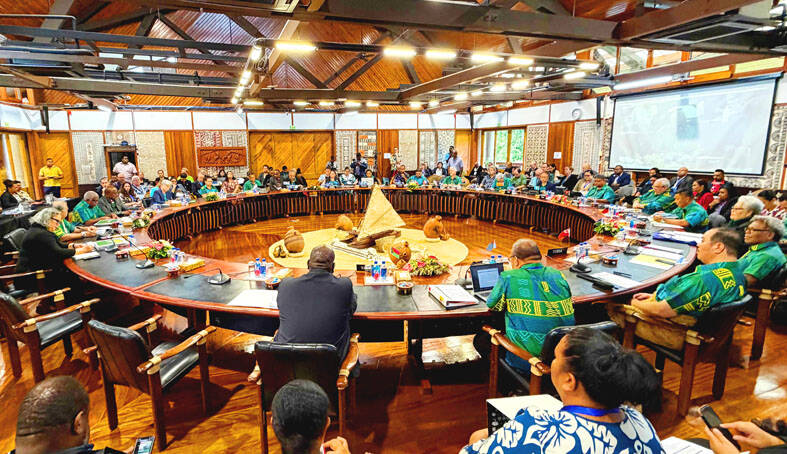
Photo: AFP
Palau, host of the Aug. 30-to-Sept. 4 meeting, as well as Tuvalu and the Marshall Islands, are among Taiwan’s 12 diplomatic partners.
Forum members Nauru, Kiribati and the Solomon Islands have all switched diplomatic recognition from Taiwan to Beijing since 2019.
The Solomon Islands, the host of last year’s leaders meeting, blocked Taiwan from attending, resulting in all external countries being disinvited to the meeting, despite the island states’ reliance on foreign aid and investment.
“This year, it is an open invitation,” said Rick Hou, foreign minister in the Solomon Islands government that took office in May and has swiftly repaired ties with the US, Japan and Australia.
A joint statement condemning China’s test of an intercontinental ballistic missile in the Pacific last month was still being negotiated, Waqa said, confirming that Nauru and Kiribati had held different positions to other forum members.
New Zealand Minister of Foreign Affairs Winston Peters on Friday accused two states he did not name of appeasing “outsiders” after the meeting failed to agree to the statement.
“Everyone wants that statement out,” Waqa told reporters, adding that the arguments centered on whether it would focus solely on the Chinese missile test or all missile testing in the Pacific.
The US conducts ballistic missile tests in the northern Pacific under a defense agreement with the Marshall Islands.
The Pacific islands also agreed to step up efforts to invite world leaders to attend an October special UN climate change event in Tuvalu.
In Taipei, the Ministry of Foreign Affairs said Taiwan has consistently supported efforts to maintain peace and stability in the Taiwan Strait and the Indo-Pacific region, and firmly opposes any attempt to unilaterally change the “status quo” through force or coercion.
Taiwan would continue to work closely with like-minded countries to promote a rules-based international order and enhance regional security, it said.
The ministry welcomed Waqa’s reaffirmation at the PIF Foreign Ministers’ Meeting that Taiwan is an important partner of the forum, as well as his reiteration that Taiwan would continue to attend meetings this year, as it has in previous years.
Taiwan would continue to deepen cooperation with PIF member states and other like-minded partners, while contributing to peace, stability and prosperity in the Pacific region, it said.
An official, speaking on condition of anonymity, confirmed separately yesterday that Taiwan would, as usual, send a delegation led by a deputy minister or higher-ranking official to this year’s meetings.
Additional reporting by Huang Ching-hsuan
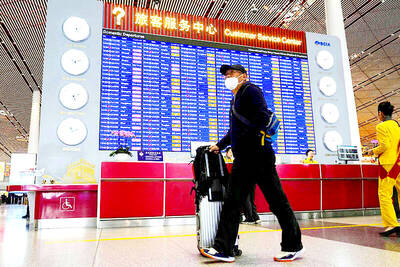
Taiwanese travelers could face exit restrictions as China expands government control under new regulations, an analyst said yesterday. China’s State Council has released new exit and entry regulations that expand the authorities’ power to restrict travel. Hung Pu-chao (洪浦釗), deputy head of Tunghai University’s Center for Mainland China and Regional Development Research, said the new regulations focus on managing cross-border activities as a whole, bringing the movement of talent, technology, information and social networks under the scope of national security oversight. The 19-part rules, which take effect on Sept. 15, were issued by Beijing for “regulating exit and entry management, protecting legitimate

Japan’s Defense White Paper released yesterday highlighted Taiwan Strait security as a major concern, saying China has expanded military activities around Taiwan, used repeated drills to normalize the presence of the Chinese People’s Liberation Army (PLA), and strengthened blockade, precision strike, and joint operation capabilities. Chinese military aircraft entering Taiwan’s surrounding airspace surpassed 3,700 sorties last year, a sharp increase from about 970 in 2021, the paper said, adding that Chinese naval activity around Taiwan also rose to about 2,600 sorties. Since 2022, Beijing has repeatedly conducted large-scale military drills around Taiwan, said the paper, which is titled Security for the Future. The
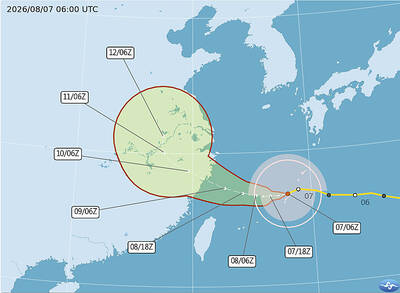
The Central Weather Administration (CWA) issued a sea warning for Typhoon Dolphin at 2:30pm yesterday, as the storm steadily moved toward the waters north of Taiwan, with heavy or extremely heavy rain expected over the weekend in the central mountains and the north. As of 5pm yesterday, Dolphin was about 680km east-northeast of Taipei and moving west at 10kph, with maximum sustained winds of 144kph and a storm radius of 280km, CWA data showed. While the typhoon has slowed slightly, it remains within forecast expectations and would not be longer than previously predicted, CWA forecaster Chu Mei-lin (朱美霖) told a news conference. The

Dutch elementary-school textbooks for English-language courses contain substantially more vocabulary and introduce more advanced words earlier than their Taiwanese counterparts, researchers said on Monday, citing a study that recommends expanding the range of vocabulary taught in Taiwanese classrooms. The study, conducted by the National Academy for Educational Research, compared elementary-school English textbooks used in Taiwan and the Netherlands, where English proficiency consistently ranks among the highest in the world. Academy associate researcher Chou Yi-ming (周一銘) said that the research team looked at elementary-school English textbooks from both countries and analyzed vocabulary difficulty and topic distribution using the English Vocabulary Profile (EVP). The findings


 RSS
RSS