

Vice President Hsiao Bi-khim (蕭美琴) yesterday emphasized the importance of conducting rigorous defense exercises during an inspection of Kaohsiung’s urban resilience drills, which were for the first time merged with the annual Han Kuang military exercises.
Yesterday was the third day of the 10-day drills, which this year feature many firsts.
Hsiao toured the local Joint Emergency Operations Command and Control Center at the Kaohsiung Fire Bureau, the Presidential Office said in a statement.
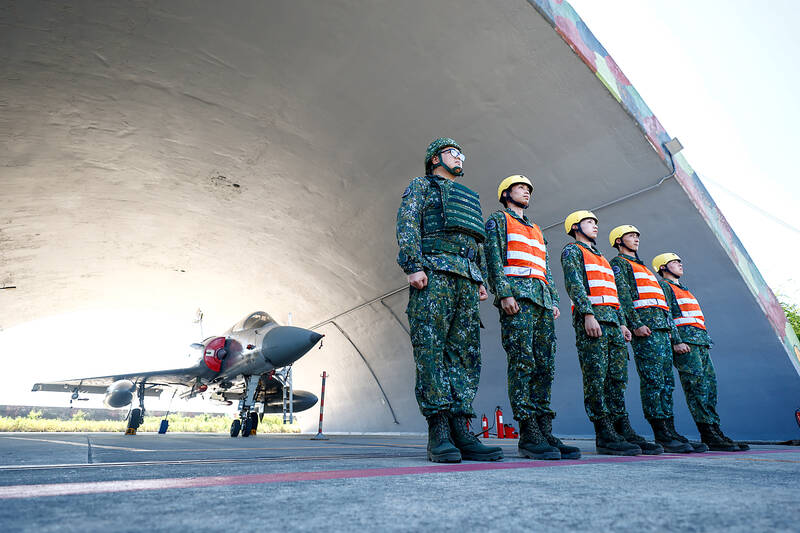
Photo: Ritchie B. Tongo, EPA
The work of President William Lai’s (賴清德) Whole-of-Society Defense Resilience Committee mainly revolves around urban resilience, a critical part of the effort to bolster overall national resilience, it quoted Hsiao as saying.
Merging the Han Kuang and Kaohsiung urban resilience drills would test the military, civilian and political leaderships’ ability to make and implement decisions rapidly, effectively and under stress, she said.
Resilience would also depend on the ability to speedily mobilize reservists, volunteers and community resources, and direct them to where they are needed, she said.
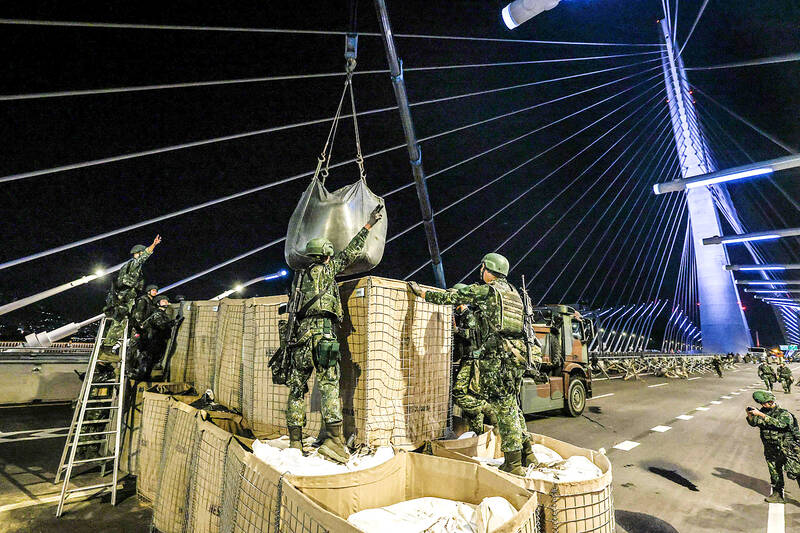
Photo: I-Hwa Cheng, AFP
Another critical facet is the hospital system’s capacity to handle mass casualties even if hospitals are forced to relocate to alternate sites, Hsiao said.
International observers would be present at the Port of Kaohsiung to monitor Taiwan’s skills in organizing and distributing materiel, she said.
The aim of the combined exercises is to test the system’s flaws, not stage a perfect performance, Hsiao added.
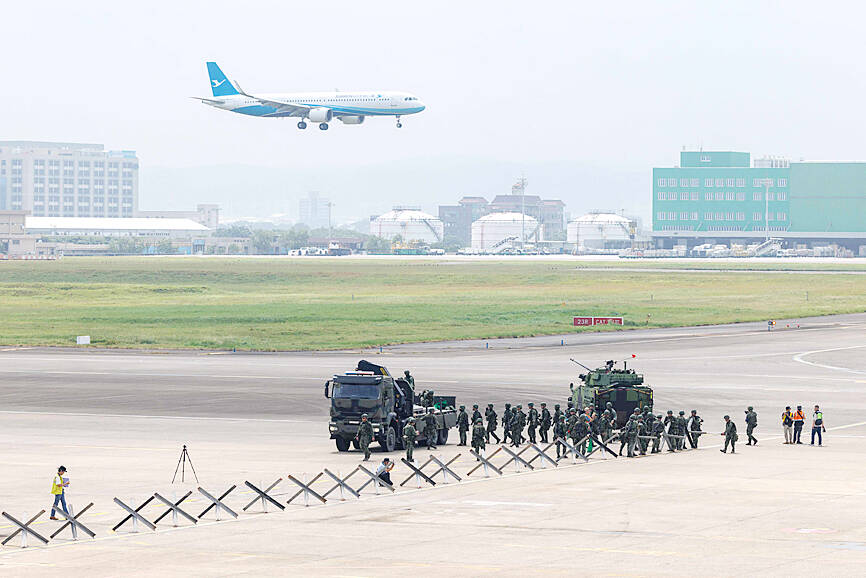
Photo: Cheng Yu-chen, AFP
Armed Forces Reserve Command personnel carried out tasks as part of Kaohsiung’s urban resilience exercise, the command’s headquarters said in a news release.
The cadres assisted with establishing medical aid and essential materiel distribution sites at Nanyang Elementary School, and conducted a mobile campaign against disinformation, it said.
The cadres drove scooters across the city to engage with police and the public, and put up posters designed to bolster media literacy as countermeasures to Chinese cognitive warfare, it said.
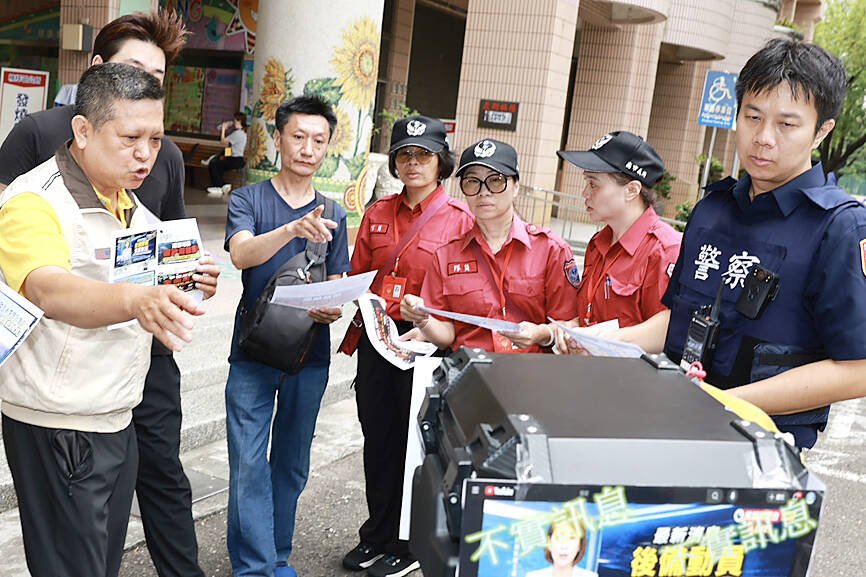
Photo courtesy of the Armed Forces Reserve Command
The drills simulated a Chinese People’s Liberation Army (PLA) operation to spread fake news that claimed top Taiwanese military commanders have defected, that resistance had ended or that mobilization was canceled, it said.
In New Taipei City, army engineers on Thursday closed the Danjiang Bridge (淡江大橋) over the Tamsui River (淡水河) for the first time in a defensive fortification drill, building barriers to block a PLA advance on Taipei.
The bridge’s southbound lanes were closed from 8pm on Thursday to 6am yesterday.
Once the drill began, military and requisitioned civilian vehicles transported the barrier equipment to the site.
The field fortifications, consisting of 15 concrete blocks, anti-tank obstacles, barbed wire and HESCO barriers, were 13m wide, 200m deep and divided into three roughly equal belts.
The army planned to erect the fortifications in four hours and remove them in another four, a military spokesperson said.
At Taiwan Taoyuan International Airport, the army’s 584th Combined-Arms Brigade yesterday deployed part of its forces to defend the strategically important site against a simulated PLA air assault.
Chinese-language media reported that four M1A2T tanks, six Clouded Leopard armored vehicles, troops and combat engineers could be seen at the airport.
Supported by airport personnel and their equipment and vehicles, soldiers organized defensive lines and placed anti-tank barriers on the tarmac to repel hostile landing forces.
The exercise also simulated emergency services and medical aid operations, although regular air traffic was undisrupted.
The drills’ purpose was to ensure that a vital air logistics hub would not fall into enemy hands, an army spokesperson said.
Should defenders be compelled to withdraw from the airport, the 53rd Engineer Group would take measures to render it useless to the PLA, they said.
Also yesterday, Taiwan scrambled its aging French-made Mirage fighter jets to demonstrate how the aircraft could be rapidly rearmed and sent back into the skies during a conflict.
On an organized trip to the Hsinchu Air Base, pilots armed a Mirage fighter with French-made Magic II and MICA air-to-air missiles.
An air force officer said that the “loading-and-mounting” mission was a very important part of combat operations.
“After an aircraft completes its mission in the air, information on the fuel and ammunition it has expended is relayed from the control tower to the ground crew here,” he said.
“We complete the necessary preparations in advance and remain on standby. Once the aircraft taxis back, we rapidly complete its servicing and rearmament so that it can quickly return to the air,” he added.
While Taiwanese armed forces are mostly equipped with domestically made or US weapons, France also provided arms in the 1990s and continues to offer technical support.
The air force also demonstrated repairing bomb and missile damage to runways and taxiways, first filling the crater with stones and sand and then covering it with a fiberglass mat.
Reuters cited another air force officer as saying that in wartime such craters could be repaired within four hours, using support from civilian contractors.
Additional reporting by Liu Hsin-de
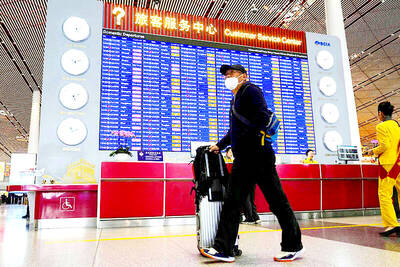
Taiwanese travelers could face exit restrictions as China expands government control under new regulations, an analyst said yesterday. China’s State Council has released new exit and entry regulations that expand the authorities’ power to restrict travel. Hung Pu-chao (洪浦釗), deputy head of Tunghai University’s Center for Mainland China and Regional Development Research, said the new regulations focus on managing cross-border activities as a whole, bringing the movement of talent, technology, information and social networks under the scope of national security oversight. The 19-part rules, which take effect on Sept. 15, were issued by Beijing for “regulating exit and entry management, protecting legitimate
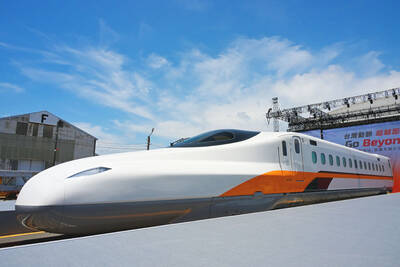
MORE WORK AHEAD: Trains must be assembled when they arrive, and undergo static and dynamic testing, while operation-critical systems must be established, an official said Taiwan High Speed Rail Corp (THSRC) yesterday said it would implement its largest timetable overhaul in 20 years, including the introduction of “super express” trains linking northern and southern Taiwan without intermediate stops. The new timetable is scheduled to be announced in the fourth quarter of this year and could be implemented as early as the beginning of next year, it said. The last major timetable revision was in 2015, when stops in Miaoli, Changhua and Yunlin counties were added to select services. All 12 new N700ST trainsets are scheduled to enter service by September 2028, expanding the fleet to 46 from

Japan’s Defense White Paper released yesterday highlighted Taiwan Strait security as a major concern, saying China has expanded military activities around Taiwan, used repeated drills to normalize the presence of the Chinese People’s Liberation Army (PLA), and strengthened blockade, precision strike, and joint operation capabilities. Chinese military aircraft entering Taiwan’s surrounding airspace surpassed 3,700 sorties last year, a sharp increase from about 970 in 2021, the paper said, adding that Chinese naval activity around Taiwan also rose to about 2,600 sorties. Since 2022, Beijing has repeatedly conducted large-scale military drills around Taiwan, said the paper, which is titled Security for the Future. The

Dutch elementary-school textbooks for English-language courses contain substantially more vocabulary and introduce more advanced words earlier than their Taiwanese counterparts, researchers said on Monday, citing a study that recommends expanding the range of vocabulary taught in Taiwanese classrooms. The study, conducted by the National Academy for Educational Research, compared elementary-school English textbooks used in Taiwan and the Netherlands, where English proficiency consistently ranks among the highest in the world. Academy associate researcher Chou Yi-ming (周一銘) said that the research team looked at elementary-school English textbooks from both countries and analyzed vocabulary difficulty and topic distribution using the English Vocabulary Profile (EVP). The findings


 RSS
RSS