

The National Chungshan Institute of Science and Technology and a US-based start-up yesterday announced a successful test of artificial intelligence (AI) pilots controlling multiple Mighty Hornet III drones in a search operation.
The success prompted the institute to renew its partnership with Shield AI to use its proprietary Hivemind AI pilots more broadly across Taiwan’s uncrewed aerial vehicle (UAV) fleet, the two said in a statement.
In less than three months, institute engineers implemented the AI pilots in three attack drones, the statement said.
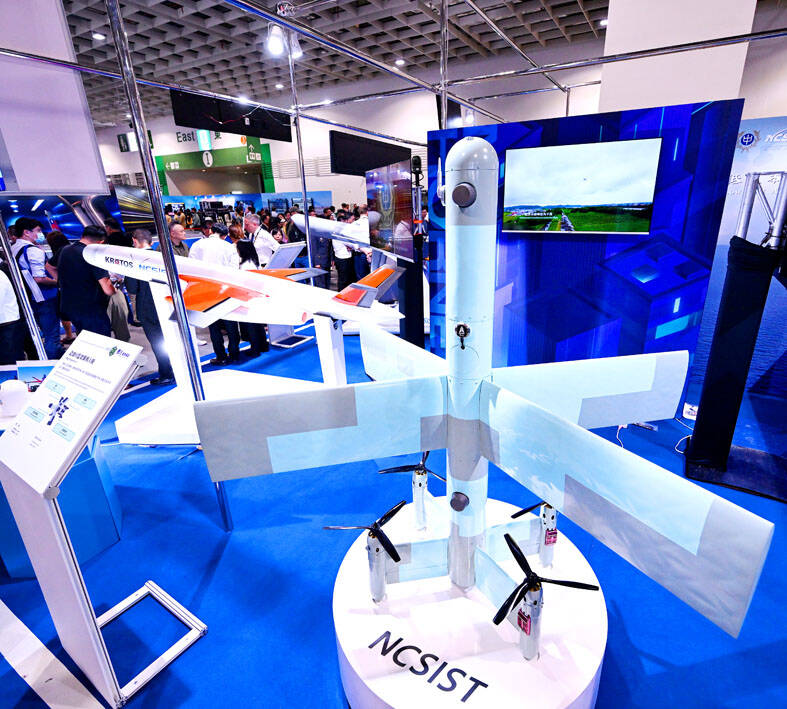
Photo: Fang Pin-chao, Taipei Times
The Hivemind-piloted UAVs “launched and coordinated ... a wide-area search while respecting a designated no-fly zone” before returning to base, all under autonomous control, it said.
Each AI-piloted UAV was assigned a search area, maintained communications with the other platforms, while one drone “operated around a partial no-fly zone within its search sector,” the statement said.
“What impressed us most was not only the high performance of the AI pilot, but Shield AI’s commitment to ensuring we could independently operate and employ the technology in such a short period,” institute president Li Shih-chiang (李世良) said in the statement.
“Their hands-on training and technical expertise and mentorship gave Taiwanese engineers the confidence to integrate and use Hivemind on our own,” Li said.
Shield AI president and cofounder Brandon Tseng (曾國光) said in the statement that “you can build 10 million drones, but you can’t train 10 million drone pilots.”
“Autonomy is the critical enabling technology to effectively leverage drones on the battlefield,” Tseng said.
“Hivemind’s ability to enable autonomous teaming is why autonomy is becoming one of the most important force multipliers in modern defense,” he added.
Hivemind’s Web site says it is “an end-to-end software for building and scaling AI pilots” to operate in contested battlespaces that feature GPS and communications jamming.
The software allows drones to autonomously execute operations and make use of coordinated multi-agent teaming and swarming, it said.
The use of autonomous attack drones has been demonstrated as a key capability in the Ukraine-Russia war, with both sides routinely targeting UAVs with electronic warfare systems.
As electronic warfare countermeasures target the wireless link between the machine and its human operator, an autonomous UAV operating independently of such connections would be immune to jamming, nullifying a mainstay in anti-drone defense.
The Mighty Hornet III, a platform developed by the institute and private-sector partners, is an X-wing anti-armor attack drone that has a 3D-printed airframe, the institute said on its Web site.
The vertical take-off-and-landing UAV has electro-optical sensors that enable autonomous navigation and target identification, it said.
The main design goals of the platform are low cost, high mobility, and ease of manufacture and deployment, it said.
Additional reporting by Aaron Tu
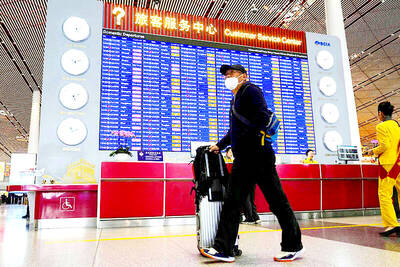
Taiwanese travelers could face exit restrictions as China expands government control under new regulations, an analyst said yesterday. China’s State Council has released new exit and entry regulations that expand the authorities’ power to restrict travel. Hung Pu-chao (洪浦釗), deputy head of Tunghai University’s Center for Mainland China and Regional Development Research, said the new regulations focus on managing cross-border activities as a whole, bringing the movement of talent, technology, information and social networks under the scope of national security oversight. The 19-part rules, which take effect on Sept. 15, were issued by Beijing for “regulating exit and entry management, protecting legitimate

MORE WORK AHEAD: Trains must be assembled when they arrive, and undergo static and dynamic testing, while operation-critical systems must be established, an official said Taiwan High Speed Rail Corp (THSRC) yesterday said it would implement its largest timetable overhaul in 20 years, including the introduction of “super express” trains linking northern and southern Taiwan without intermediate stops. The new timetable is scheduled to be announced in the fourth quarter of this year and could be implemented as early as the beginning of next year, it said. The last major timetable revision was in 2015, when stops in Miaoli, Changhua and Yunlin counties were added to select services. All 12 new N700ST trainsets are scheduled to enter service by September 2028, expanding the fleet to 46 from

Japan’s Defense White Paper released yesterday highlighted Taiwan Strait security as a major concern, saying China has expanded military activities around Taiwan, used repeated drills to normalize the presence of the Chinese People’s Liberation Army (PLA), and strengthened blockade, precision strike, and joint operation capabilities. Chinese military aircraft entering Taiwan’s surrounding airspace surpassed 3,700 sorties last year, a sharp increase from about 970 in 2021, the paper said, adding that Chinese naval activity around Taiwan also rose to about 2,600 sorties. Since 2022, Beijing has repeatedly conducted large-scale military drills around Taiwan, said the paper, which is titled Security for the Future. The

Dutch elementary-school textbooks for English-language courses contain substantially more vocabulary and introduce more advanced words earlier than their Taiwanese counterparts, researchers said on Monday, citing a study that recommends expanding the range of vocabulary taught in Taiwanese classrooms. The study, conducted by the National Academy for Educational Research, compared elementary-school English textbooks used in Taiwan and the Netherlands, where English proficiency consistently ranks among the highest in the world. Academy associate researcher Chou Yi-ming (周一銘) said that the research team looked at elementary-school English textbooks from both countries and analyzed vocabulary difficulty and topic distribution using the English Vocabulary Profile (EVP). The findings


 RSS
RSS