

Taiwan has completed the design of a hypersonic cruise missile that would be ready for mass production by next year at the earliest, a senior official said on Saturday.
The National Chungshan Institute of Science and Technology (NCIST) has finished work on the Ching Tien (擎天) missile — formerly known as Yun Feng (雲峰) II — a two-stage design that uses a solid-fuel rocket to gain altitude before switching to a ramjet engine to accelerate to hypersonic speeds, a high-ranking official familiar with the nation’s defense research and development programs said on condition of anonymity.
Although the NCIST has not released details of the Ching Tien missile’s performance to the public, outside experts have speculated that it might have a velocity of three to five times the speed of sound and a range about 1,250km.
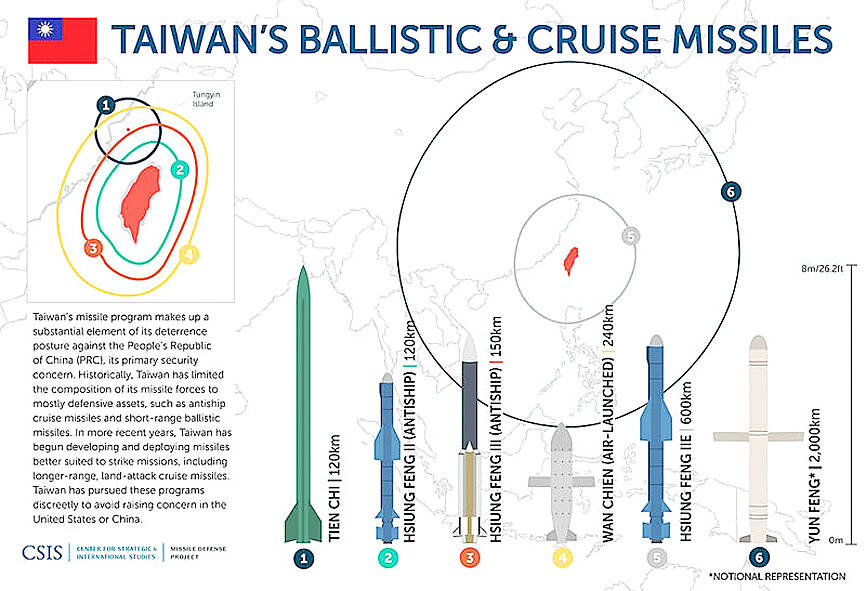
Photo: Screen grab from the CSIS Web site
Ching Tien missiles would enable Taiwan to strike at strategic targets in China’s interior, such as Beijing and Wuhan, significantly enhancing the nation’s deterrence capabilities, the official said.
The hypersonic missiles would utilize land-based launch vehicles that could be hidden in concealed shelters or tunnels during peacetime, and deployed to attack targets during wartime, they said, adding that their mobility would allow them to stay ahead of satellite-based surveillance platforms.
The Ministry of National Defense plans to initiate the missile’s mass production next year under the regular national defense budget for fiscal year 2027, the official said.
Russia is the only country in the world that possesses an operational hypersonic weapon — the 3M22 Zircon, which it has used against Ukraine.
China is arming its destroyers with YJ-20 anti-ship ballistic missiles which claim to have hypersonic capabilities, while the US is developing a hypersonic weapon that would supposedly enter service next year.
The NCIST has also made plans to improve the performance of Taiwanese air defense systems to handle a hypersonic missile threat, including a planned extended-range version of the Tien Kung III missile, the official said.
This new weapon would have a maximum altitude of 70km, which is required to intercept China’s Dongfeng missiles and hypersonic weapons, they said.
Taiwan’s AN/FPS-115 PAVE PAWS long-range radar in Hsinchu County’s Leshan (樂山) and arrangements to exchange intelligence with US-operated low-Earth orbit satellites are intended to combat this threat, they added.
The official said they hoped the legislature would support the ministry’s budget, as next year could prove a strategically crucial period for Taiwan’s race to build defensive and deterrence capabilities.

Taiwan has suspended visa processing for Moroccans in response to Morocco halting visa applications for Taiwanese travelers worldwide, the Ministry of Foreign Affairs said yesterday. The Moroccan embassy in Japan on Thursday last week informed Taiwanese travel agencies that it would suspend its visa confirmation letter application service for Taiwanese seeking to travel to Morocco, the ministry said in a statement. Taiwanese are required to obtain the letter before traveling to Morocco, the Bureau of Consular Affairs Web site says. Applications are submitted through the Moroccan embassy in Japan, which forwards them to Morocco for review. Once approved, the authorization
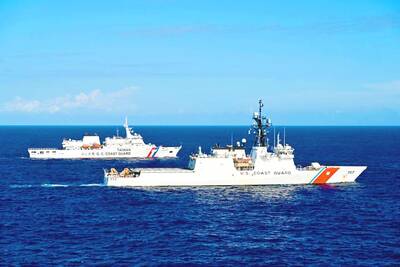
SIDE-BY-SIDE: The US appreciates Taiwan’s partnership in maritime security and safety, and supports its strong contributions to global maritime law enforcement, the AIT said The American Institute in Taiwan (AIT) yesterday for the first time shared a photograph of Taiwanese and US coast guard vessels operating side-by-side, saying that the two sides conducted joint operations ranging from search-and-rescue to maritime law enforcement. The Coast Guard Administration (CGA) and the US Coast Guard are “coordinating shared objectives such as search and rescue, preparing for tropical storms, disaster relief, preserving maritime resources, countering illegal fishing, and interdicting illegal drug shipments at sea,” the AIT said on Facebook. “The US appreciates Taiwan’s partnership in maritime security and safety, and supports Taiwan’s meaningful contributions on global issues including maritime law

MORE WORK AHEAD: Trains must be assembled when they arrive, and undergo static and dynamic testing, while operation-critical systems must be established, an official said Taiwan High Speed Rail Corp (THSRC) yesterday said it would implement its largest timetable overhaul in 20 years, including the introduction of “super express” trains linking northern and southern Taiwan without intermediate stops. The new timetable is scheduled to be announced in the fourth quarter of this year and could be implemented as early as the beginning of next year, it said. The last major timetable revision was in 2015, when stops in Miaoli, Changhua and Yunlin counties were added to select services. All 12 new N700ST trainsets are scheduled to enter service by September 2028, expanding the fleet to 46 from
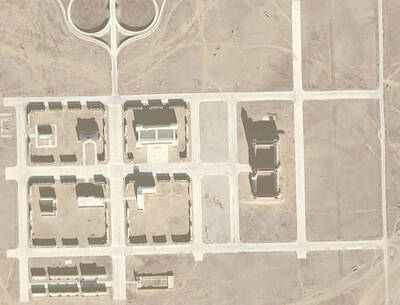
TARGETS: Taiwan has consistently planned for all possible scenarios involving Chinese action against the country and developed contingency measures, a major general said The Ministry of National Defense yesterday said it is monitoring the construction of full-scale replicas of military and government sites in Taiwan by the Chinese People’s Liberation Army’s (PLA). The comments from ministry spokesman Major General Sun Li-fang (孫立方) come after a report by the Telegraph on satellite imagery showing replicas of Taiwan’s Presidential Office Building, Suao Naval Base and other sites. Citing satellite imagery and defense analysts, the report, published on Sunday, said that the PLA had built life-size replicas of key government facilities to rehearse military operations under realistic conditions. The report described the scale and specificity of the training


 RSS
RSS