

The Executive Yuan is to unveil the central government’s general budget for the next fiscal year in a Cabinet meeting on Aug. 20, which might include President William Lai (賴清德) committing to allocating 3 percent of the nation’s GDP to defense spending, a source said yesterday.
Although the Legislative Yuan has not yet passed this year’s central government general budget, the Executive Yuan is already compiling the general budget for next year, they said, adding that the Directorate-General of Budget, Accounting and Statistics (DGBAS) last week reported on it to Lai and Premier Cho Jung-tai (卓榮泰).
Lai is expected to hold a news conference on the budget plan once it is finalized, while the Executive Yuan is scheduled to approve it on Aug. 20, the source said.
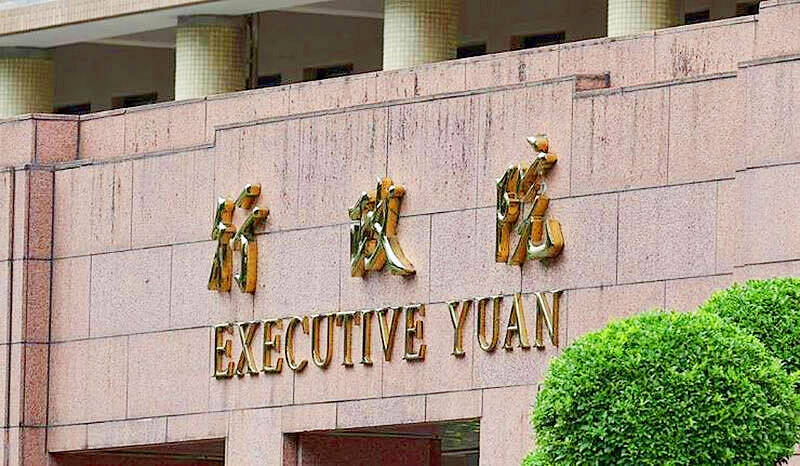
Photo: Chung Li-hua, Taipei Times
The president is also expected to reiterate his commitment to raising defense spending to 3 percent of GDP, the source added.
Next year’s central government budget is expected to feature expanded spending, including higher defense allocations.
Lai’s population strategy, announced on the second anniversary of his inauguration, would also likely receive an extra NT$205 billion (US$6.35 billion) next year, bringing total funding to NT$380 billion, they said.
Taiwan’s solid economic growth supports higher government spending, the source said, adding that annual expenditure growth had previously reached 20 percent.
However, this year’s increase would be constrained by amendments to the Act Governing the Allocation of Government Revenues and Expenditures (財政收支劃分法), they added.
As for the defense budget, the Executive Yuan had proposed a budget of NT$949.5 billion, or 3.32 percent of GDP — which meets the NATO defense spending target of at least 3 percent of GDP — but opposition parties ultimately trimmed it to just NT$8.8 billion, the source said.
It included veteran retirement payments and Coast Guard Administration expenditures, they added.
This year’s defense budget was benchmarked against last year’s GDP estimate of NT$28.6 trillion, but the DGBAS has estimated that GDP this year would be NT$33.5 trillion, so defense spending should exceed NT$1 trillion to meet the NATO standard, the source said.
However, opposition parties have blocked the defense budget, slashing the special defense bill from NT$1.25 trillion to NT$780 billion, and boycotted the proposed five-year NT$210 billion budget to fund the development of domestic drones and uncrewed aerial vehicles (UAVs), they said.
The parties also introduced a draft bill to include funding for domestic UAV development in the annual general budget instead, the source said.
Meeting the defense budget might prove to be challenging, they said, adding that to reach the 3 percent defense spending target, Taiwan would have to use last year’s GDP as its basis for the calculation, rather than using a fluctuating annual figure.

Taiwan has suspended visa processing for Moroccans in response to Morocco halting visa applications for Taiwanese travelers worldwide, the Ministry of Foreign Affairs said yesterday. The Moroccan embassy in Japan on Thursday last week informed Taiwanese travel agencies that it would suspend its visa confirmation letter application service for Taiwanese seeking to travel to Morocco, the ministry said in a statement. Taiwanese are required to obtain the letter before traveling to Morocco, the Bureau of Consular Affairs Web site says. Applications are submitted through the Moroccan embassy in Japan, which forwards them to Morocco for review. Once approved, the authorization
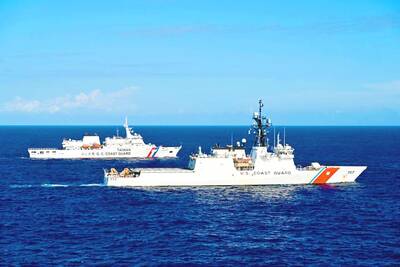
SIDE-BY-SIDE: The US appreciates Taiwan’s partnership in maritime security and safety, and supports its strong contributions to global maritime law enforcement, the AIT said The American Institute in Taiwan (AIT) yesterday for the first time shared a photograph of Taiwanese and US coast guard vessels operating side-by-side, saying that the two sides conducted joint operations ranging from search-and-rescue to maritime law enforcement. The Coast Guard Administration (CGA) and the US Coast Guard are “coordinating shared objectives such as search and rescue, preparing for tropical storms, disaster relief, preserving maritime resources, countering illegal fishing, and interdicting illegal drug shipments at sea,” the AIT said on Facebook. “The US appreciates Taiwan’s partnership in maritime security and safety, and supports Taiwan’s meaningful contributions on global issues including maritime law
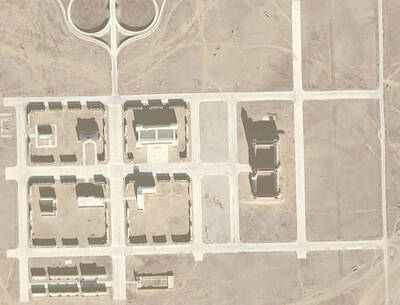
TARGETS: Taiwan has consistently planned for all possible scenarios involving Chinese action against the country and developed contingency measures, a major general said The Ministry of National Defense yesterday said it is monitoring the construction of full-scale replicas of military and government sites in Taiwan by the Chinese People’s Liberation Army’s (PLA). The comments from ministry spokesman Major General Sun Li-fang (孫立方) come after a report by the Telegraph on satellite imagery showing replicas of Taiwan’s Presidential Office Building, Suao Naval Base and other sites. Citing satellite imagery and defense analysts, the report, published on Sunday, said that the PLA had built life-size replicas of key government facilities to rehearse military operations under realistic conditions. The report described the scale and specificity of the training
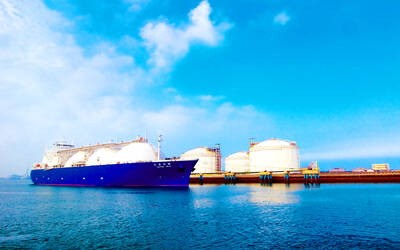
The Ministry of Foreign Affairs (MOFA) yesterday said it has temporarily suspended spot market purchases of liquefied natural gas (LNG) from Papua New Guinea (PNG) after the country’s foreign minister earlier this month unilaterally announced that Taiwan’s representative office there would be closed. PNG Minister of Foreign Affairs Justin Tkatchenko on July 16 said that his government had decided to close Taiwan’s representative office in Port Moresby. The cessation of operations and the formal closure of the physical presence of Taiwan’s representative office was an “administrative action” to “reaffirm Papua New Guinea’s one China policy,” a statement posted on Tkatchenko’s Facebook page


 RSS
RSS