

Typhoon Noul yesterday weakened to a tropical storm on Sunday, as it moved inland after lashing a stretch of southern China with strong winds and rain, prompting emergency relief in the fiercest storm to hit the country this year, state media reported.
Chinese weather authorities expected parts of southern Guangdong and southeastern Fujian provinces to experience heavy rain.
More than 801,000 people had been relocated for safety in Guangdong as of yesterday, the state-run Xinhua news agency said.

Photo: Xinhua news agency via AP
Prior to the storm’s landfall, severe weather forecasts had spurred authorities to evacuate more than 340,000 people and suspend work and rail services, with major flight disruptions continuing throughout yesterday morning.
The Hong Kong Airport Authority Hong Kong said that about 350 flights were canceled and about 2,000 passengers were stranded at the airport over the weekend.
At least 21 people were injured across the territory during the typhoon, Hong Kong authorities said.
The center of the typhoon crossed over land at about 3:50am near Guandong’s Pinghai, state broadcaster China Central Television reported.
Maximum sustained winds near the eye of the storm at the time of landfall were 162kph, it said.
That made Noul the strongest typhoon to strike the country so far this year, it added.
Before gaining intensity on Saturday over the South China Sea, Noul had already left a path of damage, clipping the extreme northern islands of the Philippines.
Three people were killed and one was missing due to the typhoon, the Philippine National Disaster Risk Reduction and Management Council said yesterday.
The Chinese Ministry of Water Resources upgraded its flood-control emergency response, including for Guangdong, over high risks of mountain floods, Xinhua said.
China’s National Development and Reform Commission said it allocated 100 million yuan (US$14.8 million) to support recovery efforts in Guangdong.
Separately, in northwestern China, at least 10 people died and 23 were injured in a flash flood in Gansu Province, Xinhua reported.
The flash flood, triggered by a period of sudden heavy rainfall, hit a scenic area in the province’s Weiyuan County in the afternoon and trapped some tourists who were camping.
Search-and-rescue operations were still under way, Xinhua said.
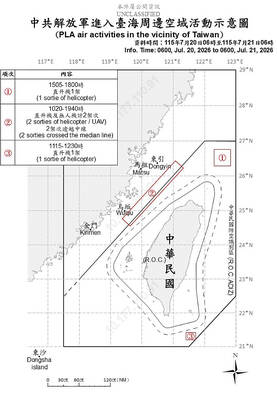
‘GRAY ZONE’ TACTICS: It was the first time a PLA chopper had crossed the line and could be part of training maneuvers in an invasion scenario, a researcher said The Chinese People’s Liberation Army (PLA) sent a helicopter across the median line of the Taiwan Strait to traverse a restricted flight zone east of the line for the first time on Monday, introducing two new “gray zone” tactics in a single day, a researcher said yesterday. Four PLA aircraft entered Taiwan’s air defense identification zone in the 24 hours ending at 6am yesterday, the Ministry of National Defense said in its daily report on PLA activities. Among them were PLA helicopters and uncrewed aerial vehicles (UAV), which were detected operating around the median line of the Taiwan Strait, as well as

Taiwan last week reported 4,766 new COVID-19 cases, five deaths and 25 patients with severe symptoms, reaching the benchmark of an epidemic, health officials said yesterday. The figure represented an increase of 66.5 percent over the previous week, Centers for Disease Control (CDC) Epidemic Intelligence Center Director Guo Hung-wei (郭宏偉) told a routine news conference in Taipei. Of those displaying severe symptoms, 74.5 percent were people older than 65, 83 had a history of chronic conditions, and 92.5 percent had not received this season’s new COVID-19 vaccines, he said. “Vaccination is still the main line of defense against severe symptoms and deaths” from
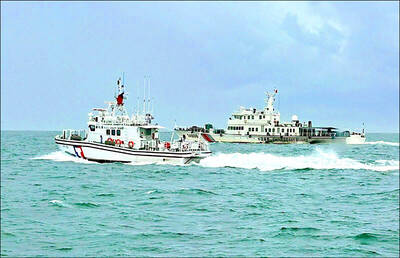
WARTIME RISK: Increased Chinese vessel activity might be rehearsals on how to sever Taiwan’s Pacific supply lines from allies, local officials said Taiwan detected a sharp rise in Chinese coast guard and research vessel activity around the nation last month, prompting Taipei to plan drills simulating Chinese escalations off its Pacific coast, the Coast Guard Administration (CGA) said. Taiwan reported 55 Chinese government vessel sightings, including coast guard and research boats, around the nation last month, up from 30 in May, CGA data showed. The sightings surged 83 percent from May and 120 percent from the 25 sightings a year earlier. The tally excluded sightings around Taiwan-controlled islands near the Chinese coast. The figures underscore the growing role of China’s coast guard in Beijing’s latest

PINGTUNG, TOO: The Yilan HSR line is to terminate at Nangang Station, while a line is to connect Kaohsiung’s Zuoying HSR Station to a planned station in Lioukuaitso Premier Cho Jung-tai (卓榮泰) yesterday officially approved a 60.6km extension of the high-speed rail (HSR) system to connect Taipei’s Nangang HSR Station with Yilan County, cutting travel time to about 28 minutes — a significant reduction compared with the Taiwan Railway Corp line. The project is expected to cost NT$352.175 billion (US$10.91 billion), with construction projected to be completed 11 years after final approval is received, or by 2037. The Yilan HSR line would run from the station in Nangang District (南港) through New Taipei City’s Sijhih (汐止), Pingsi (平溪), Shuangsi (雙溪) and Gongliao (貢寮) districts, before entering Yilan in Toucheng Township


 RSS
RSS