

Gongtian Temple (拱天宮) in Miaoli County’s Baishatun (白沙屯) has become the first temple in Taiwan to obtain an international Gold Standard (GS) carbon retirement certificate, the Tourism Innovation Association said yesterday.
The association said it has partnered with the Miaoli County Government to promote low-carbon sustainable tourism, with Gongtian Temple — one of Miaoli County’s most important religious centers and a representative site of Matsu (媽祖) worship in Taiwan — serving as a pilot site.
The project calculated carbon emissions generated by worshipers and retiring carbon credits certified under the international GS program, while integrating religious tourism, coastal scenery, industrial heritage, railway culture and community-based experiences, it said.
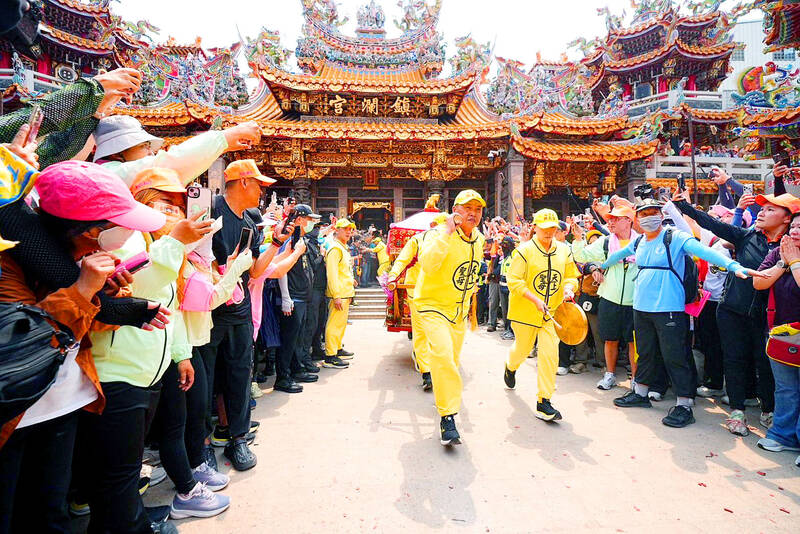
Photo courtesy of the Baishatun Gongtian Temple Culture Group
The initiative, in collaboration with Miaoli County Culture and Tourism Bureau, is the first in Taiwan to introduce carbon accounting into religious tourism, calculating emissions generated by worshipers during visits to the temple, including time spent on-site and use of facilities, it said.
The results showed that each pilgrim visit generated about 0.04kg of carbon dioxide equivalent, with the corresponding emissions fully offset through GS-certified carbon credit retirement, it said.
The project uses the temple as a demonstration hub linking several attractions along Miaoli’s coastline, including the Lower Sancha River Bridge (下三叉河橋) in Sihu (西湖), Tung Hsiao Tourism Park (通霄鹽廠), Haowangjiao (好望角) in Houlong Township (後龍), Guogang Tunnel (過港隧道) and the Shuiwei Community (水尾社區), it said.
Carbon footprint assessments and carbon offsetting were completed for three tourism routes along Miaoli’s coast, it said, adding that the low-carbon itineraries reduced emissions by as much as 78 percent compared with self-driving trips.
The initiative followed the avoid, reduce and offset framework by optimizing itineraries to avoid unnecessary travel and high-emission activities, incorporating low-carbon transportation such as rail, buses, bicycles and walking, and using carbon offsets for unavoidable emissions, it said.
The Sihu-Gongtian Temple route generated a carbon footprint of 4.43kg per person, and by combining high-speed rail and bus transportation, emissions were reduced from 33.16kg for a self-driving trip to 7.6kg — a reduction of 77 percent, it said.
The Haowangjiao-Tung Hsiao Tourism Park route produced 4.04kg per person, with emissions reduced from 32.77kg to 7.21kg, a decrease of 78 percent, it said.
The Lower Sancha River Bridge, Guogang Tunnel and Shuiwei Community route generated 19.52kg per person, reducing emissions from 48.25kg to 22.69kg — a 53 percent reduction, it said.
Companies worldwide are increasingly incorporating carbon emissions data, low-carbon transportation options and suppliers’ sustainability performance into business travel and event procurement decisions, association chairman Ringo Lee (李奇嶽) said.
Tourism products that have undergone carbon footprint assessments, third-party verification and international carbon credit retirement can help companies obtain traceable travel emissions data and strengthen green procurement and environmental, social and governance management, Lee said.
Government agencies, businesses, schools, civic groups and religious organizations visiting Gongtian Temple would be able to apply for carbon offsets based on participant numbers and receive GS carbon retirement certificates, the association said.
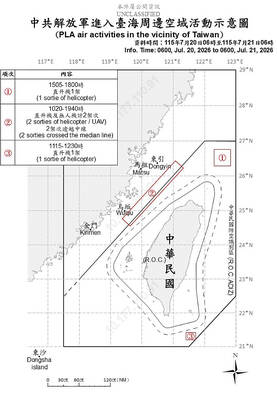
‘GRAY ZONE’ TACTICS: It was the first time a PLA chopper had crossed the line and could be part of training maneuvers in an invasion scenario, a researcher said The Chinese People’s Liberation Army (PLA) sent a helicopter across the median line of the Taiwan Strait to traverse a restricted flight zone east of the line for the first time on Monday, introducing two new “gray zone” tactics in a single day, a researcher said yesterday. Four PLA aircraft entered Taiwan’s air defense identification zone in the 24 hours ending at 6am yesterday, the Ministry of National Defense said in its daily report on PLA activities. Among them were PLA helicopters and uncrewed aerial vehicles (UAV), which were detected operating around the median line of the Taiwan Strait, as well as

Taiwan last week reported 4,766 new COVID-19 cases, five deaths and 25 patients with severe symptoms, reaching the benchmark of an epidemic, health officials said yesterday. The figure represented an increase of 66.5 percent over the previous week, Centers for Disease Control (CDC) Epidemic Intelligence Center Director Guo Hung-wei (郭宏偉) told a routine news conference in Taipei. Of those displaying severe symptoms, 74.5 percent were people older than 65, 83 had a history of chronic conditions, and 92.5 percent had not received this season’s new COVID-19 vaccines, he said. “Vaccination is still the main line of defense against severe symptoms and deaths” from
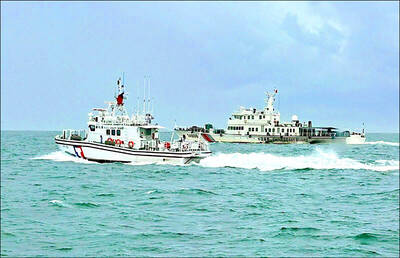
WARTIME RISK: Increased Chinese vessel activity might be rehearsals on how to sever Taiwan’s Pacific supply lines from allies, local officials said Taiwan detected a sharp rise in Chinese coast guard and research vessel activity around the nation last month, prompting Taipei to plan drills simulating Chinese escalations off its Pacific coast, the Coast Guard Administration (CGA) said. Taiwan reported 55 Chinese government vessel sightings, including coast guard and research boats, around the nation last month, up from 30 in May, CGA data showed. The sightings surged 83 percent from May and 120 percent from the 25 sightings a year earlier. The tally excluded sightings around Taiwan-controlled islands near the Chinese coast. The figures underscore the growing role of China’s coast guard in Beijing’s latest

PINGTUNG, TOO: The Yilan HSR line is to terminate at Nangang Station, while a line is to connect Kaohsiung’s Zuoying HSR Station to a planned station in Lioukuaitso Premier Cho Jung-tai (卓榮泰) yesterday officially approved a 60.6km extension of the high-speed rail (HSR) system to connect Taipei’s Nangang HSR Station with Yilan County, cutting travel time to about 28 minutes — a significant reduction compared with the Taiwan Railway Corp line. The project is expected to cost NT$352.175 billion (US$10.91 billion), with construction projected to be completed 11 years after final approval is received, or by 2037. The Yilan HSR line would run from the station in Nangang District (南港) through New Taipei City’s Sijhih (汐止), Pingsi (平溪), Shuangsi (雙溪) and Gongliao (貢寮) districts, before entering Yilan in Toucheng Township


 RSS
RSS