

The government is amending food safety laws to better define the jurisdiction and responsibilities of central and local governments, and imposing heavier fines of up to NT$30 million (US$927,500) for safety breaches, Minister of Health and Welfare Shih Chung-liang (石崇良) said yesterday.
The move follows the discovery of excessive levels of the carcinogen benzopyrene in cooking oil manufactured by Central Union Oil Corp (中聯油脂), which has affected mid and downstream producers of oil and secondary products.
The Act Governing Food Safety and Sanitation (食品安全衛生管理法) states that while both the central and local governments are responsible for food safety, neither can unilaterally provide oversight, Shih said.
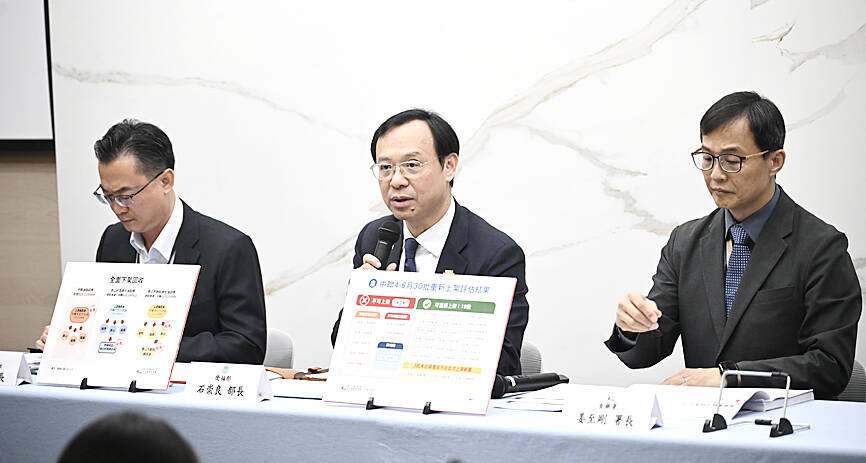
Photo: Lo Pei-de, Taipei Times
The proposed amendments would expand the responsibilities of local health departments to inspect, provide oversight and administer tests for local manufacturers, Shih said, adding that the goal is clearer responsibility.
Food safety incidents would be handled in the same way as epidemics or contagious disease outbreaks, and, depending on the severity of the situation, the central government might establish a central food safety command center to unify national response to food safety incidents, the amendments say.
The two guiding principles for dealing with food safety incidents are “prevention at the source” and “recalling all affected products,” Shih said.
Measures to preemptively remove products from shelves would be written into law and clearly define the extent of the product withdrawals, the procedures to be taken, and measures and approvals to put products back on shelves, or how they are to be disposed of, Shih said.
Increased fines are a focus of the amendment, Shih said, citing how Central Union’s delayed reporting of the incident caused the government to lose precious time in containing products at the source and delayed product recall measures.
The maximum fine for deliberately not reporting or delaying reporting, of food safety breaches would be increased 10-fold — from NT$3 million (US$92,750) to NT$30 million, Shih said.
The intention is to make the cost unbearable for manufacturers to prevent them from even thinking of delaying or not reporting safety incidents, he said.
Test labs, in addition to manufacturers or companies, must report to competent authorities if test results are abnormal or products contain excessive residual levels of heavy metals, carcinogens or other substances, the amendments say.
Shih thanked the Kaohsiung City Government and the Tainan Department of Health for assisting in the investigations, and Taiwan Sugar Corp (台糖), TTET Union Corp (大統益) and others for complying with investigations and supplying safe cooking oil during the incident.
He also thanked local health departments and offices for stepping up inspections and doing their part in maintaining food safety.
Separately, the health ministry said that of the 30 Central Union-manufactured cooking oil batches produced between April and last month, 22 were declared safe, seven were not, and one batch could not be tested because it had been exported to South Korea.
Nineteen of the 22 safety-compliant batches can be put back on shelves for sale, the ministry said.
The remaining three had never been distributed and health authorities might continue to put them under embargo, he said.
The seven found to contain excessive levels of benzopyrene would be destroyed, he said.
Shih added that Central Union had relaxed its standards for accepting soybeans damaged by heat loss to 5 percent, up from 0.5 percent, while failing to implement production controls.
Food and Drug Administration Director-General Chiang Chih-kang (姜至剛) said that preliminary investigations showed that heat loss tends to produce oil with a higher concentration of benzopyrene.
The changes made by the company might be the root cause of the problem, Chiang said.
The correlation between excessive benzopyrene levels in Central Union’s oils and the decision to accept more beans damaged by heat loss has yet to be confirmed by experts, Shih said.

SHOW OF SUPPORT: The US said it was ‘deeply concerned’ about the Pacific nation’s decision, as Taiwan is a reliable partner and its relationships provide ‘significant benefits’ Taiwan is reassessing its economic ties with Papua New Guinea (PNG) after the Pacific nation on Wednesday unexpectedly ordered the immediate closure of Taipei’s representative office in Port Moresby, Ministry of Foreign Affairs Lin Chia-lung (林佳龍) said yesterday. The ministry convened a meeting to discuss potential responses, which included reviewing Taiwan’s liquefied natural gas (LNG) purchases from Papua New Guinea, Lin said, adding that the nation’s imports of about 1.2 million tonnes of LNG annually accounted for about one-third of the Pacific nation’s LNG exports and were a major source of revenue for the country. In 2024, Papua New Guinea exported US$5.36

BIG DREAMS: The education ministry said it hoped that by hosting the competition next year, it could help Taiwan nurture talented students and foster global connections Taiwanese high-school students over the weekend swept four gold medals at the International Biology Olympiad (IBO) in Lithuania, and secured three golds and one silver at the International Chemistry Olympiad (IChO) in Uzbekistan. All four members of the Taiwan team for IBO — Hsu Ting-jui (許庭睿) from Taichung First Senior High School, Chen Yu-chen (陳語晨) from Taipei First Girls’ High School, and Chan Wei-chun (詹緯濬) and Yao Yi-keng (姚亦耕) from Taipei Municipal Chien Kuo High School — received gold medals in the competition, which was held from Sunday last week to yesterday, the Taiwanese Representative Office in Lithuania said in a
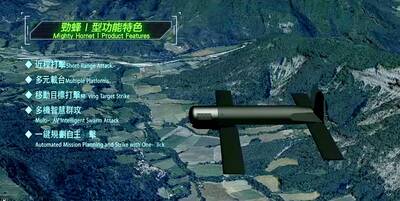
Taiwan and the US have agreed to jointly produce the National Chungshan Institute of Science and Technology (NCSIST)-developed Chien Feng I (勁蜂一型, Mighty Hornet I) drone, a high-level government official familiar with the matter said. The Mighty Hornet I, which is in service with the Marine Corps, has passed live-fire tests, including being launched from fast-moving surface ships, the source said, speaking on condition of anonymity. Under the collaboration — which must still undergo a national security review and receive budget approval from the legislature — Taiwan and the US would jointly produce the attack drone, while the US would
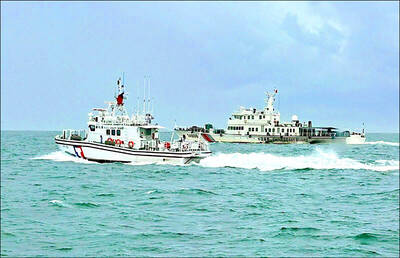
WARTIME RISK: Increased Chinese vessel activity might be rehearsals on how to sever Taiwan’s Pacific supply lines from allies, local officials said Taiwan detected a sharp rise in Chinese coast guard and research vessel activity around the nation last month, prompting Taipei to plan drills simulating Chinese escalations off its Pacific coast, the Coast Guard Administration (CGA) said. Taiwan reported 55 Chinese government vessel sightings, including coast guard and research boats, around the nation last month, up from 30 in May, CGA data showed. The sightings surged 83 percent from May and 120 percent from the 25 sightings a year earlier. The tally excluded sightings around Taiwan-controlled islands near the Chinese coast. The figures underscore the growing role of China’s coast guard in Beijing’s latest


 RSS
RSS