


The Legislative Yuan yesterday referred four competing bills on procuring domestically produced drones to committee review, setting up a battle that would focus mainly on how the government should fund its purchase of drones.
The bills, one from the Cabinet, the Chinese Nationalist Party (KMT), the Taiwan People’s Party (TPP) and Democratic Progressive Party (DPP) Legislator Lin Chu-yin (林楚茵), are to undergo a joint review by the Finance, Economics, Foreign Affairs and National Defense committees.
The Cabinet proposed its bill last month after opposition parties removed funding for domestic drone purchases from the NT$1.25 trillion (US$39.15 billion) special defense budget bill the Executive Yuan had proposed earlier in the year.
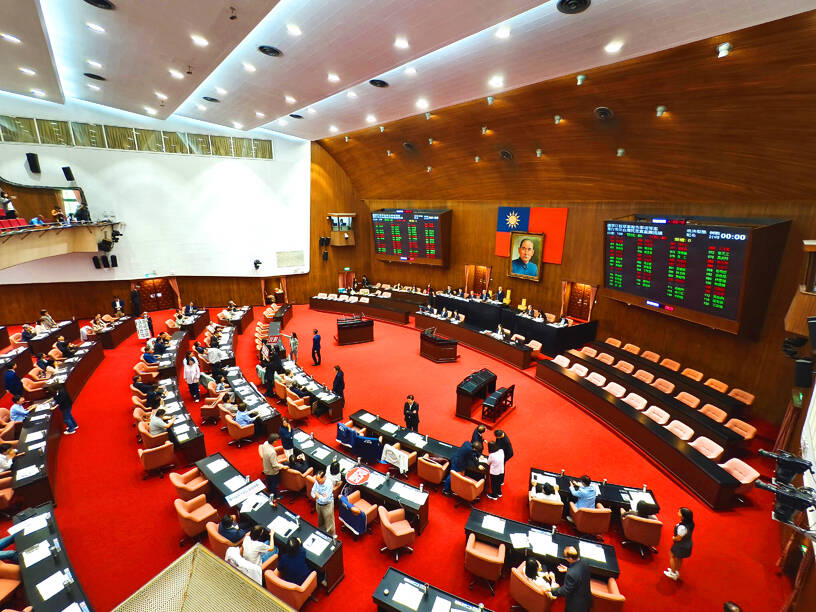
Photo: Wang Yi-sung, Taipei Times
The KMT and the TPP, which hold a combined majority in the legislature, passed an alternative version of the special budget bill, with a spending cap of NT$780 billion that focused on the purchase of US weapons.
The Cabinet’s drone procurement bill and Lin’s bill are identical in their push for a six-year NT$210 billion special budget to buy drones.
The only difference between the two is that Lin’s bill explicitly ties the legislation to the opposition’s removal of NT$470 billion from the Cabinet’s special budget bill, saying that it hampered Taiwan’s efforts to build asymmetric capabilities.
The KMT’s bill would allocate NT$240 billion through the general budget over six years.
The TPP’s version does not have a spending cap, but would require funding to also come through annual appropriations from the general budget.
The government would also be required to devise uncrewed aerial vehicle development guidelines every four years and review them every two years, the TPP’s bill says.
The main difference between the ruling and the opposition’s bills is the source of funding.
The Ministry of National Defense and the DPP said that using a special budget — which is considered separate from the general budget and is designated for specific purposes — would ensure stable funding.
That would enable the ministry to place large, long-term orders with domestic defense companies while supporting innovation to keep pace with rapidly evolving drone technology, they said.
However, opposition parties said that funding drone procurement through the general budget would reduce corruption risks and uphold fiscal discipline.
The size of the budget would also be a negotiating point.
Despite its concern over corruption risks and fiscal discipline, the KMT’s bill has a higher spending cap than the DPP’s, but did not explain why.


COUNTER: The government should put forward a more proactive exchange policy for the youth and encourage them to engage with the wider world, the source said Beijing is trying to entice young Taiwanese to attend the Cross-Strait Sun Yat-sen Forum in Guangdong Province, China, by offering to cover all their expenses except round-trip airfare, an official said yesterday. “The cheapest things are the most expensive,” an official familiar with China’s “united front” work said, adding that such tours typically include visits to “red propaganda bases.” “These kinds of united front trips only end up bringing back a lot of falsehoods,” said the official, who wished to remain anonymous. The forum, which began on Saturday last week, ends today. China is offering an all-expense paid trip to Taiwanese participants aged

BUDGET HICCUP: While the NCSIST said part of the system is ready for deployment, opposition lawmakers removed the project’s funding during its legislative review Taiwan’s integrated air defense intelligence system is on track to be completed by the end of the year, and, if additional funding is approved, the military aims to deploy it next year, a military source said. The first phase of a next-generation, domestically developed regional air defense system combines the Huanzhan Project (寰展計畫), which integrates air defense intelligence across the armed forces, and the National Chungshan Institute of Science and Technology’s (NCSIST) Chiang Kung (強弓, “Strong Bow”) missile defense program, the source said on Saturday. The Huanzhan Project would establish an automated joint command-and-control network linking the army, navy and air force, replacing
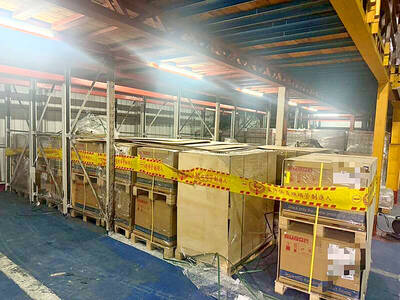
ONGOING PROBE: Prosecutors on Monday raided the offices and residences of six people suspected to be involved in the smuggling of high-end AI chips to China Keelung prosecutors yesterday detained three executives from technology firms over the alleged smuggling of NT$700 million (US$21.99 million) of advanced Nvidia Corp chips to China, Hong Kong and Macau. The Keelung District Court late last night approved the prosecutors’ request to detain an Albatron Technology Co (青雲科技) vice president surnamed Lu (呂), and managers from Super Micro Computer Inc’s Taiwan branch surnamed Wang (王) and Lin (林). Investigators on Monday raided 12 sites as part of the investigation, including the homes of six people and the offices of the companies they worked for — Albatron, Chief Telecom Inc (是方電訊) and Super Micro,

DEFENDING TAIWAN: The government would work with like-minded countries to deepen international engagement and counter cross-border repression, Lai said President William Lai (賴清德) yesterday said that “Taiwan will not accept ‘red terror,’” as he outlined countermeasures against China’s Law on Promoting Ethnic Unity and Progress. The law, passed by the Chinese National People’s Congress in March and which went into effect yesterday, requires all Chinese citizens to uphold national unification. Critics in Taiwan have said it aims to strengthen the identification of Taiwanese as members of the “Chinese nation.” It also states that people or organizations, inside or outside China, who undermine ethnic unity or promote ethnic division can be held legally liable, without clearly identifying what kind of conduct falls under


 RSS
RSS