


India and Japan will work more closely on critical minerals to boost “resilience” in their supply chains, Indian Prime Minister Narendra Modi said yesterday, as the two huge Asian economies look to cut dependence on top exporter China.
India and Japan depend on imports for many such minerals, used in everything from electric vehicles, solar panels and smartphones to jet engines and guided missiles.
They have been seeking new suppliers, including the US and other countries, as China’s dominance might leave them vulnerable to changes in their ties with Beijing.
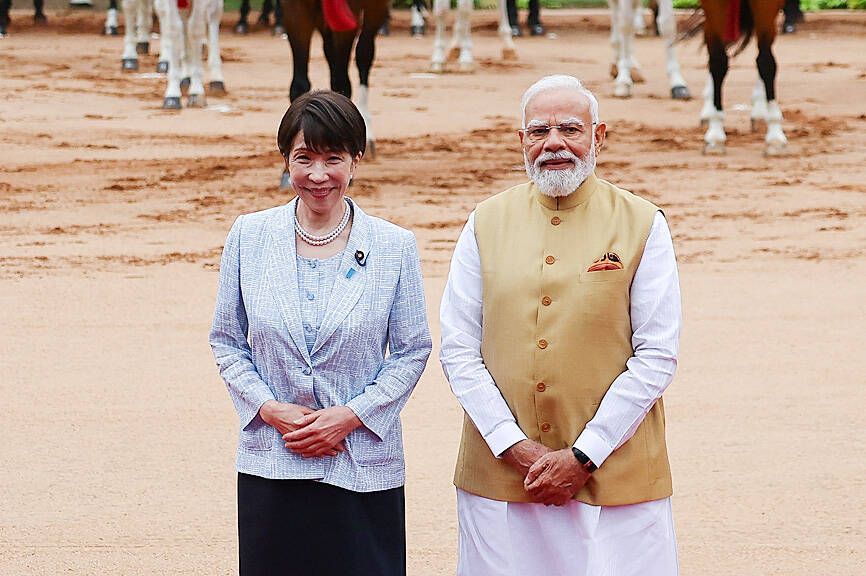
Photo: Reuters
“We have agreed to strengthen supply chain resilience in strategic sectors such as semiconductors, quantum technologies and critical minerals,” Modi said after talks with Japanese Prime Minister Sanae Takaichi in New Delhi.
Japan and India are members of the Quad security alliance along with the US and Australia, a group seen as a counterweight to China’s expanding presence in the Indian Ocean and wider Asia-Pacific region.
Japan and India were facing challenges such as “weaponization of the economy and non-market policies and practices,” Takaichi said.
“We need to urgently build resilience in our critical minerals supply chains,” she added.
In a sign of camaraderie between the two leaders, Modi referred to Takaichi as his “little sister” and the Japanese prime minister responded by calling him “elder brother.”
Japanese and Indian businesses concluded investment deals worth US$12.3 billion, the two sides said.
They form part of a Japanese pledge to pour US$68 billion into India over 10 years.
Modi said the countries had also agreed to codevelop a naval radio antenna project aimed at boosting maritime surveillance.
Earlier, Takaichi received a red-carpet welcome at the presidential palace in Delhi, where troops marched past in an honor guard parade.


COUNTER: The government should put forward a more proactive exchange policy for the youth and encourage them to engage with the wider world, the source said Beijing is trying to entice young Taiwanese to attend the Cross-Strait Sun Yat-sen Forum in Guangdong Province, China, by offering to cover all their expenses except round-trip airfare, an official said yesterday. “The cheapest things are the most expensive,” an official familiar with China’s “united front” work said, adding that such tours typically include visits to “red propaganda bases.” “These kinds of united front trips only end up bringing back a lot of falsehoods,” said the official, who wished to remain anonymous. The forum, which began on Saturday last week, ends today. China is offering an all-expense paid trip to Taiwanese participants aged
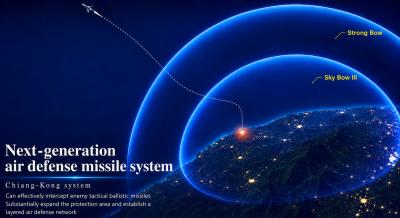
BUDGET HICCUP: While the NCSIST said part of the system is ready for deployment, opposition lawmakers removed the project’s funding during its legislative review Taiwan’s integrated air defense intelligence system is on track to be completed by the end of the year, and, if additional funding is approved, the military aims to deploy it next year, a military source said. The first phase of a next-generation, domestically developed regional air defense system combines the Huanzhan Project (寰展計畫), which integrates air defense intelligence across the armed forces, and the National Chungshan Institute of Science and Technology’s (NCSIST) Chiang Kung (強弓, “Strong Bow”) missile defense program, the source said on Saturday. The Huanzhan Project would establish an automated joint command-and-control network linking the army, navy and air force, replacing
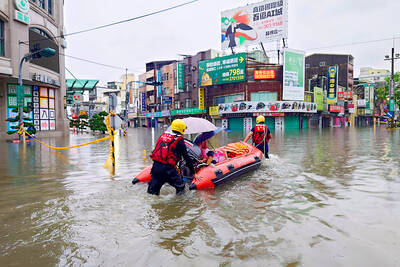
Torrential rain battered Taiwan for a second day yesterday and caused widespread flooding nationwide that led to at least two deaths as rising waters stranded residents and prompted emergency rescues. Premier Cho Jung-tai (卓榮泰) yesterday morning directed the Ministry of Economic Affairs to aid local governments with pumps to clear inundated areas. The heavy rain was brought by Tropical Storm Mekkhala as it moved northward east of Taiwan, strengthening southwesterly winds and an approaching weather front from southern China, the Central Weather Administration said. As of press time last night, the severe flooding had killed two people. Kaohsiung police said a 73-year-old woman surnamed
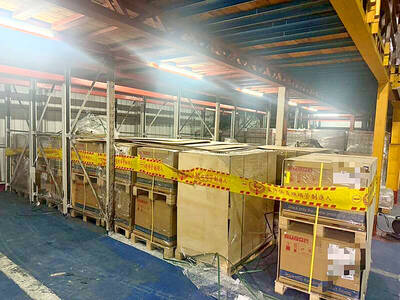
ONGOING PROBE: Prosecutors on Monday raided the offices and residences of six people suspected to be involved in the smuggling of high-end AI chips to China Keelung prosecutors yesterday detained three executives from technology firms over the alleged smuggling of NT$700 million (US$21.99 million) of advanced Nvidia Corp chips to China, Hong Kong and Macau. The Keelung District Court late last night approved the prosecutors’ request to detain an Albatron Technology Co (青雲科技) vice president surnamed Lu (呂), and managers from Super Micro Computer Inc’s Taiwan branch surnamed Wang (王) and Lin (林). Investigators on Monday raided 12 sites as part of the investigation, including the homes of six people and the offices of the companies they worked for — Albatron, Chief Telecom Inc (是方電訊) and Super Micro,


 RSS
RSS