


Iran launched a drone assault targeting Bahrain while a ship in the Strait of Hormuz separately came under attack yesterday, likely Tehran’s response to overnight airstrikes by the US.
The attacks across the Persian Gulf show the danger of the Iran war again spinning out of control, even after Iran and the US reached an interim deal to try and agree on a final accord to end the conflict.
Washington had launched its airstrikes in response to an Iranian drone attack on a ship trying to get out of the strait on Thursday, continuing a string of attacks that have shaken the uneasy ceasefire in the war.
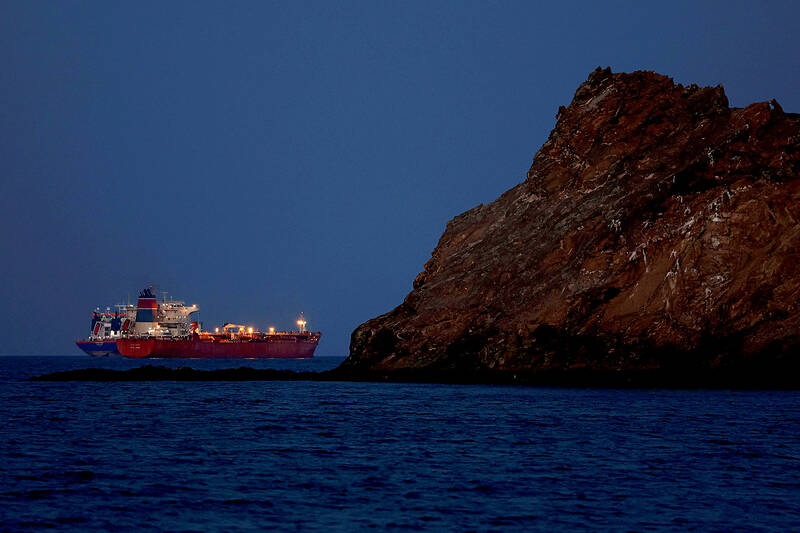
Photo: Reuters
Meanwhile, a multinational maritime body overseen by the US Navy said it would expand a route near Oman in the strait to allow for inbound and outbound traffic — likely setting up a new flashpoint with Tehran.
That Iran targeted Bahrain likely was not coincidental. The kingdom has been one of the strongest critics of Iran and is home to the US Navy’s 5th Fleet. It just hosted US Secretary of State Marco Rubio for a meeting of the Gulf Cooperation Council’s foreign ministers, which ended with a call for an end to Iran’s attacks and the strait to be completely open.
The Bahraini Ministry of Foreign Affairs said a “number of Iranian drones” targeted the country and called the attack “a flagrant threat to the security of citizens and residents.”
Iran’s Revolutionary Guard earlier said it had targeted several locations “of the US terrorist army in the region.”
It did not name what areas were targeted.
The US military’s Central Command said the military struck Iranian missile and drone locations and coastal radar sites in the overnight strikes.
US Vice President J.D. Vance on Friday said Iran should “pick up the phone” if there are disagreements about the ceasefire agreement, and that “violence will be met with violence.”
The US and Iran are still negotiating terms of the deal, including issues such as getting ships through the key strait and addressing the future of Iran’s stockpile of highly enriched uranium. Under the interim deal, the two sides have 60 days to work out the details.
Meanwhile, the British military’s UK Maritime Trade Operations center said that a tanker was attacked yesterday in the strait.
The crew was safe and no environmental damage was reported, it said.
No one immediately claimed the strike, but suspicion immediately fell on Iran.
Just after the report of the ship attack, the Joint Maritime Information Center, overseen by the US Navy, said the route near Oman’s shores is expanding to allow for inbound and outbound traffic.
Ebrahim Azizi, who heads the Iranian parliament’s national security commission, said: “the Strait of Hormuz is governed by Iran, so: Respect the rules.”
The US and Gulf Arab states have rejected Iran’s demands. The strait is considered around the world as an international waterway, despite being the territorial waters of Iran and Oman.
In its announcement, the Joint Maritime Information Center warned that the threat in the region to ships was “substantial.”
“Mariners are advised of the existence of mines and should expect a naval presence as clearance operations continue,” the center added.
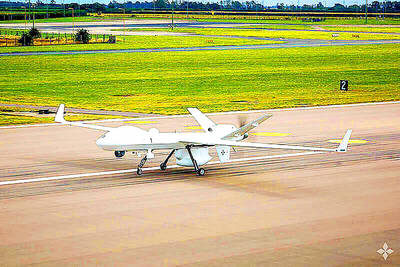
BOOST: By operating the same advanced systems as the US military, Taiwan would be better positioned to share and integrate intelligence with partners, an expert said The first batch of MQ-9B SkyGuardian drones has arrived in Taiwan, and is being assembled and tested by drone manufacturer General Atomics and the military ahead of flight trials as part of the air force’s acquisition to bolster its aerial surveillance capabilities, a source said yesterday. The air force allocated a budget of NT$21.7 billion (US$687 million) from 2022 to 2029 to procure four MQ-9B uncrewed aerial vehicles (UAVs) manufactured by General Atomics along with associated equipment such as ground control stations. The US has agreed to deliver the four MQ-9Bs to Taiwan in two batches this year and next
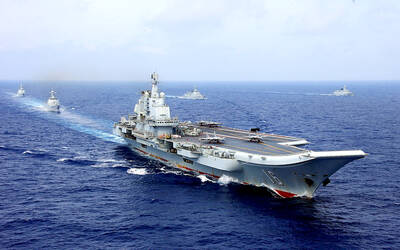
Japan on Wednesday rejected Beijing’s accusations that the Japanese military harassed a Chinese aircraft carrier strike group during 40 days of exercises in “distant waters” of the Pacific. The Chinese navy earlier this week said that Japanese ships and aircraft “repeatedly engaged in close-range tracking, surveillance, harassment and provocation.” China said a formation led by its Liaoning aircraft carrier had operated in areas including the South China Sea and the western Pacific for “multiple rounds of day-and-night offensive and defensive exercise.” The Liaoning group “maintained a high state of alert throughout, launching carrier-based aircraft for combat sorties ... and steadily responding to the

Taiwanese firms’ China investments have dwindled to less than 1 percent of their total foreign investments, putting China-based investments on track for a record low this year, Ministry of Economic Affairs data showed. Taiwan’s investments abroad in the first five months of this year reached US$35.92 billion, Department of Investment Review data showed. Investments outside China totaled US$35.61 billion, up 133.94 percent year-on-year, while investments in China totaled US$310.3 million, down 32.3 percent and about 0.86 percent of the total, data showed. Major overseas projects included Taiwan Semiconductor Manufacturing Co’s (TSMC, 台積電) US$30 billion capital injection into an overseas subsidiary,
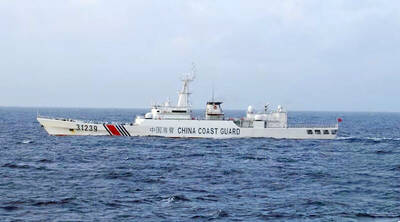
GLOBAL CONCERN: The UK, German and French offices reiterated their opposition to unilateral changes to the Taiwan Strait ‘status quo,’ particularly by threat or force The UK, Germany and France’s de facto embassies in Taiwan, as well as the US’ office, yesterday expressed concern over China’s “special maritime law enforcement operations” in waters east of Taiwan, saying that such behavior threatens regional stability. In a joint statement issued by the British Office Taipei, the German Institute Taipei and the French Office in Taipei, the three offices, which represent their respective countries’ interests in Taiwan in the absence of official diplomatic ties, said that they had “noted with concern novel Chinese activity in the waters east of Taiwan.” “These actions threaten regional stability, and the freedom of navigation


 RSS
RSS