


EU leaders agreed during talks on Thursday that the bloc must develop beefed-up trade defenses to curb a surge of Chinese exports deemed an existential threat to European industry by Brussels — while simultaneously seeking “constructive dialogue” with Beijing.
There is a growing consensus in the EU that it is too dependent on China, and Brussels fears this makes it vulnerable to potential coercion and supply shocks. The 27-nation bloc’s trade deficit in goods hit about 360 billion euros (US$413 billion) last year.
During a two-hour summit dinner in Brussels, leaders chewed over how the EU could address the imbalance, and whether the bloc needed to boost its arsenal.
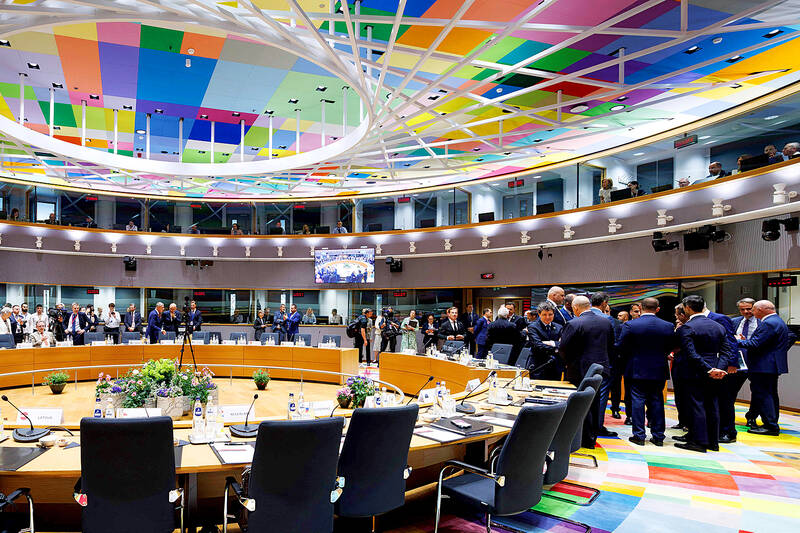
Photo: AFP
After talks ended early yesterday, an EU official said the leaders tasked the European Commission with continuing to engage “in a constructive dialogue with our main economic partners,” but did not directly say China.
They also asked the executive “to develop and eventually complement the toolbox in the area of trade defence” and to make sure the EU has “all the instruments it needs to defend its interests and derisk,” the official said.
While EU capitals agree on a common diagnosis, the positions differ on the cure and several leaders on Thursday had called for dialogue as a priority.
Spanish Prime Minister Pedro Sanchez struck a more conciliatory tone than his counterparts before the dinner.
“We need friends, we need balanced relationships, we need to be pragmatic, and we need to build bridges both with major economies and potential allies, such as China,” Sanchez told reporters.
One way to beef up the EU’s arsenal could be creating a new tool to impose sector-specific tariffs such as chemicals or green tech — taking a page out of US President Donald Trump’s playbook.
French President Emmanuel Macron last month called for a “European equivalent of Section 301” — the trade tool Trump has employed to set sweeping tariffs — saying that Europe’s “sovereignty is at stake.”
Germany has until now adopted a cautious posture because its economy is more exposed to potential retaliation, while Spain has sought to avoid tensions as it chases Chinese investment.
However, Berlin appeared to be coming around to France’s way of thinking.
A German official said Berlin was “open” to new tools if they are necessary so long as they were “not targeted at specific recipients.”
However, German Chancellor Friedrich Merz would not be drawn on China by reporters in Brussels.
Irish Prime Minister Micheal Martin said before the dinner he wanted to see “the shape and nature of any mechanisms” introduced but warned Europe had to make sure it understood the consequences.
The EU official did not comment on what any new tools would look like.
Concern about Chinese dominance is not limited to the EU.
Fears are rising in the West over Beijing’s control in the market for rare earth minerals used in everyday electronic appliances, and China was on the agenda of G7 talks in France this week.
Brussels often evokes the need for fair competition, pointing to the unfair advantage Chinese companies have because of massive state subsidies.
Between 2005 and 2024, Chinese firms received about three to eight times more government support than firms in the Organisation for Economic Co-operation and Development, according to the OECD, which called it “a conservative estimate”.
Even as its resolve appears to be hardening, the EU has shown no appetite to trigger a broader trade war with China.
Fears over Chinese retaliation are not unfounded.
After the EU hit Chinese electric vehicles with higher tariffs in 2024, China imposed anti-dumping duties on European cognac.
Moreover, Beijing has vowed to hit back if the EU pushes through rules that would exclude certain products manufactured outside the bloc from public contracts.
European Commissioner for Trade Maros Sefcovic has invited Chinese Minister of Commerce Wang Wentao (王文濤) to Brussels later this month as the bloc still hopes it can prevent escalation through dialogue with China — but an EU official would not confirm the visit.

The Tourism Administration yesterday announced that it would reward repeat international visitors with incentives of up to NT$8,000 to boost inbound tourism. The incentives are available to all international tourists, it said, adding that repeat visitors would be rewarded with NT$5,000 and would receive an additional NT$3,000 if they bring travel companions. The nation received 2,990,657 inbound visitors during the first quarter, marking a 3.8 percent increase from the same period last year, agency data showed. Japanese nationals are among groups visiting Taiwan the most. About 1.48 million Japanese tourists arrived last year, a year-on-year increase of more than 12
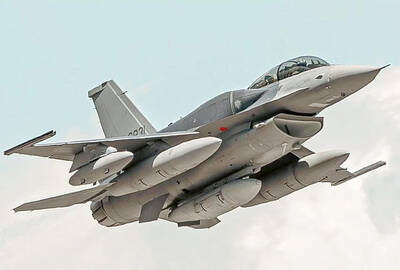
66 FIGHTER JETS: The aircraft is likely undergoing preparations for its transfer to Taiwan — a significant step forward in the nation’s modernization program, a lawmaker said The first of Taiwan’s order of F-16V Block 70 aircraft has been sighted in Texas ahead of delivery, Democratic Progressive Party (DPP) Legislator Wang Ting-yu (王定宇) said. Taiwan’s first F-16V Block 70 two-seat aircraft, tail number 6831, was seen flying from Lockheed Martin’s production facility in Greenville, South Carolina, to Naval Air Station Joint Reserve Base Fort Worth in Texas, Wang wrote on Facebook yesterday. The plane is likely undergoing preparations for its transfer to Taiwan, marking a significant step forward in the Republic of China Air Force’s modernization program, Wang said, citing military analysts. The F-16V Block 70 is a new-build version

Taiwanese aviator Roger Lin (林睿哲) returned to Taiwan on Saturday after completing a nine-day round-the-world journey in a single-engine aircraft, becoming the first Taiwanese pilot to achieve the feat. Lin departed on June 5 from Los Angeles, California, and continued through Alaska, Japan, Taiwan, the Philippines, Indonesia, Malaysia, Thailand, Nepal, Jordan, Norway, Iceland and Canada before landing at the Taipei International Airport (Songshan) via Los Angeles and Japan. Lin shared numerous photos and videos of his journey on a Facebook page titled “Pilot Roger’s Around the World Flight,” including a video showing his aircraft flying over the Danjiang Bridge and
NOT JUST NUMBERS: What matters to intelligence work is crucial, reliable information, so even a few credible leads can be highly valuable to national security, a legislator said The National Security Bureau (NSB) yesterday said it has finished the establishment of an information-reporting channel for Chinese nationals, the aim of which is to broaden intelligence gathering on China’s political, military, economic and social developments. Chinese nationals can submit information on the Web page, https://report.nsb.gov.tw, the NSB said in a statement. The move aims to expand the bureau’s diverse intelligence sources and is pursuant to the National Intelligence Services Act (國家情報工作法), it said, adding that it referenced practices adopted by intelligence agencies in the US, the UK and Israel. An increasing number of people are approaching Taiwanese agencies to provide information, as


 RSS
RSS