


The China Coast Guard has increased patrols near Taiwan’s Pratas Islands (Dongsha Islands, 東沙群島) since February 2024, increasing from occasional transits to more than 30 transits annually, the Coast Guard Administration (CGA) said.
On Feb. 14, 2024, a Chinese speedboat illegally entered prohibited waters near Kinmen County and refused inspection by coast guard personnel before fleeing.
During a subsequent pursuit, the vessel capsized, resulting in the deaths of two Chinese crew members.
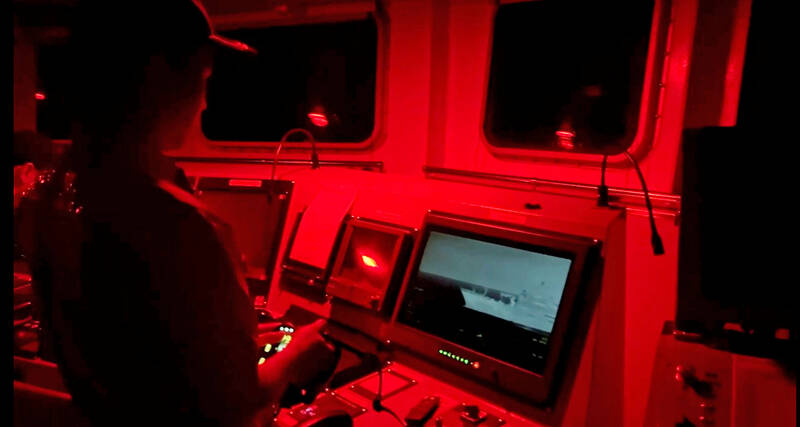
Photo courtesy of the CGA
Since then, Beijing has adjusted the frequency, timing and bearing of its incursions near Pratas Island (Dongsha Island, 東沙島) to study Taiwan’s response patterns, the coast guard said.
The actions are part of China’s multifaceted “gray zone” pressure campaign involving military, legal, information and psychological elements, it said, warning that the strategy aims to drain Taiwan’s resources, gauge its responses, and expand China’s presence and help it prepare for potential future operations.
China’s incursions have become more deliberate and strategic, typically involving one or two Chinese coast guard ships repeatedly maneuvering along the edge of restricted waters or circling the area to tie up Taiwanese enforcement resources, the agency said.
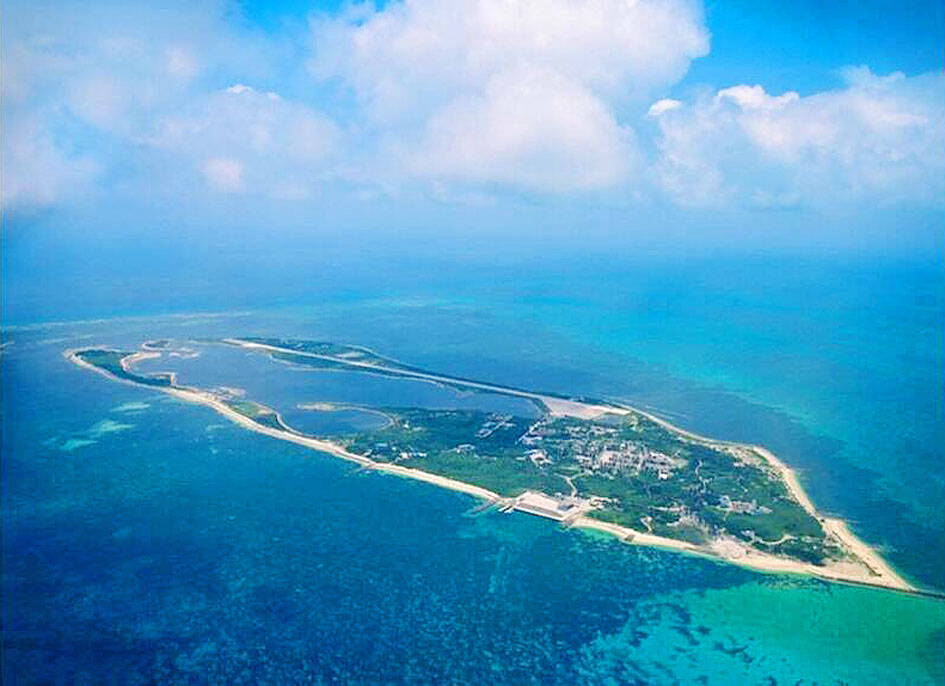
Photo courtesy of Chen Ching-neng
Chinese coast guard vessels have repeatedly switched off their automatic identification system (AIS) transponders to conceal their movements and test Taiwan’s surveillance capabilities, it said.
In response, Taiwan has dispatched patrol vessels to shadow the Chinese ships on a one-to-one basis, escorting them out of restricted waters while issuing radio warnings in Chinese and English, it added.
The two sides have frequently engaged in tense radio exchanges over sovereignty claims, the agency said.
There was an escalation last year, when several Chinese fishing vessels entered waters near Pratas Island and launched small boats into the atoll to engage in illegal fishing, it said.
While CGA vessels were expelling the boats, two Chinese coast guard vessels simultaneously conducted an incursion, it added.
One of the Chinese coast guard vessels sailed within 21.7 nautical miles (40.2km) of Pratas Island, allegedly to inspect one of the Chinese fishing boats, the agency said.
The fishing vessel stopped in apparent cooperation with the Chinese coast guard ship before the vessels eventually departed after repeated warnings from Taiwanese coast guard personnel, it added.
Kinmen has remained the primary focus of Chinese coast guard incursions over the past few years, apart from involvement with large-scale military exercises, the agency said.
Since the February 2024 incident, Chinese coast guard vessels have entered waters near Kinmen on 117 occasions, generally in the form of four-vessel formations entering, it said, adding that China had been entering restricted waters about four times a month.
Those operations are usually conducted under the guise of “law enforcement patrols” and involve a variety of formations and routes near the islands of Liaoluo (料羅), Lieyu (烈嶼), Shaxibao (沙溪堡) and Dadan (大膽), the agency said.
Chinese vessels engaged in these probes sometimes switch off their AIS transponders to conceal their movements, it said, adding that such operations are designed to create complex scenarios under varying sea and weather conditions to test Taiwan’s monitoring and response capabilities.
The agency said it recorded 52 incursions in 2024, 46 last year and 19 so far this year.
In each case, Taiwanese coast guard patrol vessels were sortied to conduct one-to-one monitoring, gather evidence and issue warnings ordering foreign vessels to leave restricted waters, it added.
On the morning of Wednesday last week, four Chinese coast guard vessels approached waters south of Liaoluo, the agency said.
Coast Guard Administration patrol vessels were sent to the restricted-water boundary, and about one hour later, the Chinese vessels entered Taiwan’s restricted waters south of Liaoluo and Zhaishan (翟山) in two separate groups, prompting Taiwanese vessels to begin close monitoring and issue warnings, it said.
China’s continued incursions and subsequent false information campaigns aim to create the impression that Beijing exercises jurisdiction over waters around Kinmen, and to support broader cognitive warfare efforts, the agency said.
The Coast Guard Administration said it would continue to publish notices about such incidents and counter what it described as false and misleading narratives.

‘NO SECURITY RISK’: The Railway Bureau reassured the public that the technicians’ activities were limited to technical guidance and did not involve sensitive systems The Railway Bureau yesterday said it had invited eight Chinese technicians to assist with an airport MRT construction project. The bureau issued the confirmation after an Internet user said Chinese nationals had entered the construction zone of Taiwan Taoyuan International Airport’s Terminal 3 project. They asked why “individuals from an enemy state” were allowed access to such a major national infrastructure project, which raised serious concerns over Taiwan’s industrial safety, sensitive systems and information security. The bureau’s Northern Region Engineering Branch Office said subcontractor Taiwan Handle Industrial Co (台灣手把工業) of the Taoyuan airport MRT’s “Contract No. CU05 Project A14 Station Civil, MEP &

A US uncrewed surface vessel (USV) encountered multiple Chinese warships during an autonomous transit of the Taiwan Strait, US defense company Seasats said in a statement on Wednesday. Seasats announced that a Lightfish USV had completed the first autonomous transit of the Taiwan Strait. Over five days, the USV traversed the entire length of the Strait while constantly monitoring surface vessel traffic, the company said. The Lightfish encountered multiple Chinese warships, one of which was a Chinese People’s Liberation Army Navy (PLAN) Type 056 corvette, it said. The Chinese vessels were operating “well within Taiwan’s exclusive economic zone without transmitting their identity via the

Taiwan is still in the process of assessing the possibility of recruiting workers from Eswatini, the Ministry of Foreign Affairs said yesterday, adding that its goal is to help Eswatini upgrade its vocational training centers. If there are plans to recruit workers from Eswatini, safeguarding national security, protecting public health and ensuring the employment rights of Taiwanese would be prerequisites, Department of West Asian and African Affairs Director-General Yen Chia-liang (顏嘉良) told a news conference. Key considerations would also include filling labor shortages in specific industries, and fostering bilateral professional and technical exchanges, he said. Yen was asked about the progress of labor

The nation’s usually punctual high-speed rail system yesterday was hit by major disruptions after all scheduled services were canceled and replaced with three hourly trains offering only non-reserved seating, affecting more than 200,000 passengers. Preliminary findings indicate the disruption was caused by a faulty power module in a track switch control cabinet, Taiwan High-Speed Rail Corp (THSRC) said, adding that as a full system inspection could only be conducted after operations end for the day, a decision on whether normal service would resume today would be announced before the first train departs. During a routine inspection early yesterday, a switch signal abnormality


 RSS
RSS