


Japanese Prime Minister Sanae Takaichi yesterday warned of growing Chinese “coercion” in her first post-election speech to the Japanese parliament, pledging to overhaul defense strategy, ease curbs on military exports and bolster critical supply chains.
Takaichi’s tenure has been marked by a diplomatic dispute with China after she said Japan could use military force to respond to any attack on Taiwan that also threatened Japanese territory.
Fresh from turning a fragile majority into a landslide victory in this month’s lower house election, she outlined an agenda to counter what she sees as a mounting economic and security threat from China and its regional partners.
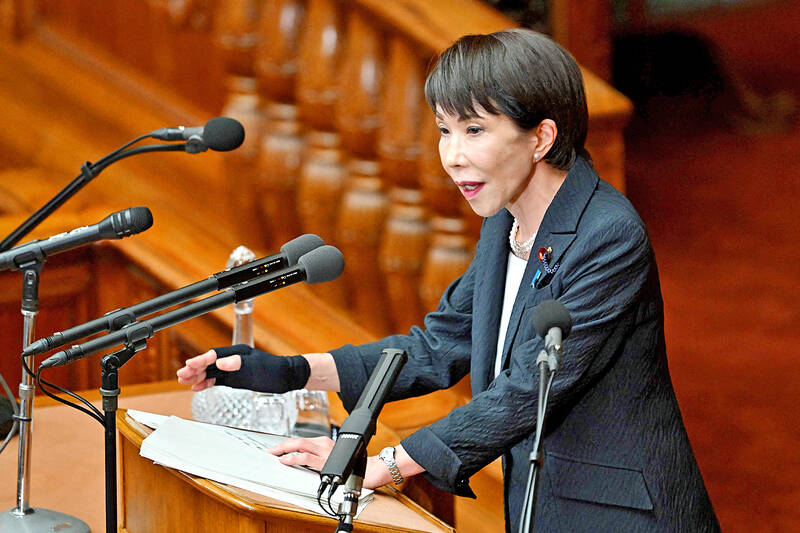
Photo: AFP
“Japan faces its most severe and complex security environment since World War II,” Takaichi said, pointing to China’s widening military activity and closer security ties with Russia, as well as North Korea’s growing nuclear missile capability.
“It is a consistent policy of the Takaichi Cabinet to comprehensively advance a ‘Mutually Beneficial Relationship Based on Common Strategic Interests’ with China and to build a constructive and stable relationship,” she said. “Precisely because China is an important neighbor and there are various pending issues and challenges, we will continue our communication and respond calmly and appropriately from the standpoint of our national interest.”
The Japanese government would revise its three core security documents this year to produce a new defense strategy, and would accelerate a review of military export rules to expand overseas sales and bolster defense companies, Takaichi said.
A policy panel of Takaichi’s Liberal Democratic Party yesterday proposed to scrap rules that limit military exports to non-lethal equipment such as body armor, the Kyodo news agency said.
Such a change could significantly widen the range of defense equipment Japanese firms sell overseas.
“China has intensified its attempts to unilaterally change the status quo through force or coercion in the East China Sea and South China Sea,” Takaichi said.
Takaichi has hastened a military buildup launched in 2023 that would double Japan’s defense spending to 2 percent of GDP by the end of next month, making it one of the world’s biggest military spenders despite its pacifist constitution.
Beyond security, she pledged to reduce dependence on “specific countries” by bolstering supply chains and working with allies to secure critical materials, including rare earths, around Minamitori, a remote Pacific island.
“A nation that does not take on challenges has no future,” she said. “Politics that only seeks to protect cannot inspire hope.”
Meanwhile, the Ministry of Foreign Affairs yesterday welcomed Japanese Minister of Foreign Affairs Toshimitsu Motegi’s remarks emphasizing the importance of peace and stability in the Taiwan Strait.
Motegi made the remarks during his first news conference as re-elected foreign minister on Wednesday, after Takaichi kept her Cabinet unchanged following the recent general election.
He criticized what he described as China’s “attempt to change the status quo with force,” adding that peace and stability in the Taiwan Strait are of great importance.
The ministry said Minister of Foreign Affairs Lin Chia-lung (林佳龍) welcomed and affirmed Motegi’s remarks.
Takaichi’s Cabinet has repeatedly called on the international community to take cross-strait issues seriously at major forums, including the 28th ASEAN-Japan Summit, the 20th East Asia Summit and the Japan-US summit, the ministry said.
Japan has also directly conveyed its concerns over regional security to China, and that peace and stability in the Taiwan Strait are closely linked to the prosperity and security of Japan and the world, it added.
The ministry called on democratic countries to continue working together to counter the spread of authoritarianism, urging them to pay close attention to developments in the Taiwan Strait and take concrete actions to safeguard regional security.
Taiwan will continue bolstering its defense capabilities and whole-of-society resilience, while working closely with like-minded partners to ensure peace, stability and prosperity in the Taiwan Strait and the broader Indo-Pacific region, the ministry said.

A signaling system malfunction disrupted high-speed rail (HSR) services beginning at 8am today, with trains temporarily reduced to three northbound and three southbound trains per hour as authorities conduct inspections. The malfunction occurred on a section of track in Miaoli County during pre-operation checks early this morning, forcing northbound and southbound trains to use a single track, the HSR operator said. The regular schedule has been replaced with three hourly trains offering only nonreserved seating in each direction, stopping at every station, it said, adding that business class cars would still have reserved seating. Departures from terminal stations are scheduled at the top

DRONE CENTRAL: Taiwan aims to become Asia’s democratic hub for drones, with most exports focused on high-quality military-grade models, an official said Taiwan’s drone industry is expected to expand significantly by 2030, producing 100,000 units per month and exporting half of them, the Ministry of Economic Affairs said yesterday. Current drone production capacity is about 15,000 units per month, but the industry can quickly scale up as demand increases, Industrial Development Administration Director-General Chiou Chyou-huey (邱求慧) told a news conference in Taipei. Taiwan’s drone output grew 2.5-fold last year to NT$12.9 billion (US$408.3 million) under a government program to develop the uncrewed vehicle sector, he said. The Executive Yuan in October last year approved plans to invest NT$44.2 billion into domestic production of uncrewed aerial

VERBOSE VESSELS: A CGA cutter and a China Coast Guard exchanged verbal barbs for more than a day in Taiwanese-controlled waters before the Chinese vessel left The Taiwanese and Chinese coast guards had a standoff near the strategically located Pratas Islands (Dongsha Islands, 東沙群島) in the north of the South China Sea, the Coast Guard Administration (CGA) said yesterday. The two sides engaged in intense radio exchanges over sovereignty claims during the 33-hour standoff. China Coast Guard vessel 3501 eventually left the restricted waters, 26.6 nautical miles (49.2km) west of the Pratas Islands, at 5pm yesterday, the CGA said. Lying approximately between southern Taiwan and Hong Kong, the Taiwan-controlled Pratas are seen by some security experts as vulnerable to Chinese attack due to their distance — more than
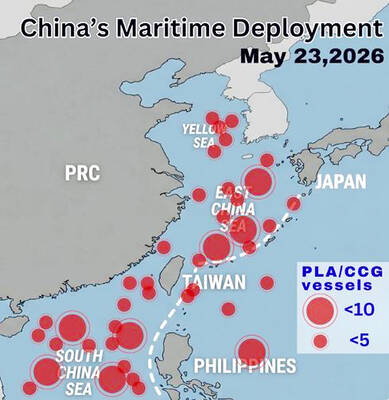
WARNING: China should stop engaging in actions that undermine regional peace and stability, as it would only build resentment among people across the Strait, the CGA said China has deployed more than 100 navy, coast guard and other vessels in waters from the Yellow Sea to the South China Sea and the western Pacific since US President Donald Trump and Chinese President Xi Jinping (習近平) met in Beijing, National Security Council Secretary-General Joseph Wu (吳釗燮) said yesterday. “In this part of the world, #China is the one & only PROBLEM wrecking the #StatusQuo & threatening regional peace & stability,” Wu wrote on X. In a separate post, he said Beijing was coercing Taiwan’s maritime domain, calling it illegal and provocative, after the Coast Guard Administration (CGA) expelled a


 RSS
RSS