


The US and the Philippines on Monday reaffirmed the importance of regional security in the Taiwan Strait following the 12th Philippines-United States Bilateral Strategic Dialogue in Manila.
Washington and Manila in a joint statement released by the US Department of State emphasized collective defense in deterring aggression anywhere along the first island chain, of which Taiwan is a part.
The two countries “condemned China’s illegal, coercive, aggressive, and deceptive activities in the South China Sea,” and reaffirmed the importance of maintaining peace and stability across the Taiwan Strait.
Photo: Reuters
“They underscored their support for preserving freedom of navigation and overflight, unimpeded lawful commerce and other lawful uses of the sea for all nations,” the statement said.
The two sides committed to maintaining a high level of vigilance in the Indo-Pacific region to prevent conflict, and vowed to establish robust measures and deterrent capabilities to ensure unhindered passage through maritime waterways, free from arbitrary control by any single nation.
“Collective defense is critical to denying and deterring aggression anywhere in the first island chain,” the statement said.
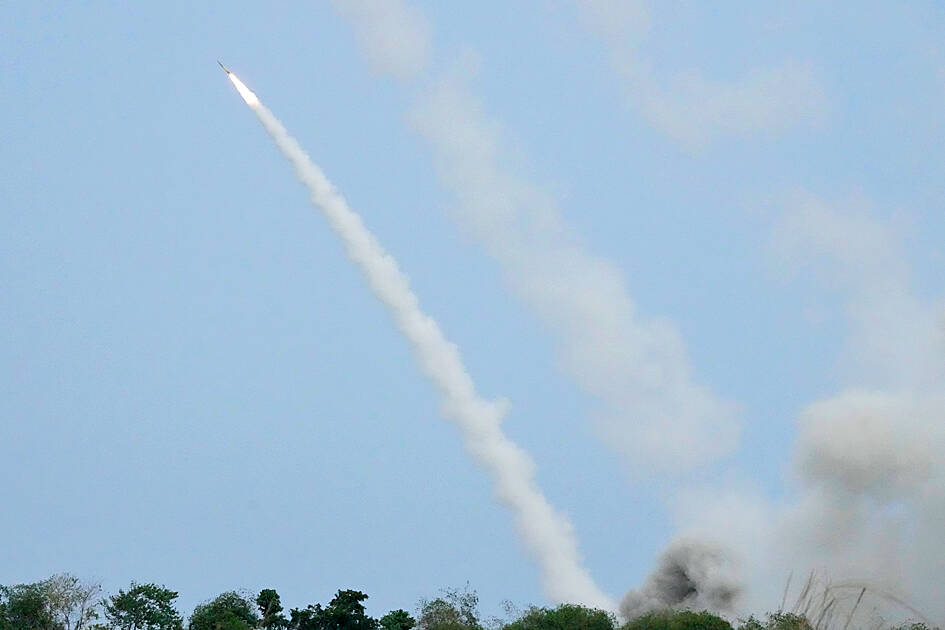
Photo: AP
The US and the Philippines also reaffirmed their commitment to the 1951 Mutual Defense Treaty, promising to act jointly in response to armed attacks on either nation’s territory, armed forces, public vessels or aircraft in the Pacific, including the South China Sea
The statement said the countries “strongly opposed any threat or use of force against the territorial integrity or political independence of any state.”
The statement also outlined plans to bolster interoperability and conduct more realistic exercises to enhance readiness for contingencies.
The US pledged to push for modernizing the Philippine armed forces and coast guard, and “to increase the deployments of US cutting-edge missiles and unmanned systems to the Philippines.”
Additionally, the US is allocating an additional US$144 million for this fiscal year to support sites under the Enhanced Defense Cooperation Agreement, focusing on infrastructure development.
The agreement allows US forces to use Philippine bases for joint training, equipment storage, and the construction of facilities such as runways and fuel depots, although it does not establish permanent US basing.
The US in 2024 installed in the northern Philippines a US mid-range missile system called Typhon and an anti-ship missile launcher last year.
Neither side elaborated on the new planned missile deployments but Philippine Ambassador to Washington Jose Manuel Romualdez, who took part in Monday’s talks, said that US and Philippine defense officials discussed the possible deployment this year of “upgraded” types of US missile launchers that the Philippines might eventually decide to purchase.
“It’s a kind of system that’s really very sophisticated and will be deployed here in the hope that, down the road, we will be able to get our own,” Romualdez said.
The US missile deployments to the Philippines did not aim to antagonize any country, he said.
“It’s purely for deterrence,” he said. “Every time the Chinese show any kind of aggression, it only strengthens our resolve to have these types.”
Additional reporting by AP
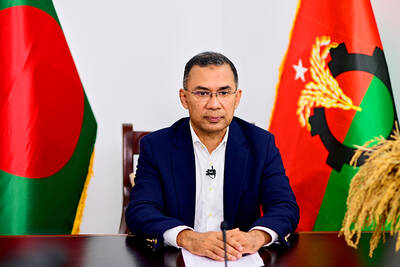
PEACE AT LAST? UN experts had warned of threats and attacks ahead of the voting, but after a turbulent period, Bangladesh has seemingly reacted to the result with calm The Bangladesh Nationalist Party (BNP) yesterday celebrated a landslide victory in the first elections held since a deadly 2024 uprising, with party leader Tarique Rahman to become prime minister. Bangladesh Election Commission figures showed that the BNP alliance had won 212 seats, compared with 77 for the Islamist-led Jamaat-e-Islami alliance. The US embassy congratulated Rahman and the BNP for a “historic victory,” while India praised Rahman’s “decisive win” in a significant step after recent rocky relations with Bangladesh. China and Pakistan, which grew closer to Bangladesh since the uprising and the souring of ties with India, where ousted Bangladeshi prime minister Sheikh Hasina

FAST-TRACK: The deal is to be sent to the legislature, but time is of the essence, as Trump had raised tariffs on Seoul when it failed to quickly ratify a similar pact Taiwan and the US on Thursday signed a trade agreement that caps US tariffs on Taiwanese goods at 15 percent and provides preferential market access for US industrial and agricultural exports, including cars, and beef and pork products. The Taiwan-US Agreement on Reciprocal Trade confirms a 15 percent US tariff for Taiwanese goods, and grants Taiwanese semiconductors and related products the most-favorable-treatment under Section 232 of the Trade Expansion Act, the Executive Yuan said. In addition, 2,072 items — representing nearly 20 percent of Taiwan’s total exports to the US — would be exempt from additional tariffs and be subject only to
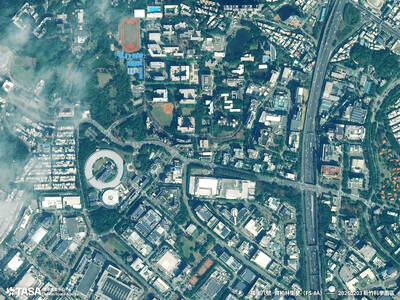
The Taiwan Space Agency (TASA) yesterday released the first images from its Formosat-8A satellite, featuring high-resolution views of Hsinchu Science Park (新竹科學園區), Tainan’s Anping District (安平), Kaohsiung’s Singda Harbor (興達港), Japan’s National Stadium in Tokyo and Barcelona airport. Formosat-8A, named the “Chi Po-lin Satellite” after the late Taiwanese documentary filmmaker Chi Po-lin (齊柏林), was launched on Nov. 29 last year. It is designed to capture images at a 1m resolution, which can be sharpened to 0.7m after processing, surpassing the capabilities of its predecessor, Formosat-5, the agency said. It is the first of TASA’s eight-satellite Formosat-8 constellation to be sent into orbit and

President William Lai (賴清德) yesterday approved a special pardon exempting a woman in her 80s convicted of killing her disabled son from imprisonment. After carefully reviewing the case, Lai pardoned Lin Liu Lung-tzu (林劉龍子) from the prison sentence while acknowledging her conviction, citing the extreme circumstances she faced, Presidential Office spokeswoman Karen Kuo (郭雅慧) said in a statement. Under Article 3 of the Amnesty Act (赦免法), the two kinds of pardons are exempting an offender from the execution of a punishment or declaring the punishment to be invalid. Kuo said Lin Liu had spent more than 50 years caring for her son, before


 RSS
RSS