


Taiwan is to seek an extension to the date by which an agreement must be signed with the US for a batch of weapons deliveries, given the ongoing standoff in the legislature about defense spending, the Ministry of National Defense (MND) said yesterday.
President William Lai (賴清德) last year proposed a US$40 billion special defense budget to counter the rising threat from China, but the opposition-controlled legislature has instead advanced its own, less expensive proposals that only fund select purchases.
The ministry has urged the opposition to approve the proposal, saying that any delay could postpone much-needed weapons deliveries.
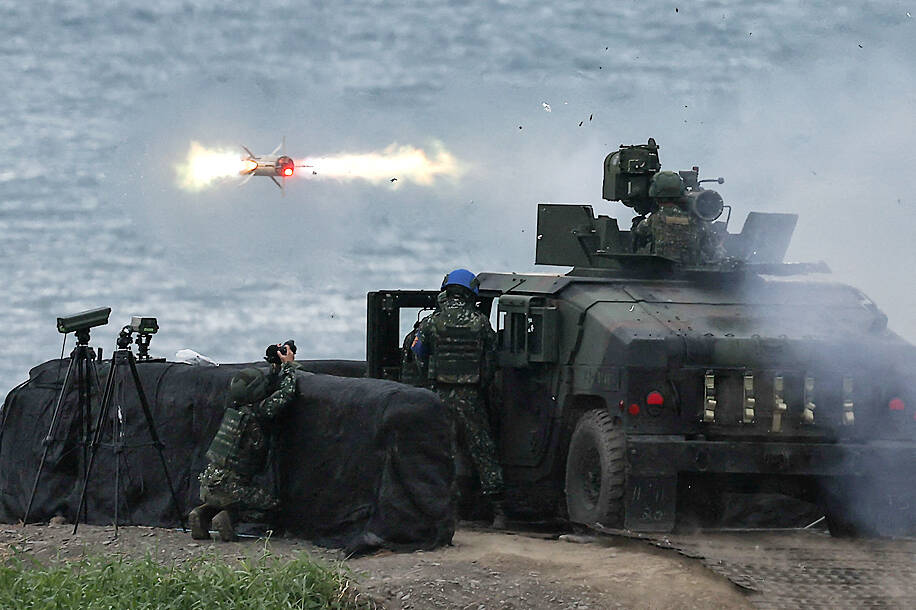
Photo: Ann Wang, Reuters
The ministry said it has received Letters of Offer and Acceptance (LOA) proposals from the US — valid until March 15 — for tube-launched, optically tracked, wire-guided anti-tank missiles; Javelin anti-armor missiles; and M109A7 self-propelled howitzers.
The first installment must be paid by March 31, but the legislature has not yet sent the government’s defense spending proposal to the committee for review, it said.
“The ministry will seek an extension for the LOA signing validity period to avoid the cancelation of the entire order due to a failure to sign within the deadline,” it said.
The ministry said it has already coordinated with the US regarding which weapons are included in the spending plan, and has confirmed key factors such as the US’ willingness to sell, production lines and delivery timelines.
The main opposition Chinese Nationalist Party (KMT) said it supports defense spending, but has a duty to scrutinize the plans and would not sign “blank checks.”
Meanwhile, the US reiterated support for Taiwan’s efforts to boost defense spending.
“As the State Department and AIT [American Institute in Taiwan] have repeatedly stated publicly, and we’ve made clear to Taiwan counterparts, we welcome Taiwan’s announcement of a US$40 billion special defence procurement budget,” a US Department of State spokesperson said.
Minister of National Defense Wellington Koo (顧立雄) said Taiwanese are at risk of becoming “numb” to China’s daily pressure tactics aimed at wearing down the nation.
Over the past year, China has used more complex and precise military pressure, cyberattacks and psychological warfare against Taiwan, Koo said.
The number Chinese military aircraft, including fighters and drones, detected last year rose by 23 percent from 2024, he added.
When such actions are repeated over and over, we worry the public would become numb, despite the fact that such a threat exists urgently and realistically, Koo said.
As for delayed deliveries of US weapons due to supply chain and capacity problems, Koo said that production has “gradually returned to normal,” and Washington is making the administrative process for purchases easier and quicker.
The comments come after US President Donald Trump on Tuesday signed a sweeping appropriations bill that includes more than US$1.4 billion for security cooperation with Taiwan.
The Consolidated Appropriations Act bundles five bills, and includes measures covering defense spending and national security.
The act allocates US$1 billion for the Taiwan Security Cooperation Initiative (TSCI) under the Operation and Maintenance, Defense-Wide program, with funding available through Sept. 30 next year.
The TSCI aims to bolster Taiwan’s self-defense capabilities, enhance deterrence, maintain peace and stability in the Taiwan Strait, and reduce risks to US forces.
It complements Taiwan’s defense investments, as well as other US security assistance and cooperation authorizations.
The TSCI also includes US$150 million to replace defense articles and reimburse defense services supplied to Taiwan.
The act provides at least US$300 million under the Foreign Military Financing (FMF) program for assistance to Taiwan.
The FMF helps US allies and partner countries acquire US military equipment, services and training through US-funded assistance.
At least US$4 million in funding under the National Security Investment Programs is to be allocated for the Global Cooperation and Training Framework, which is administered by the AIT.
The act also specifies that none of its funds “should be used to create, procure or display any map that inaccurately depicts the territory and social and economic system of Taiwan and the islands or island groups administered by Taiwan authorities.”
Additional reporting by CNA
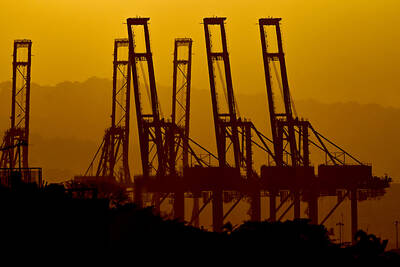
A subsidiary of a Hong Kong-based company that has lost control of two critical ports on the Panama Canal said it is seeking US$2 billion of compensation in damages from Panama over its “illegal” takeover of the ports. Panama Ports Co, a unit of Hong Kong’s CK Hutchison Holdings (長江和記實業), on Friday said in a statement that it is demanding the sum under international arbitration proceedings that it had already started. The Panamanian government last week seized control of the Balboa and Cristobal ports on each end of the Panama Canal, after the country’s Supreme Court declared earlier that a concession allowing
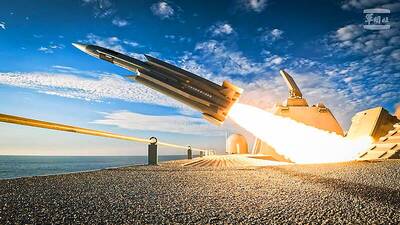
DETERRENCE: With 1,000 indigenous Hsiung Feng II and III missiles and 400 Harpoon missiles, the nation would boast the highest anti-ship missile density in the world With Taiwan wrapping up mass production of Hsiung Feng II and III missiles by December and an influx of Harpoon missiles from the US, Taiwan would have the highest density of anti-ship missiles in the world, a source said yesterday. Taiwan is to wrap up mass production of the indigenous anti-ship missiles by the end of year, as the Chungshan Institute of Science and Technology has been meeting production targets ahead of schedule, a defense official with knowledge of the matter said. Combined with the 400 Harpoon anti-ship missiles Taiwan expects to receive from the US by 2028, the nation would have

POSSIBILITIES EMERGE: With Taiwan’s victory and Japan’s narrow win over Australia, Taiwan now have a chance to advance if South Korea also beat the Aussies Taiwan has high hopes that the national baseball team would advance to the World Baseball Classic (WBC) quarter-finals after clinching a crucial 5-4 victory over South Korea in a nail-biting extra-inning game at the Tokyo Dome yesterday. Boosted by three home runs — two solo shots by Yu Chang (張育成) and Cheng Tsung-che (鄭宗哲) and a two-run homer by Stuart Fairchild — the triumph gave Taiwan a much-needed second victory in the five-team Pool C, where only the top two finishers would advance to the knockout stage in Miami, Florida. Entering extra innings with the game tied at four apiece, Taiwan scored
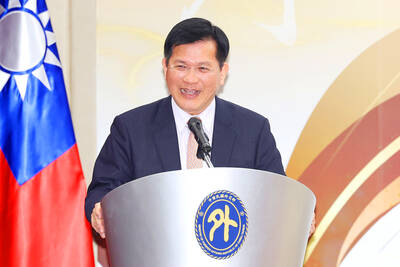
MISSION OF PEACE: The foreign minister urged Beijing to respect Taiwan’s existence as an independent nation, and work together to ensure peace and stability in the region Minister of Foreign Affairs Lin Chia-lung (林佳龍) yesterday rejected Chinese Minister of Foreign Affairs Wang Yi’s (王毅) comments about Taiwan, criticizing China as a “troublemaker” in the international community and a disruptor of cross-strait peace. Speaking at a news conference on the sidelines of the Chinese National People’s Congress, Wang said that Taiwan has always been a territory of China and that it would be impossible for it to become its own country. The “return” of Taiwan to China was the natural outcome of the Chinese people’s resistance against Japan in World War II, and that any pursuit of independence was “doomed


 RSS
RSS