


Taiwan is crucial to Japan’s survival, and the two nations should work together to strengthen supply chains, Japan-Taiwan Exchange Association Representative Kazuyuki Katayama said.
Katayama made the remarks in an interview with SETN that aired on Saturday, adding that relations should be complementary, with the two sides cooperating to build supply chains that ensure economic security.
“For Japan, Taiwan is of existential importance,” he said.
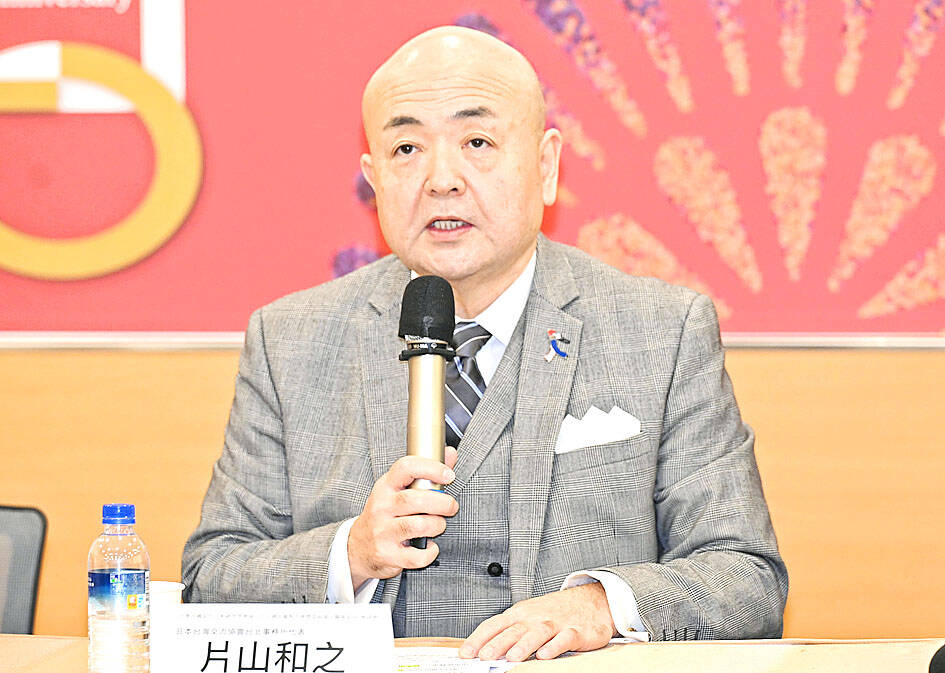
Photo: Chang Chia-ming, Taipei Times
Relations between the two nations have reached a historic high for four main reasons, he said.
First, the two sides are partners that share common values; second, they are important economic partners; third, they maintain close people-to-people and cultural exchanges; and fourth, they are key partners in preserving peace in the Taiwan Strait, which is indispensable to global security and prosperity, Katayama said.
Bilateral ties have developed broadly in areas including the economy, culture, people-to-people exchanges, security and disaster prevention, he said.
“In particular, bilateral ties are increasingly characterized by horizontal cooperation, with each side leveraging its respective strengths,” Katayama said.
“Trust is a crucial foundation of Japan-Taiwan relations, and mutually beneficial cooperation built on trust is essential,” he said.
Asked what message he would like to convey to Taiwanese, Katayama said that during his two years and two months stationed in Taiwan he has become firmly convinced that Taiwan is an extremely important partner for Japan and an irreplaceable friend.
“Taiwan is a free, democratic, stable and developed society that is friendly toward Japan and located in its immediate neighborhood,” he said, adding that the future direction Taiwan-Japan cooperation would have a significant impact on the future course of regional development as a whole.
Commenting on Taiwan Semiconductor Manufacturing Co’s (台積電) investment in a plant in Kumamoto, Japan, Katayama said the move was a step in the right direction, as Japan and Taiwan should form a complementary relationship by capitalizing on their respective strengths rather than competing with one another.
Taiwan’s strength lies in semiconductor production, accounting for 70 to 90 percent of global output, while Japan has advantages in materials and manufacturing equipment, he said.
“From the perspective of economic security, it is vital to build supply chains and cooperate in cultivating talent from both sides, as well as from third countries,” he said.
Taiwan and Japan signed a digital trade agreement in December last year, which lays the foundation for deeper bilateral cooperation by expanding on an earlier e-commerce agreement, and updating it to reflect future technologies and artificial intelligence, he said.
Regarding areas for further cooperation, Katayama said disaster prevention and relief, environmental energy and public health are challenges jointly faced by Taiwan, Japan and the global community, and areas where the two nations could make strides together.
In addition, cooperation in areas such as drones and the security of undersea cables could enhance economic security and promote development, Katayama said.

A signaling system malfunction disrupted high-speed rail (HSR) services beginning at 8am today, with trains temporarily reduced to three northbound and three southbound trains per hour as authorities conduct inspections. The malfunction occurred on a section of track in Miaoli County during pre-operation checks early this morning, forcing northbound and southbound trains to use a single track, the HSR operator said. The regular schedule has been replaced with three hourly trains offering only nonreserved seating in each direction, stopping at every station, it said, adding that business class cars would still have reserved seating. Departures from terminal stations are scheduled at the top

Taiwan is still in the process of assessing the possibility of recruiting workers from Eswatini, the Ministry of Foreign Affairs said yesterday, adding that its goal is to help Eswatini upgrade its vocational training centers. If there are plans to recruit workers from Eswatini, safeguarding national security, protecting public health and ensuring the employment rights of Taiwanese would be prerequisites, Department of West Asian and African Affairs Director-General Yen Chia-liang (顏嘉良) told a news conference. Key considerations would also include filling labor shortages in specific industries, and fostering bilateral professional and technical exchanges, he said. Yen was asked about the progress of labor

VERBOSE VESSELS: A CGA cutter and a China Coast Guard exchanged verbal barbs for more than a day in Taiwanese-controlled waters before the Chinese vessel left The Taiwanese and Chinese coast guards had a standoff near the strategically located Pratas Islands (Dongsha Islands, 東沙群島) in the north of the South China Sea, the Coast Guard Administration (CGA) said yesterday. The two sides engaged in intense radio exchanges over sovereignty claims during the 33-hour standoff. China Coast Guard vessel 3501 eventually left the restricted waters, 26.6 nautical miles (49.2km) west of the Pratas Islands, at 5pm yesterday, the CGA said. Lying approximately between southern Taiwan and Hong Kong, the Taiwan-controlled Pratas are seen by some security experts as vulnerable to Chinese attack due to their distance — more than

A US uncrewed surface vessel (USV) encountered multiple Chinese warships during an autonomous transit of the Taiwan Strait, US defense company Seasats said in a statement on Wednesday. Seasats announced that a Lightfish USV had completed the first autonomous transit of the Taiwan Strait. Over five days, the USV traversed the entire length of the Strait while constantly monitoring surface vessel traffic, the company said. The Lightfish encountered multiple Chinese warships, one of which was a Chinese People’s Liberation Army Navy (PLAN) Type 056 corvette, it said. The Chinese vessels were operating “well within Taiwan’s exclusive economic zone without transmitting their identity via the


 RSS
RSS