


US President Donald Trump yesterday announced that he is nominating former US Federal Reserve governor Kevin Warsh to be the next central bank chief.
Trump’s decision capped a closely watched search for a successor to Fed Chair Jerome Powell, whom the president has repeatedly lambasted for not cutting interest rates more swiftly.
“I have known Kevin for a long period of time, and have no doubt that he will go down as one of the GREAT Fed Chairmen, maybe the best,” Trump wrote on his Truth Social platform. “On top of everything else, he is ‘central casting,’ and he will never let you down.”
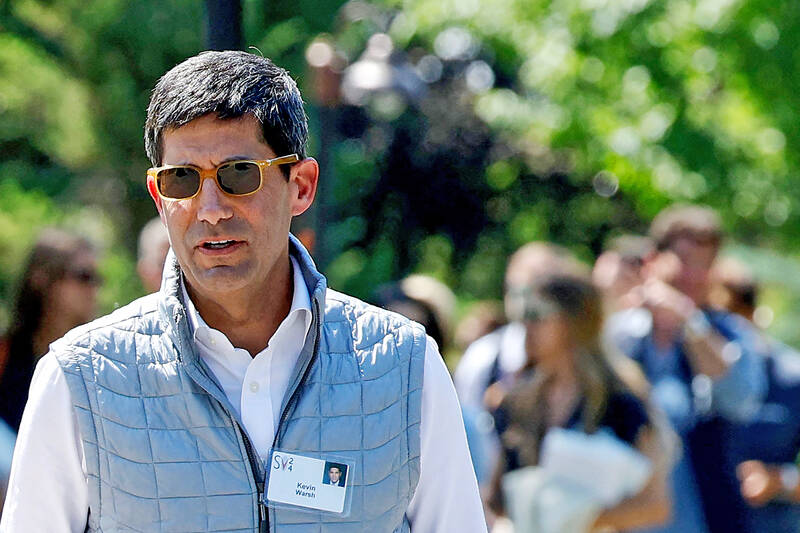
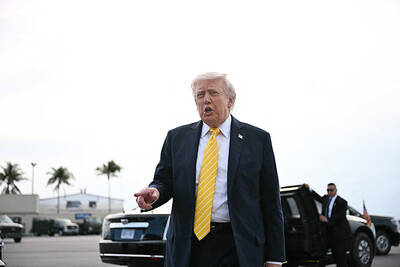
Photo: Getty Images North America, AFP
Powell’s term at the helm ends in May.
Trump’s selection ends a race that had narrowed to four contenders — Warsh, Fed Governor Christopher Waller, BlackRock senior managing director Rick Rieder and Trump’s top economic adviser Kevin Hassett.
Warsh would need to be confirmed by the US Senate, facing questions by lawmakers on both sides of the aisle.
If given the green light, he is also set to take the Fed chief role at a time when the Trump administration has sharply escalated pressure on the independent central bank.
Trump’s recent moves have sparked worries about the Fed’s insulation from politics, which if eroded could have ramifications for the world’s biggest economy, experts said.
Warsh has stepped up his criticism of the Fed, endorsing many of the policy positions of Trump and his administration.
He was a mergers and acquisitions banker at Morgan Stanley.
In Trump’s first term, the president considered Warsh for the Fed chair position as well, but eventually chose Powell.
As Trump continues to call for lower interest rates to boost the economy, all eyes would be on how Warsh defends the bank’s independence in the face of politics.
Already, Trump has sought to fire Fed Governor Lisa Cook over claims of mortgage fraud, sparking a legal battle likely to prove crucial in determining how much discretion the president has when it comes to removing key central bank officials.
The Trump administration has also launched an investigation into Powell over renovations at the Fed’s headquarters, in a probe that Powell has slammed as a threat to the bank’s independence.
The next Fed chairman would need to convince financial markets and policymakers that he is upholding the bank’s dual mandate of stable prices and low unemployment independently of politics, analysts said.
That job is becoming increasingly challenging as Trump’s tariffs over the past year have fueled worries of stubborn inflation, while the employment market has cooled.
The situation has left Fed policymakers walking a tightrope as they adjust interest rates, deciding if they should keep levels higher to curb inflation or lower them to boost the economy.
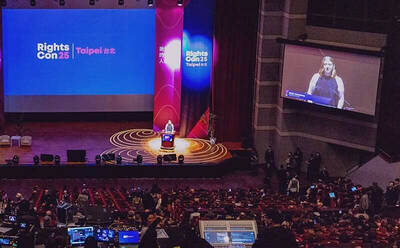
SILENCING CRITICS: In addition to blocking Taiwan, China aimed to prevent rights activists from speaking out against authoritarian states, a Cabinet department said The Ministry of Foreign Affairs (MOFA) yesterday condemned transnational repression by Beijing after RightsCon, a major digital human rights conference scheduled to be held in Zambia this week, was abruptly canceled due to Chinese pressure over Taiwanese participation. This year’s RightsCon, the world’s largest conference discussing issues “at the intersection of human rights and technology,” was scheduled to take place from tomorrow to Friday in Lusaka, and expected to draw 2,600 in-person attendees from 150 countries, along with 1,100 online participants. However, organizers were forced to cancel the event due to behind-the-scenes pressure from China, the ministry said, expressing its “strongest condemnation”
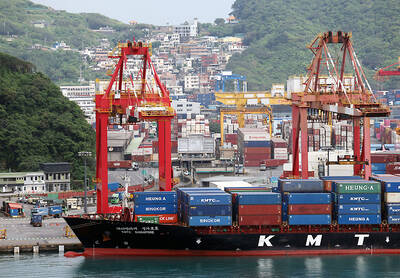
Taiwan’s economy grew far faster than expected in the first quarter, as booming demand for artificial intelligence (AI) applications drove a surge in exports, spilling over into investment and consumption, the Directorate-General of Budget, Accounting and Statistics (DGBAS) said yesterday. GDP growth was 13.69 percent year-on-year during the January-to-March period, beating the DGBAS’ February forecast by 2.23 percentage points and marking the most robust growth in nearly four decades, DGBAS senior official Chiang Hsin-yi (江心怡) told a news conference in Taipei. The result was powered by exports, which remain the backbone of Taiwan’s economy, Chiang said. Outbound shipments jumped 51.12 percent year-on-year to
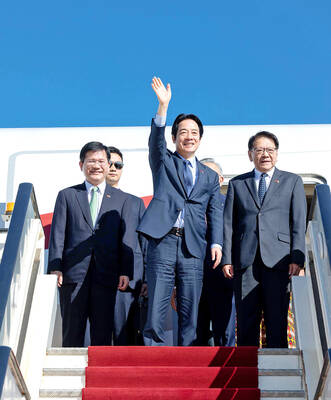
DELAYED BUT DETERMINED: The president’s visit highlights Taiwan’s right to international engagement amid regional pressure from China President Willaim Lai (賴清德) yesterday arrived in Eswatini, more than a week after his planned visit to Taiwan’s sole African ally was suspended because of revoked overflight permits. “The visit, originally scheduled for April 22, was postponed due to unforeseen external factors,” Lai wrote on social media. “After several days of careful arrangements by our diplomatic and national security teams, we successfully arrived today.” Lai said he looked forward to further deepening Taiwan-Eswatini relations through closer cooperation in the economy, agriculture, culture and education, as well as advancing the nation’s international partnerships. The president was initially scheduled to arrive in time to celebrate
Iran’s Islamic Revolutionary Guard Corp (IRGC) yesterday said the US faced a choice between an “impossible” military operation or a “bad deal” with Tehran, after US President Donald Trump disparaged Iran’s latest peace proposal. Negotiations between the two countries have been deadlocked since a ceasefire came into effect on April 8, with only one round of direct peace talks held so far. Iran’s Tasnim and Fars news agencies reported that Tehran had submitted a 14-point proposal to mediator Pakistan, but Trump was quick to cast doubt on it. “I will soon be reviewing the plan that Iran has just sent to us, but


 RSS
RSS