


Senior Taiwanese and US officials on Tuesday discussed cooperation in artificial intelligence (AI), tech and drones at a high-level forum, with the US Department of State praising Taipei as a “vital partner.”
Taiwan was represented by Minister of Economic Affairs Kung Ming-hsin (龔明鑫) at the meeting in Washington, while US Undersecretary of State for Economic Affairs Jacob Helberg represented the US, the state department said.
It was the sixth edition of the US-Taiwan Economic Prosperity Partnership Dialogue since November 2020 and the first since US President Donald Trump returned to office last year.
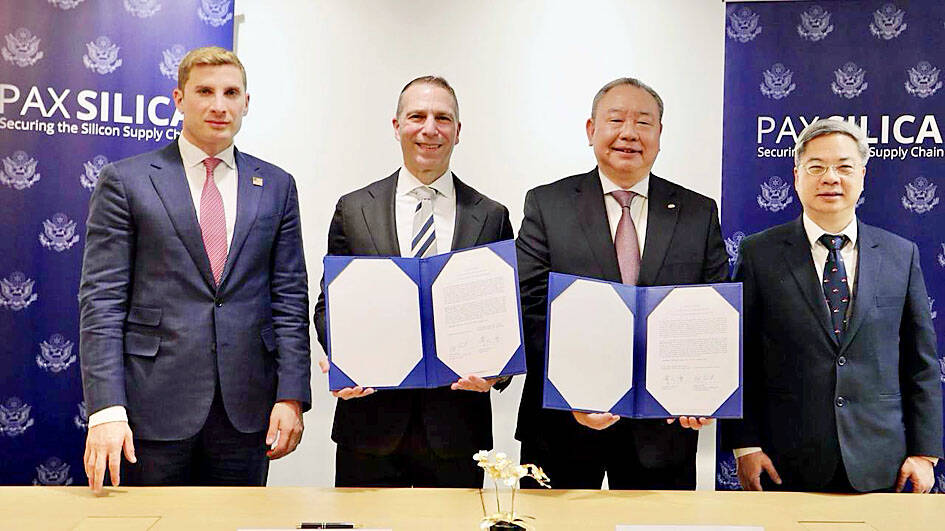
Photo courtesy of Ministry of Foreign Affairs
The two sides signed statements on the Pax Silica Declaration — a US-led initiative to secure AI and semiconductor supply chains — and Taiwan-US cooperation on economic security, the state department said.
The agreements demonstrate Taiwan’s critical role in the global AI supply chain, the Ministry of Economic Affairs said in a separate statement.
“Taiwan is a vital partner on these and other important economic initiatives and its advanced manufacturing sector plays a key role in fueling the AI revolution,” the state department added.
Pax Silica is a US-led initiative focused on coordinating trusted supply chains for advanced technologies. Its initial eight signatories did not include Taiwan, the world’s leading producer of advanced semiconductors.
One of the areas of consensus at the meeting was on advocating for Taiwanese and US companies to partner on AI, advanced robotics and the development of large language model applications for traditional Mandarin language databanks, the ministry said.
Officials also focused on digital infrastructure, agreeing to explore low Earth orbit satellite development, and how to protect submarine cables and strengthen information and communications infrastructure, it said.
Taiwan has accused China of being involved in damaging undersea telecom and Internet cables, which Beijing denies, and is expanding the use of low Earth orbit satellites for backup communications should China sever the cables during an attack.
The ministry said that both sides agreed that peace and stability across the Taiwan Strait are “crucial to global economic security and prosperity.”
Taiwan and the US would also collaborate on critical mineral exploration and refining, as well as strengthening cooperation in drone supply chains to reduce dependence on China, it said.
Before the talks, the government-supported Industrial Technology Research Institute signed an agreement with the US-based Association for Unmanned Vehicle Systems International on drone cooperation.
Others areas targeted for cooperation were cultivating AI talent, promoting regional economic development, expediting investment application reviews and addressing double taxation issues, the ministry said.
Taiwan and the US earlier this month reached a deal to reduce tariffs on Taiwan’s exports to the US, and boost Taiwanese investment in semiconductors and other sectors in the country.

A signaling system malfunction disrupted high-speed rail (HSR) services beginning at 8am today, with trains temporarily reduced to three northbound and three southbound trains per hour as authorities conduct inspections. The malfunction occurred on a section of track in Miaoli County during pre-operation checks early this morning, forcing northbound and southbound trains to use a single track, the HSR operator said. The regular schedule has been replaced with three hourly trains offering only nonreserved seating in each direction, stopping at every station, it said, adding that business class cars would still have reserved seating. Departures from terminal stations are scheduled at the top
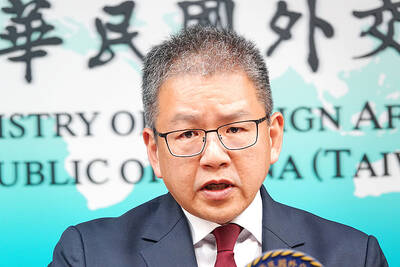
Taiwan is still in the process of assessing the possibility of recruiting workers from Eswatini, the Ministry of Foreign Affairs said yesterday, adding that its goal is to help Eswatini upgrade its vocational training centers. If there are plans to recruit workers from Eswatini, safeguarding national security, protecting public health and ensuring the employment rights of Taiwanese would be prerequisites, Department of West Asian and African Affairs Director-General Yen Chia-liang (顏嘉良) told a news conference. Key considerations would also include filling labor shortages in specific industries, and fostering bilateral professional and technical exchanges, he said. Yen was asked about the progress of labor
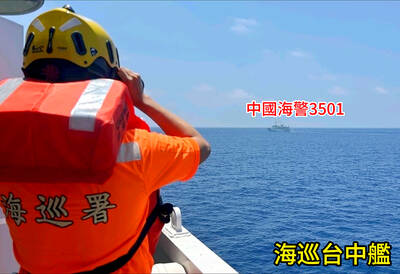
VERBOSE VESSELS: A CGA cutter and a China Coast Guard exchanged verbal barbs for more than a day in Taiwanese-controlled waters before the Chinese vessel left The Taiwanese and Chinese coast guards had a standoff near the strategically located Pratas Islands (Dongsha Islands, 東沙群島) in the north of the South China Sea, the Coast Guard Administration (CGA) said yesterday. The two sides engaged in intense radio exchanges over sovereignty claims during the 33-hour standoff. China Coast Guard vessel 3501 eventually left the restricted waters, 26.6 nautical miles (49.2km) west of the Pratas Islands, at 5pm yesterday, the CGA said. Lying approximately between southern Taiwan and Hong Kong, the Taiwan-controlled Pratas are seen by some security experts as vulnerable to Chinese attack due to their distance — more than

A US uncrewed surface vessel (USV) encountered multiple Chinese warships during an autonomous transit of the Taiwan Strait, US defense company Seasats said in a statement on Wednesday. Seasats announced that a Lightfish USV had completed the first autonomous transit of the Taiwan Strait. Over five days, the USV traversed the entire length of the Strait while constantly monitoring surface vessel traffic, the company said. The Lightfish encountered multiple Chinese warships, one of which was a Chinese People’s Liberation Army Navy (PLAN) Type 056 corvette, it said. The Chinese vessels were operating “well within Taiwan’s exclusive economic zone without transmitting their identity via the


 RSS
RSS